

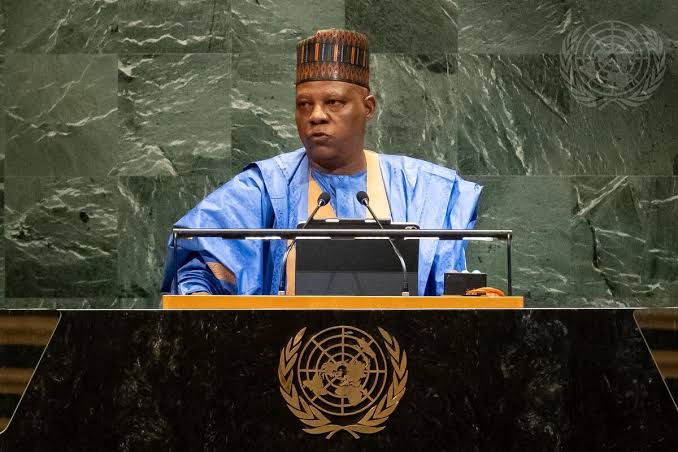
New York, USA – Nigeria has renewed its call for sweeping reforms at the United Nations, including a permanent African seat on the Security Council, debt relief for developing nations, equitable benefits from natural resources, and a concerted effort to close the global digital divide.
Vice President Kashim Shettima, who delivered Nigeria’s national statement on behalf of President Bola Ahmed Tinubu at the 80th United Nations General Assembly (UNGA80) in New York, said the world body must evolve beyond its 1945 structure to remain relevant in a rapidly changing world.
Themed “Better Together: 80 Years and More for Peace, Development, and Human Rights”, the UNGA session gathered world leaders to chart a course for global cooperation amid growing geopolitical and economic challenges.

UN Must Reflect Today’s Realities
Shettima declared that Nigeria’s growing population, leadership in regional security, and decades-long commitment to global peacekeeping justify its demand for a permanent seat on the Security Council.
“When the UN was founded, Nigeria was a colony of 20 million people, absent from the tables where decisions about our fate were taken. Today, we are a sovereign nation of over 236 million, projected to be the third most populous country in the world,” he stated.
He argued that a reformed Security Council reflecting current geopolitical realities would “restore credibility to the very institution upon which the hope of multilateralism rests.”
Debt Relief, Trade Access Critical to Peace and Growth
On global economic reform, Shettima urged the creation of a binding international mechanism for managing sovereign debt — likening it to an “International Court of Justice for money” — to free developing nations from economic constraints that stifle growth.
He warned that peace and security cannot be sustained without inclusive growth, adding that “the path to sustainable peace lies in growth and prosperity.” Nigeria, he said, has taken “difficult but necessary steps” to restructure its economy and unlock its market potential.
The Vice President also called for fairer access to trade and finance, emphasizing that natural resource–rich countries must benefit equitably from their mineral wealth.
“Africa — and Nigeria — has in abundance the critical minerals that will drive the technologies of the future. But when we export raw materials, tension, inequality, and instability fester,” he said.
Climate Action and Humanitarian Concerns
Shettima urged the UN to prioritise climate financing, describing climate change as a global security and migration challenge rather than a distant environmental issue. He said Nigeria would partner with the UN to use climate funds effectively, focusing on education, technology, and resilience in vulnerable communities.
On conflict and human rights, he reaffirmed Nigeria’s commitment to global peace, citing the country’s participation in 51 UN peacekeeping operations and its fight against violent extremism.
He reiterated Nigeria’s support for a two-state solution in the Israeli-Palestinian conflict, insisting that “the sanctity of human life should not be trapped in endless debate” and that Palestinians are “human beings entitled to the same freedoms and dignities the rest of us take for granted.”
Closing the Digital Divide
Highlighting technology’s growing influence on governance and society, Shettima proposed a new global initiative bringing together governments, the private sector, and research institutions to close the digital divide.
“As technology shakes up public administration, finance, and conflict, we must ensure emerging economies can close the wealth and knowledge gap. ‘AI’ must stand for Africa Included,” he said, warning against the corrosive effects of misinformation and growing public distrust.
Nigeria Reaffirms Commitment to Multilateralism
In his closing remarks, the Vice President reaffirmed Nigeria’s unwavering commitment to peace, development, human rights, and multilateralism.
“For none of us is safe until all of us are safe,” he declared. “A renewed commitment to multilateralism — not as a slogan but as an article of faith — remains our surest path forward.”
Facebook Comments

GIPHY App Key not set. Please check settings