

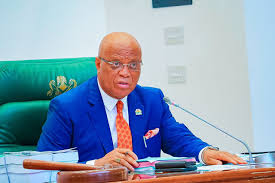

What began as a carefully managed political defection by Akwa Ibom State Governor, Umo Eno, has spiraled into a full-blown crisis of press freedom, party democracy, and executive overreach, drawing the attention and condemnation of an international media watchdog.
The International Press Institute (IPI) Nigeria has warned Governor Eno that his administration’s actions will not only stain his local record but will also be escalated to embassies, multilateral institutions, and international partners worldwide. The consequence: coordinated global advocacy campaigns aimed at holding him and his government accountable for what IPI describes as serious violations of press freedom and democratic norms.
The chain of events dates back to May, days before Governor Eno defected from the Peoples Democratic Party (PDP)—the party that ruled Akwa Ibom uninterrupted for over 20 years and handed him the ticket that made him governor, to the All Progressives Congress (APC).
At a tense meeting convened at the Government House in Uyo, attended by cabinet members, senior political appointees, and journalists, Governor Eno bluntly announced that his defection was irreversible. More controversially, he issued an ultimatum: all political appointees must follow him to the APC or resign.
Witnesses at the meeting described an atmosphere thick with fear and uncertainty. Many in the room had spent their entire political careers in the PDP and were deeply uneasy about abandoning the party—and about the governor’s ability to navigate the volatile power dynamics of the APC, already dominated in the state by Senate President Godswill Akpabio.
Then came the moment that would haunt the governor.
In remarks captured on video, Governor Eno openly declared his intention to retain control of the PDP even after defecting, vowing not to “leave the PDP for thieves to come and hijack it” and insisting he would “lead the structure of the party” from outside. The statement stunned the audience and laid bare a troubling contempt for internal party democracy.
Sensing the political damage, the governor’s spokesperson, Ekerete Udoh, allegedly ordered journalists present to suppress both the story and the video. When Channels Television defied the directive and aired the footage, the response from the government was swift and punitive: the station’s reporter, Christopher Moffat, and cameraman, Kufre Ikpe, were expelled from the Government House Press Corps.
That expulsion triggered the intervention of IPI Nigeria, a global media freedom organisation headquartered in Vienna. After verifying the incident, IPI Nigeria wrote formally to Governor Eno on 25 September, demanding the immediate reinstatement of the journalists and warning that the ban violated the Nigerian Constitution and the governor’s oath of office.
“Access to cover the activities of the state government is a constitutional right of the press, not a privilege to be granted or withdrawn at will,” IPI Nigeria stated, warning that failure to reverse the action would land Governor Eno and his administration in its infamous Black Book.
The warning was ignored.
Although Governor Eno received the letter and forwarded it to his spokesperson, no formal response was sent to IPI Nigeria. On 2 December, the organisation made good on its threat, blacklisting Governor Eno for grave assaults on press freedom, alongside Niger State Governor Mohammed Bago and Inspector-General of Police Kayode Egbetokun.
IPI Nigeria further disclosed that the Black Book would be circulated to embassies, multilateral organisations, and international partners, triggering sustained advocacy to expose and sanction democratic backsliding in Akwa Ibom.
Rather than de-escalate, the Akwa Ibom government doubled down.
On 1 December, just a day before the blacklisting was announced, Mr Udoh declared the administration “battle-ready” to confront critics, boasting of “taking no prisoners” in defence of the governor. The inflammatory remarks were endorsed by the Commissioner for Information, Aniekan Umanah, who publicly echoed the threat-laden posture.
As of 16 December, the Channels Television crew remains barred from the Government House. Meanwhile, the PDP state secretariat in Uyo has been locked down by police, allegedly under the governor’s directive, as he executes his vow to control the opposition party from the outside.
For critics, the pattern is unmistakable.
“This is anti-democracy,” said Sammy Etuk, a lawyer and former campaigner for Governor Eno. “You cannot sit in the APC and still seek to run the PDP just to destroy it. That is how political competition dies.”
What was sold as a personal political choice has now exposed a far deeper problem: the dangerous fusion of power, intolerance of dissent, and a willingness to crush institutions; media and political alike, that stand in the way. And with international eyes now firmly fixed on Akwa Ibom, Governor Umo Eno’s actions are no longer just a local controversy—they are a global indictment.
• Source: PremiumTimes
Facebook Comments

GIPHY App Key not set. Please check settings