

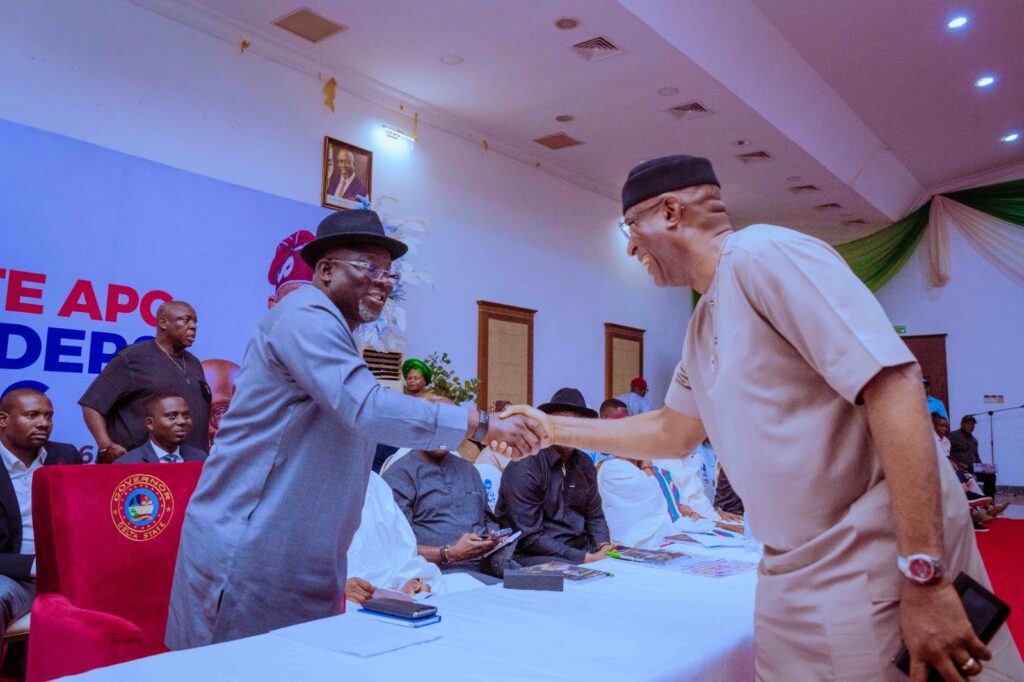

Senator Ovie Omo-Agege’s remarks at the January 23, 2026 APC high-level stakeholders’ meeting in Asaba were short, polite, and outwardly conciliatory. But beneath the measured tone lay a speech heavy with subtext, unresolved tensions, and quiet warnings to a party still struggling to reconcile conquest with coexistence.
At first glance, the former Deputy Senate President sounded like a man extending an olive branch. On closer examination, he was also drawing lines.

The Invitation That Exposed a Crack
Omo-Agege opened by thanking Governor Sheriff Oborevwori for personally inviting him to the meeting. On the surface, this appeared to be a gracious acknowledgment. In reality, it exposed a troubling institutional failure within the Delta APC.
This was a party stakeholders’ meeting, not a private political caucus. Under normal circumstances, the APC Delta State secretariat, under the direction of the state chairman, Chief Omeni Sobotie should have formally invited all major stakeholders, especially the party’s immediate past governorship candidate. Why didn’t it? Why did it take the personal intervention of Governor Oborevwori for Omo-Agege to be notified?
The implication is stark: but for the Governor’s personal initiative, Omo-Agege may not have attended at all, not out of boycott, but out of deliberate exclusion. And had that happened, the same party machinery that failed to notify him would likely have been quick to weaponise his absence as evidence of disloyalty.
That single line in Omo-Agege’s speech quietly indicted the APC secretariat and raised unavoidable questions about animosity, selective inclusion, and internal gatekeeping. More damningly, it raised the question of why the state chairman appears either unwilling or unable to rein in a secretariat acting in ways that deepen factional suspicion.
Acknowledging Leadership Without Surrendering Ambition
Omo-Agege recognised Governor Oborevwori as the leader of the party in the state and pledged to work with him to ensure good governance. Notably, however, he was careful not to pledge electoral subservience.
This distinction matters. Nowhere in his remarks did Omo-Agege say he would work for Oborevwori politically, campaign for him, or support a second-term project. Instead, he committed himself to governance, not elections. That was not an oversight. It was a calculated separation.
In Delta APC today, cooperation in governance is being subtly framed as an expectation of political loyalty. Omo-Agege’s speech resisted that framing. He made it clear, politely but firmly that working together does not automatically translate into surrendering political ambition.
The 240,000 Votes as Political Currency
Perhaps the most consequential part of the speech was Omo-Agege’s reminder that over 240,000 Deltans voted for him in 2023, forming a “huge organic political following” that remains mobilisable. This was not nostalgia. It was leverage.
By stressing this point, Omo-Agege was effectively saying: APC did not suddenly acquire these supporters by virtue of Oborevwori’s defection. They pre-exist the Governor’s arrival. They are loyal to structures, not convenience. And they cannot be wished away.
His call for the inclusivity of his supporters was therefore not a plea, it was a condition. A subtle message that support is transactional in politics, and that recognition precedes mobilisation.
The Deafening Silence Since the Defection
Since Governor Oborevwori’s dramatic defection from the PDP to the APC, a simple question has lingered unanswered: why has Omo-Agege not been formally wooed?
The Governor defected with a large PDP structure, effectively abandoning the mandate voters gave the PDP in 2023 and transplanting it wholesale into the APC, largely to secure a smoother path to a second-term ticket amid PDP’s internal chaos.
But what of those who built the APC when it was in opposition? What of those who contested, lost, reorganised, and stayed?
The unspoken message to old APC members appears to be: step aside, shelve your ambitions, and watch the new entrants take over. Omo-Agege’s speech quietly rejected this logic.
Inclusiveness Without Integration?
Observers expected that by his second anniversary in office, Governor Oborevwori would have rejigged his cabinet to reflect APC inclusiveness, bringing in old party hands as a gesture of reconciliation and balance. That has not happened.
Instead, the Governor appears to have taken over the leadership of a party he neither built nor supported in the last election, without making visible efforts to integrate those who carried the APC banner through years of opposition.
This is the unfairness Omo-Agege was pointing to without naming it. Inclusiveness cannot be rhetorical. It must be structural. It must reflect in appointments, access, influence, and opportunity.
The Bigger Question for Delta APC
At its core, Omo-Agege’s speech forces Delta APC to confront an uncomfortable truth: Is the party a coalition of equals, or merely a landing strip for political defectors seeking re-election? If ambition is only legitimate for those who defect with incumbency, then the APC risks becoming a temporary shelter, not a principled platform.
Omo-Agege did not threaten. He did not grandstand. But he also did not surrender. In his calm, carefully worded remarks was a reminder that political peace built on exclusion is temporary, and that unity imposed without fairness will always fracture at the point of succession.
The ball, unmistakably, is now in the court of the party leadership.
Facebook Comments

GIPHY App Key not set. Please check settings