

By Abraham Maina Joda
I have carefully reviewed the recent industrialisation proposal put forward by Senator Ishaku Abbo, particularly the plans for a ₦200 billion cement plant in Guyuk and a similar-scale fertilizer and agrochemical facility. Let me begin by acknowledging the boldness of this vision. The focus on industrial growth, job creation, and economic expansion in Adamawa State is both commendable and necessary.
However, for such a vision to inspire confidence and attract serious investment, it must be supported by verifiable data, realistic projections, and industry-aligned benchmarks.
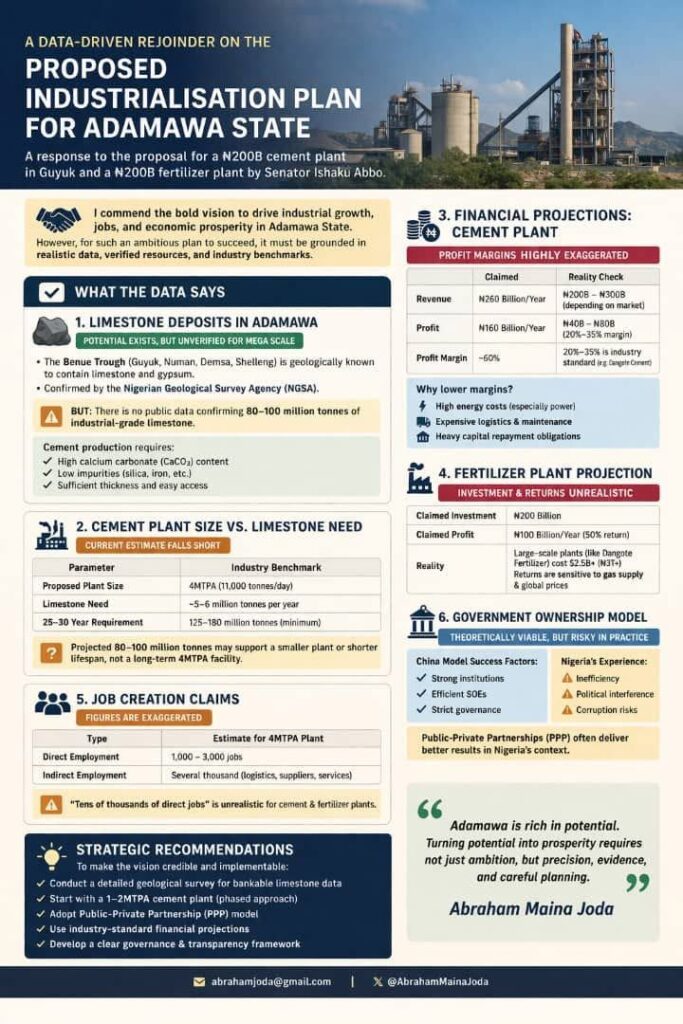
On the issue of limestone availability, it is correct that parts of Adamawa—especially Guyuk, Numan, Demsa, and Shelleng—fall within the Benue Trough, a formation known to host limestone and gypsum deposits. Surveys by the Nigerian Geological Survey Agency have indeed identified occurrences in these areas. However, the leap from “presence of deposits” to “commercially viable reserves sufficient for a mega cement plant” requires caution.
Available public data does not conclusively confirm 80–100 million tonnes of proven, industrial-grade limestone in Adamawa. Beyond volume, cement production depends on critical factors such as calcium carbonate purity, impurity levels, depth, and ease of extraction. Without these, resource estimates remain speculative rather than bankable.
This brings us to the scale of the proposed cement plant. A 4 million tonnes per annum (4MTPA) facility—equivalent to roughly 11,000 tonnes per day—is technically sound in isolation. However, industry benchmarks show that such a plant requires approximately 5–6 million tonnes of limestone annually. Over a standard operational lifespan of 25–30 years, this translates to a minimum reserve requirement of 125–180 million tonnes.
In this context, even the upper estimate of 100 million tonnes would likely be insufficient for long-term sustainability. At best, it may support a smaller plant or a shorter production lifecycle. This is a critical point that must be addressed through detailed geological verification before any serious investment decision is made.
On financial projections, the estimates provided appear significantly optimistic. The projection of ₦260 billion in annual revenue and ₦160 billion in profit implies a net profit margin of over 60%. In reality, global cement industry benchmarks—including operators such as Dangote Cement—typically record profit margins in the range of 20% to 35% under strong performance conditions.
Cement production is highly capital- and energy-intensive, particularly in Nigeria where power, logistics, and maintenance costs are substantial. A more realistic projection for a plant of this size would place profits in the range of ₦40 billion to ₦80 billion annually under favorable conditions, not ₦160 billion.
The fertilizer plant projections raise even greater concerns. A ₦200 billion investment yielding ₦100 billion annual profit suggests a 50% return, which is inconsistent with global industry realities. Large-scale fertilizer plants, such as Dangote Fertilizer, require multi-billion-dollar investments and operate in a market influenced by natural gas supply, global pricing, and export dynamics. Such margins are not typical in this sector.
There is also the issue of internally generated revenue (IGR). The claim that Adamawa State could generate over ₦460 billion annually from just two companies appears to conflate company revenues or profits with government earnings. In practice, IGR is derived primarily from taxes and levies, not total company turnover. Even Nigeria’s top-performing states do not generate such figures from two entities alone.
On job creation, while industrial projects do stimulate employment, cement plants are not labour-intensive. A 4MTPA facility typically employs between 1,000 and 3,000 people directly, with additional indirect jobs across logistics and supply chains. While the broader economic impact is real, projections of “tens of thousands” of direct jobs should be moderated to reflect industry realities.
The proposal for government ownership, inspired by models such as China, is intellectually interesting. However, the success of such systems is built on strong institutions, disciplined governance, and operational efficiency. In Nigeria, state-owned enterprises have historically struggled with inefficiency and political interference. A public-private partnership model would likely provide a more practical and sustainable pathway.
Finally, the mention of electricity generation from Kiri Dam is a promising direction. The dam indeed exists and holds both irrigation and hydroelectric potential. However, unlocking this potential would require substantial technical upgrades, feasibility studies, and investment planning.
In conclusion, this proposal reflects a bold and forward-looking vision for Adamawa State. My respectful submission is that the credibility of this vision will be greatly enhanced by deeper research, bankable feasibility studies, and alignment with established industry data.
A phased approach—such as starting with a 1–2MTPA cement plant, confirming mineral reserves, and adopting realistic financial projections—would not only strengthen the proposal but also increase its chances of successful implementation.
Adamawa State is rich in potential. Turning that potential into sustainable prosperity requires not just ambition, but precision, evidence, and careful planning.
I look forward to more detailed and data-driven policy frameworks as this important conversation continues.
• Abraham Maina Joda is a media consultant and political analyst
07038543606
Facebook Comments

GIPHY App Key not set. Please check settings