

Says foreign-dependent development is ‘parasitism,’ urges Delta to lead Nigeria’s economic revolution through African capital, energy, innovation and home-grown investment
By Chukwudi Abiandu
ASABA — Renowned Kenyan scholar and Pan-Africanist, Prof. Patrick Loch Otieno (PLO) Lumumba, on Monday delivered a blistering indictment of Africa’s continued dependence on foreign investors, declaring that the continent would remain economically subservient unless Africans themselves begin financing and driving their own development.
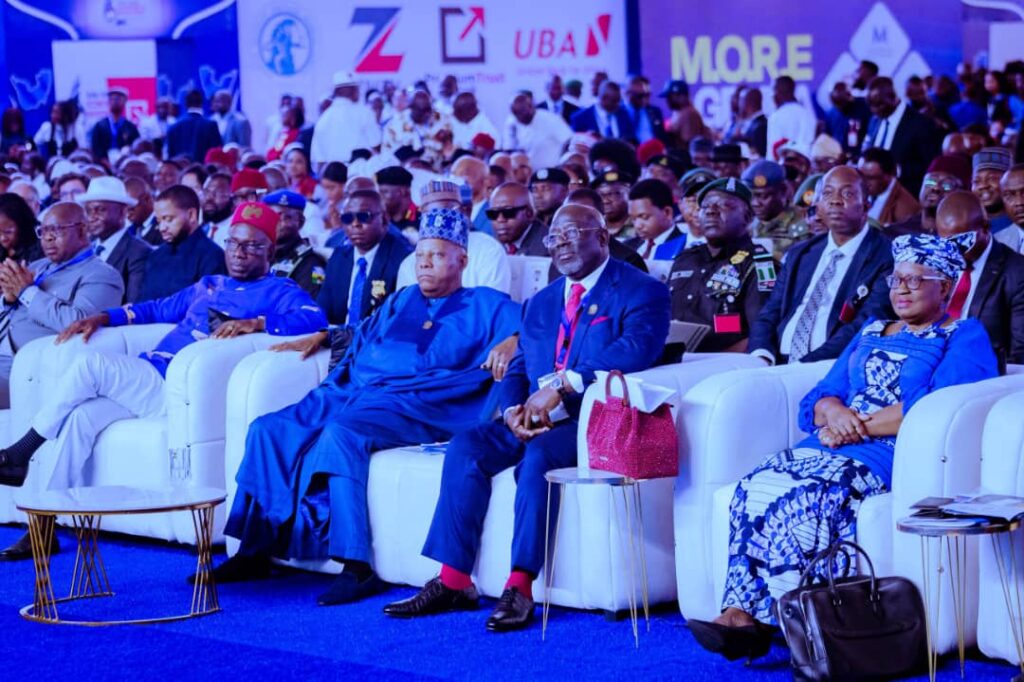
Speaking at the opening session of the ongoing Delta Economic and Investment Summit in Asaba, Lumumba challenged African leaders to abandon what he described as a colonial mentality that measures investment solely by the arrival of Europeans, Chinese, Malaysians or Americans while ignoring the enormous financial and intellectual capacity that already exists within Africa.
In a speech laced with sharp criticism, historical reflections and bold prescriptions, Lumumba warned that what many African governments proudly celebrate as development is, in reality, “parasitism.” “Many times what we call development is not development, it is parasitism,” he declared.
The celebrated public intellectual praised the Delta State Government for initiating a deliberate economic transformation agenda but insisted that the state must become a model capable of inspiring Nigeria and the rest of Africa. “You are doing a good job,” he told Governor Sheriff Oborevwori. “But that job can be better. That job can become an African job. That job can give real meaning to the African Continental Free Trade Area and Africa’s Agenda 2063.”
Lumumba lamented that despite constantly boasting about Africa’s population of 1.4 billion people, the continent has failed to convert its demographic strength into economic prosperity. “What are we doing with the 1.4 billion Africans?” he asked.
He pointed to the thousands of young Africans risking death across the Mediterranean in desperate attempts to reach Europe, describing the migration crisis as evidence of Africa’s failure to create opportunities for its own people.
Turning specifically to Delta State, Lumumba urged the government to manage its oil wealth with the same long-term vision demonstrated by Norway, whose sovereign wealth fund has grown into one of the world’s largest investment funds. “You have the oil. The question is whether you will use it the way Norway did,” he challenged.
He noted that Delta’s economy is already larger than those of more than twenty African countries, arguing that the state should benchmark itself against the world’s best-performing economies rather than celebrating marginal progress within Africa. “We Africans have a tendency to compare ourselves with those who are only slightly taller than us. We should compare ourselves with the best.”
Lumumba also questioned Africa’s preparedness for the Fourth and Fifth Industrial Revolutions, warning that while African leaders enthusiastically discuss artificial intelligence, the continent controls almost none of the technologies shaping the digital future. “The world talks about artificial intelligence. But who controls Africa’s artificial intelligence? It is certainly not Africans,” he said.
He warned that overdependence on foreign technology leaves Africa dangerously vulnerable. “It could all disappear in the twinkling of an eye, and we would return to the Dark Ages.”
The Pan-Africanist criticised the fact that even intellectual leadership on African economic integration has largely been ceded to outsiders. “When you look for experts on the African Continental Free Trade Area, they are not Africans. They are Chinese, Europeans and others. That is tragic.”
Lumumba reserved some of his strongest criticism for Africa’s investment culture, insisting that African governments continue to overlook wealthy Africans while aggressively courting investors from outside the continent. “We still think investors must come from China, Brazil, Malaysia or Europe. That is not the case.”
Recalling the Pan-African Investment Movement established in 2018, he argued that thousands of Africans contributing modest amounts of capital could finance transformational projects across the continent.“I want to see Kenyans investing in Delta. I want to see Ghanaians here. Ethiopians, Moroccans, Egyptians and Sudanese. Africans must begin to believe that they have both the financial and intellectual capacity to develop Africa.”
He said only when Africans invest in themselves would partnerships with Europe, America and Asia become relationships of equals rather than dependency. “It is only then that our relationship with the rest of the world will become symbiotic instead of parasitic.”
Calling on the Nigerian Government to champion continental integration, Lumumba urged Abuja to dismantle visa restrictions that continue to hinder trade and investment among African countries. “I look forward to the day when I can board a plane in Addis Ababa and land in Asaba without filling landing cards or applying for visas,” he said.
He contrasted Africa’s fragmented markets with Europe’s seamless integration, where citizens travel across multiple countries using a common currency. “We cannot build prosperous economies while remaining so fragmented.”
The respected scholar also urged Delta State to invest heavily in research, innovation and skills development, insisting that universities must become engines of industrial growth rather than institutions devoted only to producing graduates. He challenged the government to ask difficult questions about how university research is supporting agriculture, energy, manufacturing and technological advancement.
Lumumba further identified electricity as the single most critical ingredient for industrialisation, comparing Nigeria’s power generation of about 5,000 megawatts with China’s approximately three million megawatts. “Without energy, you are going nowhere,” he warned. He argued that no manufacturing economy could compete globally with such a massive power deficit, urging Delta to leverage its abundant gas resources to become an energy-driven industrial hub.
In his closing remarks, Lumumba congratulated Governor Oborevwori for initiating what he described as a promising economic journey but urged him to ensure that Delta’s transformation becomes contagious across Nigeria and the African continent. “Delta looks good. Make it truly good. Let it remain good.”
He concluded with a challenge that drew loud applause from participants. “You are not successful until your successor succeeds.”
Facebook Comments

GIPHY App Key not set. Please check settings