

By Our Correspondent from PremiumTimes Reports
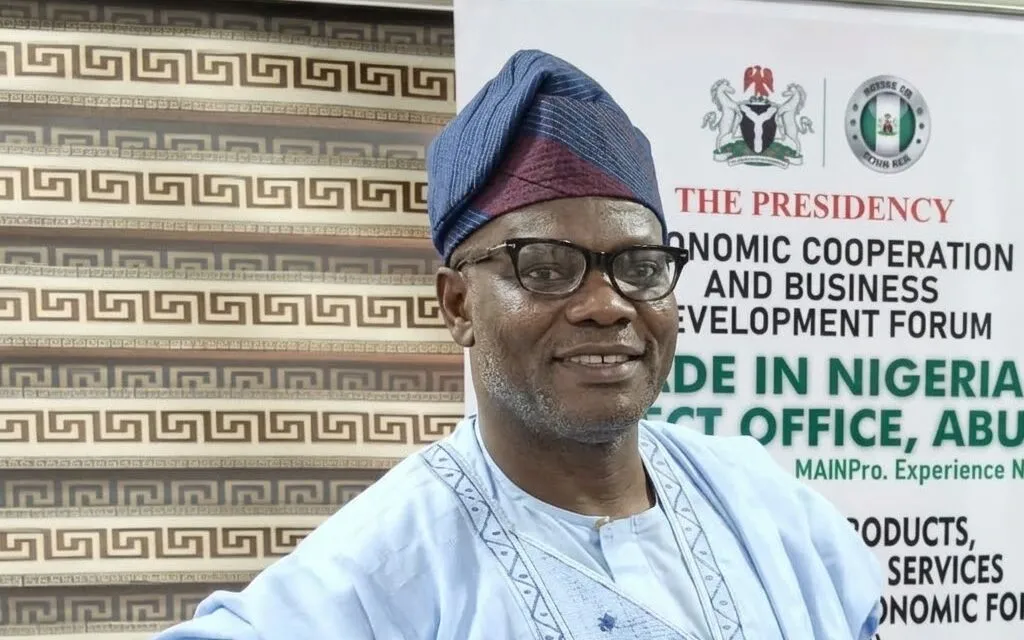
George Nwabueze, accused by the Independent Corrupt Practices and Other Related
 Offences Commission (ICPC) of promoting a fictitious federal government agency, has challenged the commission’s claim, producing documents he says establish the official status of the National Brands Development and Made-in-Nigeria Special Project Office.
Nwabueze, who identifies himself as the National Coordinator and Executive Director of the project office, said the initiative was linked to the Office of the Secretary to the Government of the Federation (OSGF) and had operated with official government involvement.
His defence comes days after the ICPC announced that President Bola Ahmed Tinubu had ordered his immediate arrest over allegations that he promoted a fake government office.
The commission also said the President ordered the suspension of three permanent secretaries — M.S. Danjuma, Nadungu Gagare and Richard P. Pheelangwah — following the discovery of the controversial office within the OSGF premises.
According to the ICPC, the organisation had been allocated office space within the OSGF complex without presidential authorisation, while some senior public servants allegedly collaborated with its activities.
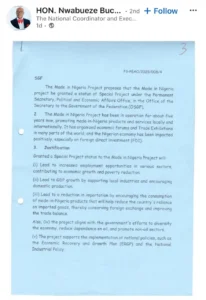
But Nwabueze has rejected the allegations, posting documents on LinkedIn which he said demonstrate that the project was known to and connected with the OSGF.
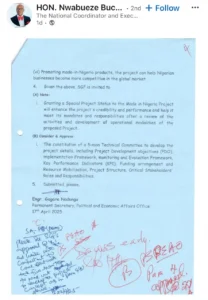
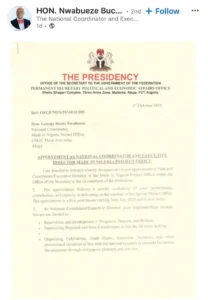
One of the documents is an appointment letter dated October 3, 2025, purportedly issued by the Office of the Permanent Secretary, Political and Economic Affairs Office of the OSGF.
The letter, referenced OSGF/MIN/59310/II/205 and addressed to “George Buchi Nwabueze,” conveyed his appointment as National Coordinator/Executive Director of the Made-in-Nigeria Project Office.
The appointment was stated to be for five years beginning from July 2025, renewable thereafter.
According to the document, the appointment followed an assessment of Nwabueze’s “commitment, contribution, and capacity” to deliver the mandate of the Special Project Office.
It assigned him responsibilities including supervision of programmes, projects and policies, coordination of regional and state coordinators across the 36 states, and organisation of exhibitions, trade expos and economic summits aimed at promoting Nigerian products and services.
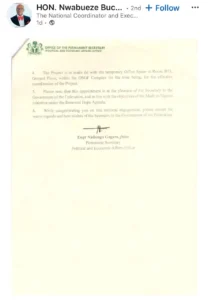
A second page of the document indicated that the project office was to operate temporarily from Room B53, Ground Floor, within the OSGF complex to facilitate its activities.
The letter further stated that Nwabueze’s appointment was at the pleasure of the Secretary to the Government of the Federation and aligned with the objectives of the Made-in-Nigeria initiative under the Renewed Hope Agenda.
It bears the name and signature of Nadungu Gagare, identified as Permanent Secretary of the Political and Economic Affairs Office.
The document, if authentic, could have significant implications for the ICPC’s allegation that the project office had no official authorisation to operate from the OSGF premises.
However, the authenticity of the documents has not been independently established.
Nwabueze traces project to 2010
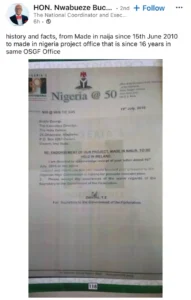
Nwabueze also released another document which he said showed that the Made-in-Nigeria initiative predates the current administration by more than a decade.
The July 19, 2010 letter was addressed to “Buchi George,” then described as Executive Director of The Hats Centre in Owerri, Imo State.
The letter acknowledged receipt of a proposal seeking endorsement for a “Made in Naija” project planned to take place in Ireland as part of activities marking Nigeria’s 50th anniversary.
It advised that the proposal be forwarded to the Nigerian High Commission in Ireland for possible consideration.
Using the document, Nwabueze argued that the initiative could not suddenly be dismissed as a fictitious government structure.
“History and facts, from Made in Naija since 15th June 2010 to the Made in Nigeria project office,” he wrote in his LinkedIn post.
He questioned how an initiative he claimed had existed for about 16 years could now be described as a fake government agency.
The authenticity and current administrative relevance of the 2010 document have, however, not been independently verified.
2025 proposal raises fresh questions
Nwabueze had also previously published a document dated April 17, 2025, proposing that the Made-in-Nigeria initiative be granted special-project status.
The document, signed by Gagare and addressed to the Secretary to the Government of the Federation, said the initiative had promoted Nigerian products and services both locally and internationally and had organised economic forums and trade exhibitions.
It listed job creation, economic growth, poverty reduction, increased domestic production and reduced dependence on imports among the expected benefits of granting the initiative special status.
However, the same document indicated that the project’s activities were to undergo review and that its operational modalities would be examined to ensure clarity and effectiveness.
That provision could become central to the controversy, as it raises questions about the precise administrative status of the initiative at the time Nwabueze was appointed.
Government links now under scrutiny
The controversy has also drawn attention to records showing that the organisation had engagements with government institutions before the ICPC’s announcement.
The project had reportedly established contacts with government institutions in Abia and Anambra and presented itself on its website as a strategic initiative of the OSGF.
Its structure included a national coordinator, zonal directors, state coordinators and representatives in the United States and China.
The organisation also described its mandate as promoting Nigerian products, supporting small and medium-sized enterprises, attracting investment and organising trade fairs and economic forums.
Nwabueze was identified on the platform as National Coordinator and Executive Director.
The claims have now come under intense scrutiny following the ICPC’s assertion that the office operated without presidential authorisation.
At the heart of the controversy is therefore not merely whether Nwabueze received an appointment letter, but whether the project office was legally and administratively constituted as a government entity.
Questions also remain over who authorised its operations, how it secured office space within the OSGF complex, what powers were granted to its officials and the extent to which serving public officers participated in its activities.
ICPC investigation holds key
Nwabueze’s documents provide a direct challenge to the ICPC’s description of the organisation as a fictitious government structure. But they have not, on their own, conclusively resolved the dispute over its legal status.
The ICPC maintains that the office was among the alleged fictitious government structures uncovered during its investigation into the controversial Presidential Foreign Intervention Promotion Council and has identified Nwabueze as its promoter. Nwabueze, on the other hand, insists that the organisation is a legitimate project office under the OSGF.
With the conflicting claims now in the public domain, the authenticity of the documents, the authority behind them and the outcome of the ICPC investigation are likely to determine whether the Made-in-Nigeria Project Office was a legitimate government initiative or an unauthorised structure operating from the heart of the Federal Government.
• Written from reports bPremium Times
Facebook Comments

GIPHY App Key not set. Please check settings