

By Chido Nwakanma
The 2026 Nigeria Prize for Literature is a poetry cycle, not an essay cycle. That distinction matters, because the three books on the shortlist argue anyway. They are intensely polemical and take on subjects that invite caution and even fear.
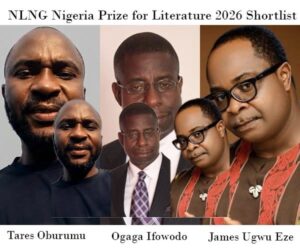
James Ngwu Eze’s Unbind Me Now, Ogaga Ifowodo’s Why Does God Need a Gun?, and Tares Oburumu’s Flora’s Love Colony were selected from 223 entries, first narrowed to a working list of fifty, then to an eleven-book longlist in July, and finally to three on 26 August. The winner, who receives the $100,000 award sponsored by Nigeria LNG, is due to be announced on 9 October. What the books share is not a form of address but a stance: they quarrel with the Nigerian state, with the uses of history, and with the uses of God.
Unbind Me Now — James Ngwu Eze
Eze’s collection is the most openly civic of the three and also more contemporary. The Advisory Board described a book that “decries the sociopolitical dysfunction of the nation and the world at large,” while still “interrogating the human condition and charting a path for redemption,” using language it called fluid and aesthetically captivating. Fire is the governing image. Churches, flags, farms and the country itself burn. The poems take in Lekki Toll Gate, herder–farmer conflict, insecurity, COVID-19, the killing of George Floyd, and ecological ruin. Eze has called the book poetry of outrage, anger and discontent, written as if from the market square rather than the study.
The polemic is against silence. The poet sits, in his own figure, on the tongue of the inferno, a human shield between the blaze and the spectators who would rather look away. Hope is present, but it is not consoling. It does not soothe the country into patience. It demands that the country be unbound now. Published by Masobe Books, and running to seventy-one poems, the collection treats witness as a public office. Eze, Enugu-born and a former literary editor of Sunday Sun, had already won the Association of Nigerian Authors Poetry Prize for Dispossessed. He was previously on the Nigeria Prize for Literature longlist. Unbind Me Now is less a sequel than a raising of the voice.
Why Does God Need a Gun? — Ogaga Ifowodo
This is the sharpest theological argument on the list. The title is not a riddle. It is an accusation aimed at anyone who kills and then calls the killing sacred. The collection centres on Leah Sharibu and the 2018 abduction of schoolgirls in Dapchi, Yobe State, then widens to cover religious and political violence in Nigeria and beyond. The Advisory Board noted a rich allegorical style and a tripartite structure of body, mind and spirit. Ifowodo’s question is simple and unsparing: an omnipotent God does not need human protectors with guns. The poems treat weaponised faith as both a local trauma and a global pattern.
Some readers have praised the moral focus; at least one review has called the verse overwritten and thematically repetitive. Either judgement leaves the book where it belongs. It is an argument, not a lyric diary. Ifowodo has said the work is a poetic reflection on belief and on what belief licenses when it meets someone who does not share it. The gun in the title is therefore not a metaphor for spiritual struggle. It is the instrument by which faith is made to dehumanise.
Flora’s Love Colony — Tares Oburumu
Oburumu’s polemic is historical. Flora is Flora Shaw, the colonial writer who proposed the name Nigeria. The collection is not a love story. It reads the country from pre-colonial life through slavery and empire to the present,insisting that the three periods rhyme more than official history admits. The Board called it a socio-historical work that challenges the mainstream narrative through dense, lucid imagery. Oburumu, a Warri-born poet, essayist and playwright, and winner of the 2022 Sillerman First Book Prize for Origins of the Syma Species, has named the condition geographical grief: a nation named from outside, still living within that naming.
The poems mix colonial encounter, identity and the failure of the postcolonial state. The argument is that Nigeria’s present is not a rupture from empire but its continuation, under a new set of managers. Poetry, as Oburumu has put it, lets him carry that historical load without the drag of lengthy narration. The love in the title is the love of possession. The colony is still being administered, only now from within.
What the polemics have in common
The courage of the Advisory Board
Prior restraint on authors is pre-publication censorship. The Nigeria Prize for Literature Advisory Board takes the oppositestance. It does not license what may be written. It judges books that have already been published.
The prize, sponsored by NLNG and worth $100,000, is administered by an Advisory Board, currently chaired by Professor Akachi Adimora-Ezeigbo, with members drawn from the Nigerian Academy of Letters and the Association of Nigerian Authors. Writers submit finished books. A panel reads them and produces a longlist, a shortlist and a winner. Nothing in that process prevents a manuscript from reaching print. Punishment or praise comes after publication, exactly the distinction the US First Amendment doctrine drew between liberty of the press and a licensing system.
That design matters in Nigeria, where writers more often describe informal pressure than a formal censor’s stamp. Ogaga Ifowodo, shortlisted this year with Why Does God Need a Gun?, has put the fear plainly: he dreads clandestine censorship more than open censorship and treats the right to write as close to a right to life. A prize that will read a book about Dapchi, Lekki and the colonial naming of the country is not, by itself, a guarantee of freedom. It is evidence that the gate, in this institution, stands after speech rather than before it.
The 2026 shortlist is politically unquiet. Ifowodo tackles religious and political violence. Eze addresses sociopolitical dysfunction at home and abroad. Oburumu challenges mainstream accounts of how Nigeria came to be named and governed.
The Board did not filter out those subjects before the books existed. It let the work stand, then measured language, form, originality, craftsmanship and lasting literary value. Professor Adimora-Ezeigbo has said as much in another register, urging younger writers to keep making poetry that can speak to the nation. The shortlist is that advice practised on books already in the world.
The courage in “no prior restraint” is therefore institutional, not theatrical. It is the decision to keep the gate at the point of judgement rather than at the point of speech: open entry, published books only, literary excellence as the criterion, and no requirement that a theme be safe before it can compete. A prize that has withheld the award in years when no entry met the standard — as happened in 2004, 2009 and 2015 — is strict about quality. It is not strict about permission to write. That is the difference between adjudication and censorship.
Facebook Comments

GIPHY App Key not set. Please check settings