

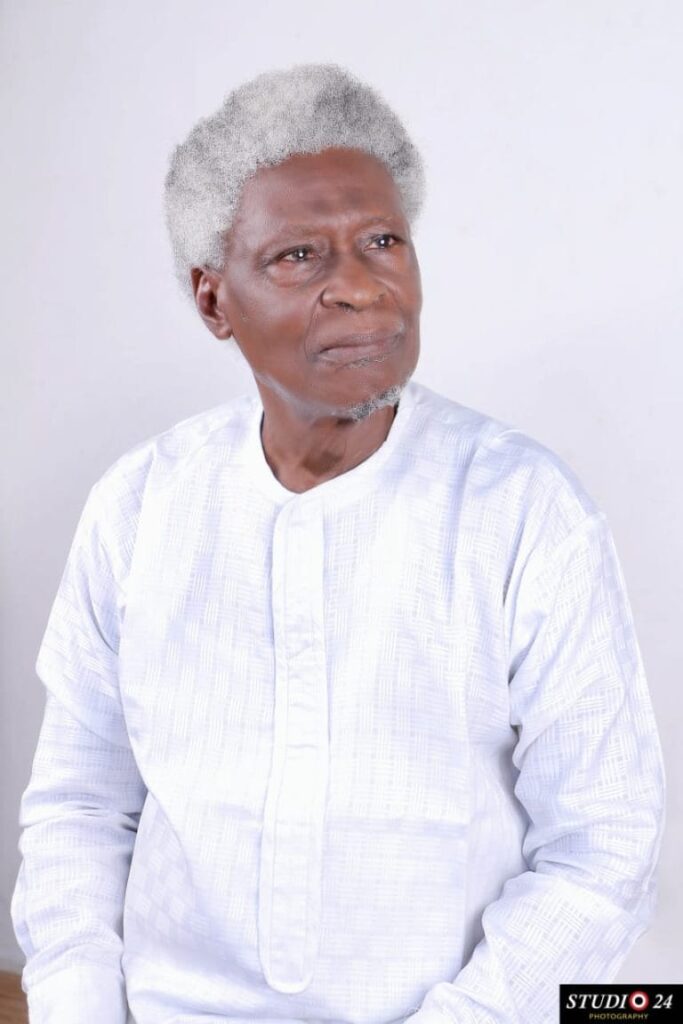
By Chris O. O. Biose
The Human Rights Community in Delta State, particularly the Civil Liberties Organisation (CLO) has received with great delight the assurance from the Governor of Delta State, His Excellency, Rt. Hon. Sheriff Oborevwori that there will be no further room for criminals in Delta State even if such persons are related to him. Governor Oborevwori gave this heart-warming guarantee when he received the newly deployed Commissioner of Police in Delta State, CP Samuel Edafe, who paid him a Courtesy Visit at Government House, Asaba, Delta State.
As a Sociologist, a Rights Activist and an octogenarian who has keenly observed the Nigerian political scene from the First Republic in 1960, through the period of Military Rule to the post-military era, it is important for me to let the Governor and the Commissioner of police understand that the centre of gravity of criminality both in Nigeria and Delta State lies in the political class.

The problem in Nigeria is not that there are criminals. Law breakers of various kinds exist in all parts of the world. In days gone by, there were pick pockets, thieves who carried out their operations mainly at night, later on, breaking and entry.
As time went on, some specialized in vehicle theft, phone theft, white collar crimes, illegal selling such as fake and counterfeit drugs, or organised crime such as narcotic rings, armed robbery, violent religious extremism and terrorism.
If one or two individuals violate the criminal law, the society has rules and mechanisms to punish them. But if rule violation become the norm or if the mechanisms provided by the society is incapable of checking highly-placed rule violators such as political office holders, then there is breakdown of the social control system.
The issue in our dear country is that the culture of law violation with impunity established during the long period of military rule gradually and steadily overtook the pre-existing culture of respect for law in the country. The coup plotters did not merely kill politicians and their colleagues to seize power. They entrenched themselves and instituted a culture of murder as a means of acquiring political power. This is evident in the series of coups, counter coups, attempted coups, phantom coups and rumours of coups.
During this long period, a large section of the political elite as well as the wider society seemed to accept violent behaviour as normal. A generation of Nigerian children, who were born and nurtured during about three decades of military barbarism was socialized to view killing fellow citizens to acquire political power as normal. The rulers cheapened life and glamourized bloodshed.
Some Nigerians would remember what was called “Bar Beach Show” in the 1970s involving series of public executions. There was also the reign of terror attributed to late General Sani Abacha’s “Strike Force” or “Killer Squad” in the mid-1990s as attested to by one Sergeant Rogers who gave evidence at the Human Rights Violations Investigation Commission, otherwise known as Oputa Panel appointed in 1999 by President Olusegun Obasanjo. Members of this Secret Force and Killer Squad did not vanish into the air at the end of the Abacha dictatorship.
A lot of graduates of the Abacha School of political violence transferred their skills to new positions in the ensuing democratic dispensation. Indeed, the first eight years of post-military administration was characterized by extremely high number of unresolved high-profile political assassinations exceeding 60 in number between 1999 and 2006.
Notable among these were the murder of Chief Bola Ige, SAN, former Governor of old Oyo State, Minister of Justice and Attorney-General of the Federation, killed on December 23, 2001, in his Bodija home in Ibadan, Oyo State; Chief Harry Marshall, then National Vice-Chairman of All Nigeria Peoples Party (ANPP), South-South, killed on March 5, 2003, in his home at Karaye Close, Off Ladoke Akintola Boulevard, Garki, Abuja; Engineer Anthony Funsho Williams, 58-year old PDP gubernatorial aspirant in Lagos State, killed on July 27, 2006, in his Home, 34A, Corporation Drive, Dolphin Estate, Ikoyi, Lagos; and Dr. Ayodele Daramola, 53-year old nutritionist, World Bank Consultant, and Governorship aspirant of Ekiti State, killed on August 14, 2006, in his bedroom at Ifaki-Ekiti, Ekiti State.
When the Upper Chamber of the National Assembly invited the then Director General of the State Security Services (SSS), Mr. Kayode Are, and then Inspector General of Police, Mr. Sunday Ehindero, to appear before the Senate to shed light on the worrisome spate of political violence in the country, the then Director General of the SSS told the senators that top government functionaries, including some State Governors, were brains behind political violence and rampant assassinations in the country.
Mr. Are revealed that some governors were involved in assassinations in their states and that killer squads were “owned and financed by state governors”. (Emmanuel Aziken & Ayodele Adegbuyi, “Nigeria: SSS DG Fingers Govs in Political Killings”, Vanguard online, August 25, 2006).
On his part, the then Inspector General of Police (IGP), Mr. Sunday Ehindero, corroborated the submission of his SSS counterpart when he appeared before the House on September 6, 2006. He added that state governors often frustrated the prosecution of arrested perpetrators of political violence.
Mr. Ehindero said that many politicians funded thugs and illegal gangs, leading to proliferation of arms. He however submitted that the SSS had failed to share intelligence information on “killer squads” with the Police. (Cosmas Ekpunobi and Moses Ezulike, Nigeria: Political Assassinations – IGP Indicts Govs, SSS, Daily Champion, September 7, 2006).
Here in Delta State, a former State Police Commissioner, Mr. Charles Akaya hit the nail on the head when he said while briefing his men attached to Ekpan Police Station in Uvwie Local Government Area of the state that “the rampaging bandits were thugs armed by politicians for election purposes”.
The police boss regretted that “politicians failed to disarm their private army after the election.” Elaborating, Mr. Akaya said:
“When there was politics, when there was campaigns, I mean politicking, there were many of these prominent politicians who bought arms and engaged some men to be guiding them, they call these men thugs, that is what they call them and that is what they are.
“Election has come and gone, those who won the election have won, those who were defeated have been defeated but politicians failed to withdraw the sophisticated weapons in the hands of the thugs.
Unfortunately for us, the huge money they used to give to these thugs are gone and the thugs want to maintain that kind of life they were used to and the quickest way to make money with arms in their possession, they feel, is robbery.”
“But with the nature of our jobs, we are not expected to permit them to commit robbery and when they want to do this and you are around, they want to finish you first.” (Sola Adebayo, Police Commissioner blames rising crime wave on politicians, Vanguard, Thursday, June 19, 2003, p 6).
At the August 15, 2026 gubernatorial election in Osun State, at least 29 citizens were killed in pre-election day violence according to Amnesty International. A popular Senator was also reported to have asked his supporters to kill his political opponents, according to a rendition of the directive given in Yoruba language, interpreted by a veteran journalist and publisher of Ovation Magazine, Chief Dele Momodu, who told Seun Okinbaloye of Channels TV that his mother hailed from Gbangan in Osun State, that he lived the first 28 years of his life in that Yoruba town, and that he had a First Class Degree in Yoruba Language from the prestigious University of Ife.
From the above episode, it is not surprising that the Nigerian Legislature shelters all categories of criminals. For example, on Wednesday, January 23, 2008, Senator Nuhu Aliyu representing Niger North Senatorial District of Niger State stood up in the Nigerian Senate to state in categorical terms that the Upper Chamber of the Nigerian National Assembly was “a den of robbers and a haven of fraudsters, swindlers and men of notorious character”.
Senator Aliyu retired from the Nigeria Police Force (NPF) as Deputy Inspector General of Police (DIG). He said that he was surprised to see some criminals that he had once hand-cuffed sitting as Distinguished Senators and threatened to release names of ‘419’ that populated the Senate.
The then Senate President, Brigadier General David Mark (retd.), himself not a stranger to several military coups de tat, stopped him. Aliyu was compelled to withdraw his statement and apologise to his colleagues on pain of severe sanctions by the Senate.
The fact that he made the telling statements could not be erased. The question is how those “robbers, fraudsters and swindlers” found their way into the Nigerian Senate with the complex security apparatus in the country.
The successful gagging of Senator Aliyu in the matter did nothing to remove the “robbers, fraudsters and swindlers” from the Senate or prevent continued recruitment of such notorious characters into the hallowed chambers of Nigeria’s highest legislative body.
This situation has not changed but the crime-infested National Assembly enacted the Cyber Crime Act to criminalise questions being asked about their legitimacy at the Chambers.
A state of affairs where criminals have taken over the commanding heights of the political structure of the Nigerian society, requires firm commitment of the authorities to reverse the troubling situation.
When any behaviour pattern is allowed to predominate in a society for one generation or more such as the rule of violence institutionalised during 30 years of military dictatorship in Nigeria, such behaviour pattern tend to become the norm in that society.
It would therefore be a historic achievement for which Deltans would be eternally grateful, if Governor Oborevwori and the new CP will achieve the historic feet of reversing the half-century pattern of violent behaviour among the Nigerian political class starting with Delta State.
It is hoped that the renewed commitment of the Governor of Delta State and the newly appointed Police Commissioner in the State will critically address this issue and establish a new lease of peace for the generality of citizens of Delta State.
*Biose, a Rights Activist, Author, Sociologist
chrisoobiose@gmail.com
• Source: thetownhall.com. ng
Facebook Comments

GIPHY App Key not set. Please check settings