


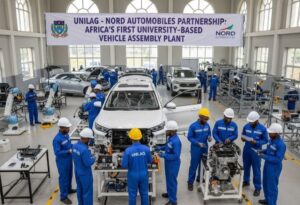
The quiet but groundbreaking automobile breakthrough at the University of Lagos (UNILAG) — where Africa’s first university-based automobile assembly plant has taken shape — is more than a technological milestone. It is a bold testament to the transformative power of knowledge when given the right environment to thrive. In partnership with Nord Automobiles, UNILAG has shown that our universities can do far more than churn out graduates: they can design, innovate, manufacture, and solve real-life problems when they are properly supported.
This achievement deserves the highest commendation. The UNILAG auto assembly initiative is not only producing vehicles and drones; it is training the next generation of engineers and innovators, providing practical exposure, and demonstrating that universities can be hubs of industry and enterprise. It is a vision of what Nigeria’s future can look like — one where our citadels of learning are at the forefront of national development, not struggling for relevance on the sidelines.

Yet, this singular accomplishment also highlights a painful truth: if one institution can do so much with so little, imagine how much more our universities could achieve with sustained, adequate funding. This is why we call on the Federal Government, state governments, and the National and State Houses of Assembly to prioritise proper funding for our universities — not as an act of charity, but as a strategic investment in the country’s economic future.
Universities are more than classrooms; they are incubators of innovation, research centres, and engines of national productivity. When properly funded, they can develop solutions that address the most pressing needs of society — from renewable energy systems and affordable housing technologies to innovative water supply solutions and locally manufactured goods. These are not theoretical possibilities; they are practical outcomes waiting to happen if the environment is right.
Furthermore, adequate funding for research and innovation can help break the vicious cycle of unemployment. When universities produce commercially viable research, companies and entrepreneurs can partner with them to develop products for mass production — for domestic use and export. Patents developed on our campuses can give birth to startups, industries, and employment opportunities, stimulating the economy and lifting millions out of poverty.
A well-funded tertiary education system would also reduce the brain drain that continues to sap Nigeria of its brightest minds. Our scholars — the “eggheads” who today seek opportunities abroad — would see little reason to leave if they had access to world-class research facilities, robust funding, and a national culture that values their contributions.
But achieving this vision requires more than policy pronouncements. It demands a fundamental change in mindset from our political class. Too often, national resources are squandered on frivolities, patronage, and private luxuries — funds that could transform our universities into centres of excellence and innovation. It is time for a new way of thinking: one that places national progress above personal gain. The resources many politicians divert into private pockets — money they could never exhaust in a lifetime — must instead be channelled into building a future where Nigerian institutions compete globally in science, technology, and innovation.
UNILAG has shown the way. It has proved that Nigerian universities can lead in research, manufacturing, and technological development when given the tools to succeed. The challenge before government is clear: to scale this success across the nation by investing in higher education, supporting research, and nurturing a knowledge-based economy.
If Nigeria is to truly diversify its economy, reduce unemployment, and claim its place among the world’s emerging powers, then our universities must be at the heart of that transformation. And that transformation begins with funding them — not as an afterthought, but as a national priority.
The automobile plant at UNILAG is not just an innovation milestone; it is a powerful message: Nigeria’s future can be built right here — if we choose to fund it.
Facebook Comments

GIPHY App Key not set. Please check settings