

By Owei Lakemfa
Liam Conejo Ramos, five, a preschooler at Colombia Heights Public School, Minnesota, returned home on January 20, 2026. He might have looked forward to the warm embrace of his mother, but in the drive way of his home, United States, US Immigration and Customs Enforcement, ICE, agents captured him and his father, Adrian.
The family had entered the US legally from Ecuador and are undergoing a legal process on their stay. But the agents were not interested. Another adult in the house who was outside, offered to take custody of the child, but the agents refused and two of them took the child to detention in Texas, 1,300 miles away from his home.
Mass protests, a national outcry and order from an apparently angry judge, forced ICE to release him on Sunday, February 1, 2026. He left four of his school mates in detention. Further protests forced the US government this week to release two of them; second and fifth graders.
The number of children in ICE detention facilities are unknown, but in the first ten months of 2025, ICE detained some 3,800 minors.
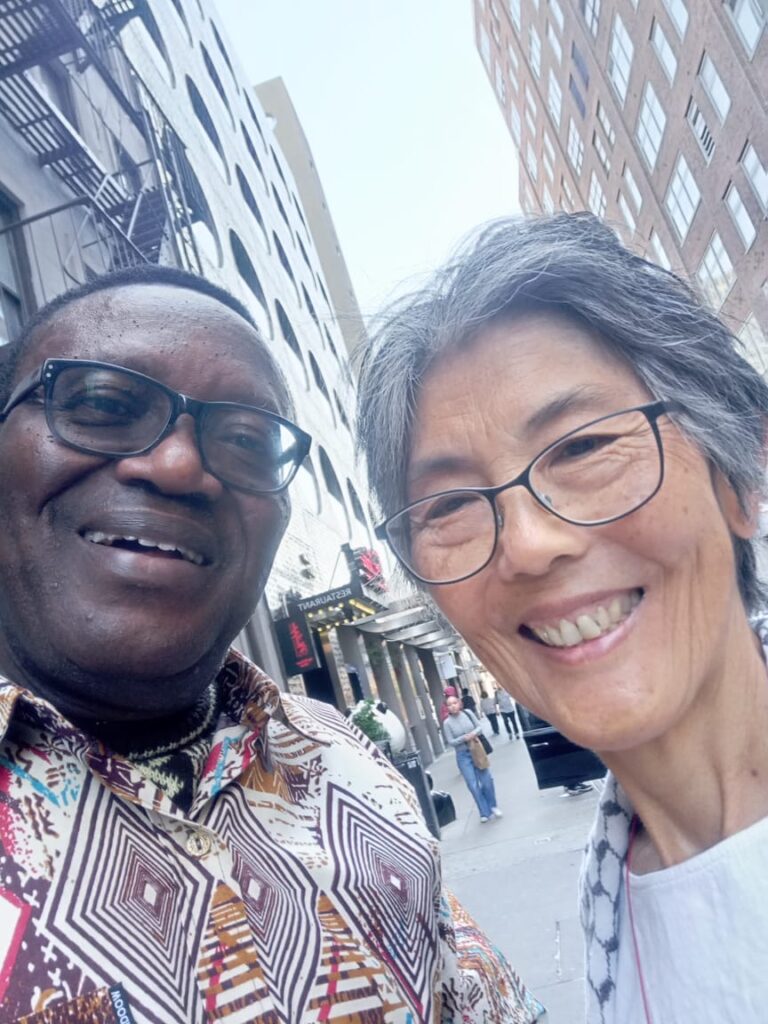
My realisation of the grassroots resistance to ICE, mass detentions and illegal deportations, was mainly brought to me by Reverend Nozomi Ikuta. A mass mobiliser in New York, she had told me in October 2025 that the protests will gather momentum and would not end until justice is done.
Nozomi had gone to the church to lead people to Christ, but the church led her to a life-long commitment to social justice, especially for Blacks, Latinos, the poor and colonised people around the world.
Nozomi, as the retired Reverend is popular called, went to the Holy land in in the Palestine with husband, James Watson, not just for spiritual purposes but also in furtherance of their campaigns for a free Palestine; a Palestine free from genocide and avoidable human tragedies.
In the on-going Trump mass detentions, she finds a link with her own family history. Nozomi’s family is part of the Nikkei (Japanese) diaspora in the US. During World War II, her father and his brother were in the U.S. army. However, just as Nazi Germany established concentration camps for Jews, so did the US under Executive Order 9066, establish concentration camps for the Japanese in California, Colorado, Utah, Arkansas, Arizona, Idaho and Wyoming. Over 120,000 people of Japanese descent, two thirds of whom were US citizens, were forcibly incarcerated in those concentration camps that ran from 1942-1946. Also, about 3,000 Japanese, Italian and German residents from Latin America, were brought to those concentration camps which virtually, had no amenities and, were surrounded by barb wire fences and armed patrol guards.
The camp Nozomi’s family was incarcerated was the Poston Concentration Camp also called the Colorado River Relocation Center, Parker, Arizona. It had about 18,000 incarcerated Japanese and was referred to as the third largest “city” in Arizona.
There, her grandfather, grandmother, her Aunty Pearl, her husband and three children, her Uncle George and his wife Louise, and her three other aunts, were incarcerated.
While this was an open wound for her, it was her calling as a Reverend that led her to socio-political activism. After attending Carleton College, Harvard Divinity School and New York Theological Seminary, she ministered in urban, rural, congregational and office settings.
She returned in 1991 to Cleveland where she was born, to serve at the national office of the United Church of Christ, UCC, where she ministered to farm workers, Native Americans, the Hawaiian sovereignty movement, and political prisoners in the US. Her work with political prisoners, meeting people incarcerated for long years for their political beliefs and activism, fired her enthusiasm to fight for freedom. Some of our mutual friends like Edwin Cortes and Adolfo Matos spent decades in jail. In fact, another mutual friend, Oscar Lopez Rivera who Nozomi visited in jail, spent 38 years behind bars.
Once, after visiting the Supermax Control Unit Prison at Florence, Colorado, Nozomi said: “The evil of the whole is somehow even worse than the sum of its parts. The sensory deprivation; the shackling and strip searches; the lack of colour, scenery and fresh air; the disorienting, triangular-shaped recreation rooms; the practically non-existent library and educational opportunities; the utter denial of human contact; even the employment of Ph.D’s in psychology to help create and maintain an environment of psychic torture – taken together, somehow these still don’t fully convey the horror.”
Linking her family’s concentration camp experiences, Nazi Germany and contemporary US, Nozomi reflected thus: “We are facing just such a time of extraordinary evil in our national life. A time of overt racism – as exemplified in every aspect of the criminally unjust system called by the misnomer of ‘criminal justice.’ A time of brutal capitalism which makes even Reaganomics seem ‘kinder and gentler’ in comparison. A time of grave political and ideological repression…We must choose whether we can simply continue going to church, paying our taxes, keeping up our property, joining the PTA, and simply refraining from personal acts of robbery or murder, while allowing the torture of Latina men and women, to continue.”
Nozomi had been the Director of Liberation Ministries, United Church Board for Homeland Ministries of UCC, Member of the National Council of Churches Racial Justice Group and Secretary of the Interfaith Prisoners of Conscience Committee.
But a place she fought one of her most memorable battles was as the Reverend of Cleveland’s Denison Avenue United Church of Christ for 18 years from 2005.
She didn’t think much about opening the church doors to the homeless, providing them diner, hot coffee, advise and offering them a warm place to sleep and shower. She thought the church could prevent some homeless from freezing to death. It was therefore shocking to her when told by the Cleveland City Councilwoman, Dona Brady that the church would not be allowed to do this because it might add to the area’s criminal problems.
Nozomi rejected what she saw as a threat. Then on December 19, 2019, the Building and Fire Departments visited the church and, on Christmas eve, the City of Cleveland Office of Public Safety pasted a “ Cease Use Notice”. It ruled that for the church to continue its homeless shelter programme, it must apply for a use of facility change, add more emergency lighting and, a working Manual Fire Alarm System.
Rather than shut down as ordered, Nozomi appealed to the community which mobilised mass protests at the Cleveland City Hall. The City Council backed down, and the following week, Council woman Brady resigned.
Nozomi, even in retirement, is not slowing down as she has her hands full with activities to make the US and the world a better place.
Facebook Comments

GIPHY App Key not set. Please check settings