

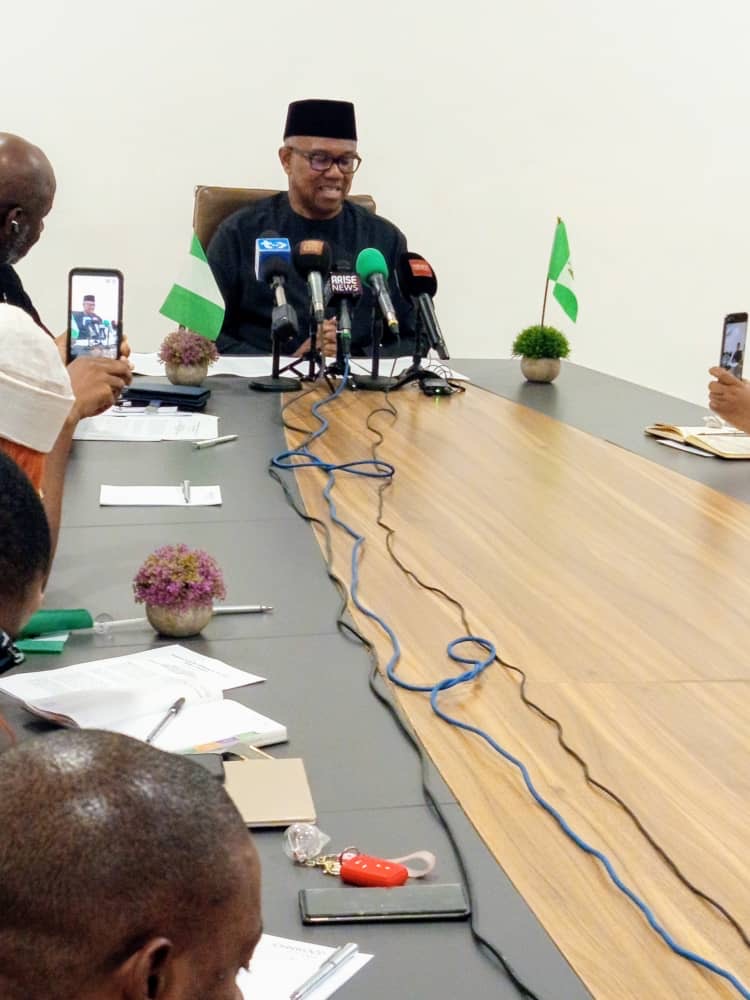
(H.E. Peter Obi, Former Governor of Anambra State and Labour Party Presidential Candidate in Nigeria 2023 Presidential Election On 12 June 2025).
Today, June 12, is slated as Democracy day. Most unfortunately, in our
present state, our dear country Nigeria cannot be justifiably classified as
a democratic country. The vital indicators of democracy are noticeably
absent. Some do not even exist. Democracy is said to be ‘a government
of the people, by the people, and for the people,’ yet none of these three
measures exist in our democracy today.
Rules, regulations and requirements to participate in elections or be
elected for are not followed, consequently, individuals who are to be
disqualified ab-initio are now holding public offices.
As we mark June 12, a day symbolizing the struggle for true democracy
in Nigeria, it is deeply troubling that under this present administration in
a short span of two years, our nation has witnessed broad erosion of
democratic principles. There has been a corresponding decline in
security and the quality of life for millions of Nigerians. We have
traversed from rigged elections to collapsing social services; from
soaring poverty to rising corruption; and from a seemingly stable
economy to a parlous economy.
It is most troubling that in its two years in office, the present government
has brought the nation to the point where our leaders now celebrate and
endorse failure, lies, and propaganda. The government today, rather than
show genuine accountability and measurable progress, focuses on
manipulating narratives, gaslighting the public, shifting blame and
1 | P a g eweaponizing governance. Meanwhile, Nigerians live in a worsening and
worrisome insecurity, widespread corruption, hunger, and general
despondence. There are no clear benchmarks for measuring tangible
development, as we continue to witness the collapse of key indicators –
like education, healthcare, and poverty alleviation- which are parameters
for measuring national progress.
Simple comparisons of what has happened in the past two years, now
relies on propaganda and misinformation to mask the mis governance.
Our country today can best be described as a nation declining fast in
all its facets. The security of lives and property has worsened, and the
rule of law is virtually non-existent. These are the hard-verifiable facts:
1. On May 29th, 2023, when this government was sworn into office,
Nigeria’s Gross Domestic Product (GDP) stood at $364 billion. As of
today, it has declined to $188 billion, a decline of almost fifty percent
(50%).
2. Nigeria’s GDP per capita was $1,640 as of May 2023, but today it
has dropped drastically to about $835, a devastating decline of about
50%.
3. Nigerians living in multi-dimensional poverty increased from
38.9% to 54% within this period, with about 129 million Nigerians now
living below the poverty line. The World Bank reported recently, that
75% of Nigerians in the rural area now live in poverty as at 2025, and
even more than previously recorded in the urban areas.
4. Our education sector has deteriorated significantly. Today, more
than 18.3 million Nigerian children are out of school, the highest number
in the world. The quality of education in Nigeria is also fast
deteriorating. Many of our children are being taught sciences without
any science lab and computer studies without any computers. Students
are now writing WAEC and other national exams in darkness relying on
candles. There are now even glitches in their exams.
2 | P a g e5. Health services have worsened drastically. The National Primary
Health Care Development Agency decried that less than 20% of over
30,000 Primary Healthcare Centers across the nation are fully functional.
I have even recently visited some Health Centers where delivery rooms
were without toilets. The United Nation recently reported Nigeria as the
world’s worst country to give birth, with one death recorded every seven
minutes.
6. Nigerian businesses continue to collapse at alarming rates. Within
the past two years, approximately 7 million Small and Medium
Enterprises (SMEs) shut down and folded up across Nigeria. Over 80
manufacturing companies have permanently closed their operations.
Funding costs cost of raw materials and energy costs have surged to an
incredible level making these manufacturers shut down. Over 15 major
multinationals (including GlaxoSmithKline, Diageo, Procter & Gamble,
and Shoprite) have exited Nigeria due to the harsh operating
environment.
7. Our hunger crisis arising from food insecurity has deepened in
these 2 years. Based on the Global Hunger Index (GHI) reports,
Nigeria’s hunger situation has taken a hit, as we are now one of the
hungriest countries in the world. Millions can no longer afford food due
to high costs of food and nonexistent disposable income.
8. Our national population is experiencing a mental health crisis as
the mental health and stress level within this period has increased
drastically. Nigeria is now one of the top three (3) most stressed
countries in the world. Fifty nine percent (59%) of Nigeria’s population
are under daily stress. Mental health experts and advocates have warned
the present situation in Nigeria is having extremely adverse effect on the
population as it contributes to anger, anxiety, and depression levels in
the country. The World Health Organization (WHO) estimates that over
20 million Nigerians are now affected by mental illness.
3 | P a g e9. Despite the trillions of naira purportedly saved from the removal
of fuel subsidies (a policy initially justified as a means to curb
borrowing), this government has, within two years, borrowed far more
money than the administrations of President Umaru Yar’Adua, President
Goodluck Jonathan, and President Muhammadu Buhari combined.
Today, Nigeria’s overall public debt is estimated at close to ₦188
trillion. Nigerians were informed that these borrowed funds would be
allocated to critical sectors of development. Still, there has been no
significant improvement in education, healthcare, or poverty alleviation;
critical sectors that are vitally important for national development.
10. Brazen Corruption is at its worst under this administration. Nigeria
has now become a crime scene. Now our national budget is routinely
inflated and padded without consequences. One of the most glaring
manifestations of this, is the extensive padding of the 2025 national
budget. BudgIT revealed that about ₦7 trillion was questionably inserted
by the National Assembly. These figures suggest a pattern of inflated
costs and misappropriation of funds.
11. Power generation rate which the administration claimed to have
increased is yet another propaganda. The only increases in power are the
excessively high electricity tariffs being paid by Nigerians. The
incessant blackout arising from multiple collapse of the national grid is a
clear indication of the sorry state of our power and electricity industry.
In 2022, the electricity tariff for Nigerian consumers averaged around
₦64 per kilowatt-hour (kWh). By 2025, there has been a substantial
mark up in electricity tariffs, with Nigerians now paying approximately
₦225 per kWh to be in darkness. What we have now is a more-tariffs-
more-darkness situation for our citizens.
Nigerians should not forget the promise of Mr. President while
campaigning on 22nd December 2022: “If I Don’t Give You Constant
Electricity in The Next 4 Years, Don’t Vote For Me For Second
Term.” It’s been 2 years of grid collapses and constant darkness. This is
already midterm of the administration. We look forward to when he will
fulfill this categorical promise.
4 | P a g e12. Unemployment remains alarmingly high in the country. Although
the government has attempted to manipulate the statistics to suit its
narrative, the reality is that unemployment is worsening, especially
amongst youths in their productive age. A majority of Nigerian youths
are “not in education, employment or training” (NEET)
category. Multiple reputable organizations, including the International
Labour Organization (ILO) and the United Nations Development
Programme (UNDP), have cautioned against reliance on the nations’
data, as they are inconsistent with the realities on ground. The ILO has
noted that Nigeria’s youth unemployment and underemployment rates
remain dangerously high. There are also concern on the government’s
reporting unemployment figures without addressing the underlying
employment challenges, as the revised figures do not reflect the true
hardship in the labour market of over forty percent (40%).
Finally, I respectfully appeal to President Tinubu to emulate late
President Umaru Yar’Adua who was honest enough to admit the process
that brought him into office was wrong and not sufficiently credible and
thus insisted on doing what is right to save our democracy. And
similarly, President Goodluck Ebele Jonathan who saved our nascent
democracy by accepting defeat even before the election results were
announced. We must end this troubling governance era that is filled with
impunity, state capture, and absolute disregard for the rule of law and
the checks and balances required of any worthwhile democracy.
Accordingly, this administration must:
1. Start upholding the rule of law and ensure there is transparency and
real progress to the people. The President should stop touring outside
Nigeria and use his remaining 2 years to tour the Nigerian states instead.
Mr. President you have already made over 30 international trips,
spending nearly 150 days abroad. If you tour Nigeria’s 36 states and
dedicates just 2 days to tour each state, it would take only 72 days for
you to do, less than half the time you have already spent outside the
country on foreign trips. You need to go around the country to see
5 | P a g efirsthand what the citizens you are serving are going through. Governing
by remote control is not what Nigerians need.
2. We must endeavour forthwith to end insecurity and resettle all
Nigerians living in Internally Displaced Persons (IDP) camps. It is
unacceptable that millions of our fellow citizens remain displaced in
their own homesteads and fatherland, while the rest of us live in
comfort, and some, in opulence.
3 Allow the national electoral body in the country to be truly
independent. The very agency that is supposed to serve as an
independent electoral body for Nigeria elections has lost its neutrality
and credibility and now operates as an extension of the APC
government, thus undermining democracy, eroding public trust, and
turning elections into orchestrated endorsements rather than credible
contests.
4. Aggressively tackle the economic problems by expanding agricultural
and manufacturing productivity, through measures that will secure our
farmers to go back to the farms and reduce production costs for
manufacturers—in order to boost employment, which will, in turn,
contribute to the nation’s growth and generate even more revenue for the
government. This is a better approach than attempting to increase taxes
in an unproductive economy, which will only lead to less growth.
This is time to stop the propaganda and lies and let us make Nigeria the
democratic nation that it supposed to be.
I respectfully call on all Nigerians not to give up, but to put all hands on
deck. Now is the time to demand accountability, genuine leadership, and
a government that prioritizes the welfare, security and democracy of its
people over empty rhetoric and propaganda.
A New Nigeria is POssible.
God bless the Federal Republic of Nigeria
Facebook Comments

GIPHY App Key not set. Please check settings