

By Chukwudi Abiandu
If governance is truly about service, then Aniocha North Local Government Area stands today as a painful testimony to what happens when elected leaders abandon their most basic responsibilities. It is a scandal, an unpardonable dereliction, that in 2025, more than ten communities in a single local government are crying out like war-time refugees, begging simply for motorable roads.
From Ezi to Ogodo, from Issele-Uku to Onicha-Ugbo, from Idumuje-Unor to Ugbodu, from Obomkpa to Ubulubu, every major artery in Aniocha North has collapsed. The people are not speaking in metaphors; they are describing their roads as “gone,” “a war zone,” “impossible to traverse,” and “difficult to explain.” These are not exaggerations. They are the blunt, bitter realities of a constituency abandoned by those elected to represent it.

President Bola Tinubu did not mince words when he told Nigerians to hold their governors and local government chairmen accountable, especially now that allocations have risen dramatically. Aniocha North is receiving more money today than at any time in its history.
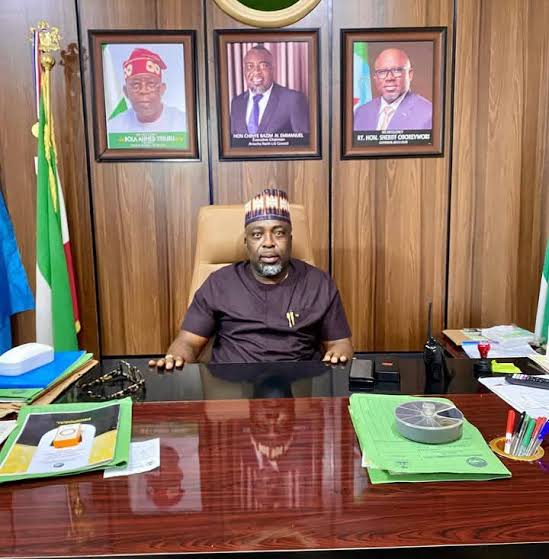
So, Hon. Chinye Bazim, Chairman of Aniocha North Local Government Council, must answer a very simple question: What have you done, specifically, tangibly, visibly with the humongous federal allocations entrusted to you on behalf of the people?
Because one thing is clear to every man, woman, and child in Aniocha North: You have not spent it on roads.
How does a local government chairman live comfortably with the knowledge that “there is no single good road” in his entire council area? How does he sleep at night knowing that farmers cannot reach markets, pregnant women cannot reach hospitals, traders cannot move goods, and whole communities are cut off from one another? Silence is no longer acceptable. The people deserve answers.
Hon. Emeka Nwaobi, the Aniocha North constituency representative in the Delta State House of Assembly, finds energy to sponsor a controversial bill designed to silence public criticism, yet he cannot find the same energy to raise a motion on the floor of the House about the horrific road conditions in his constituency.
Why is a lawmaker more concerned with gagging the people than speaking for them?What is the priority here; protecting political egos or protecting citizens from suffering?
Nigeria already has enough provisions on defamation in the constitution and statutory laws. What Aniocha North does not have are roads. The honourable member should drop this needless “gag bill” and return to the fundamentals of representation—advocacy, oversight, and constituency protection.
As for Hon. Ngozi Okolie, the people cannot point to a single instance where he has raised the alarm on the worsening infrastructural decay in his constituency. Representation is not about occupying a seat; it is about defending the interests of the people who sent you there. Aniocha North is crumbling, yet their representative in Abuja is silent. Silence, in this case, is betrayal.
It is shocking that Senator Ned Nwoko, himself an indigene of Aniocha North, is more preoccupied with political theatre: second-term permutations and the distracting noise about “Anioma State” than the immediate realities of the people who are trapped in economic stagnation because their roads have become death traps.
This is not the time for fanciful state creation debates or ego-driven political crusades. This is the time to fight for the dignity and development of the communities that gave him a mandate. A senator should not be a spectator while his home constituency collapses.
Governor Sheriff Oborevwori’s administration prides itself on its “MORE Agenda” and a renewed push for infrastructural development. Road projects are ongoing across Delta State. But the people of Aniocha North are asking a fundamental question: Why have we been left behind?
Aniocha North is not a barren land; it is a vibrant agricultural hub, a cultural treasure, and a strategic link between communities. The governor must intervene, not out of political favour, but out of duty. The cries of the people are legitimate, urgent, and long overdue.
The collapse of virtually every road in Aniocha North has inflicted:
- crippling economic stagnation
- rising insecurity
- disconnection between communities
- threats to life during emergencies
- loss of agricultural value
- erosion of public trust in government
These are avoidable tragedies—if only leaders would lead.
The political leadership of Aniocha North—Hon. Chinye Bazim, Hon. Emeka Nwaobi, Hon. Ngozi Okolie, and Senator Ned Nwoko—must wake up from their dangerous slumber. A people who cannot move cannot grow. A community without roads is a community condemned. Leadership without empathy is leadership without legitimacy.
This is a call to conscience. A call to duty. A call to accountability. The roads of Aniocha North must be reclaimed. Not tomorrow. Not next election cycle. Now.
The people have spoken. Their cries are loud, justified, and impossible to ignore.
The leaders must act, or be remembered as the generation that watched their own communities collapse and did nothing.
• Chukwudi Abiandu is Editor-in-Chief, Banner Communication Network, publishers of banneronlinenews.com
Facebook Comments

GIPHY App Key not set. Please check settings