

By Solomon Dalung
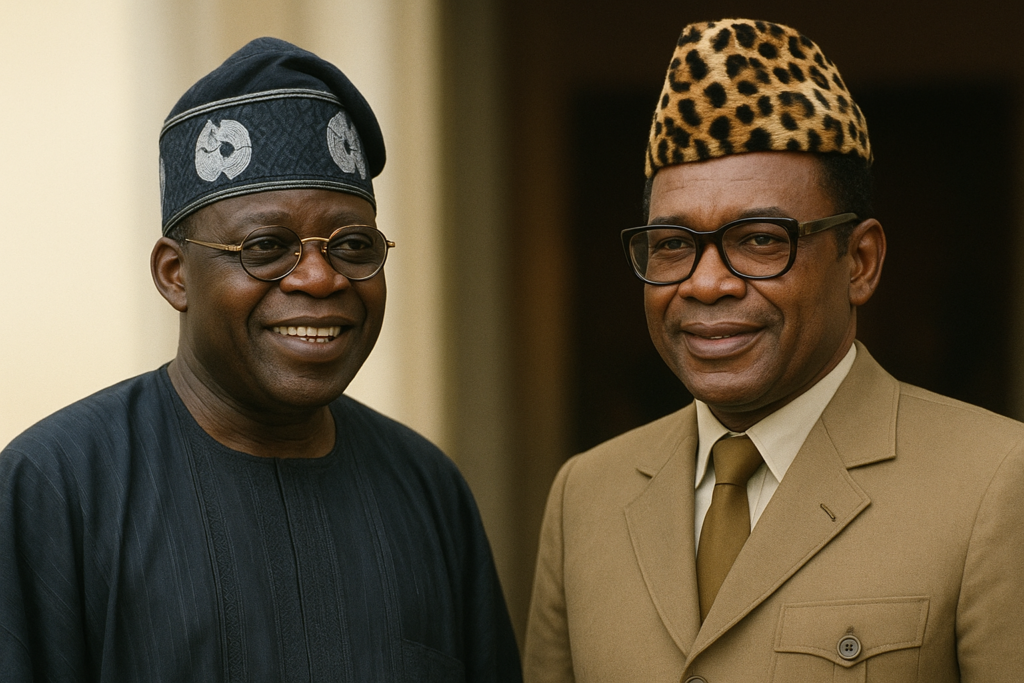
Mobutu Sese Seko’s rise in Zaire was anchored on the construction of a powerful cult personality, where he projected himself as the “Messiah of Zaire,” “The All-Knowing Leader,” and the embodiment of national destiny. Similarly, Asiwaju Bola Ahmed Tinubu’s political machinery has cultivated a growing aura of cult worship, symbolized by the “Emilokan” doctrine, mandatory initiation of people with compulsory wearing of jagaban’s cap with its insignia and the deliberate projection of Tinubu as the irreplaceable stabilizer of Nigeria. Both leaders used controlled narratives, loyalist propaganda, and media dominance to elevate personal prestige above institutional legitimacy, thereby shrinking critical inquiry and promoting unquestioning loyalty.
One of Mobutu’s most damaging legacies was the transformation of Zaire into a one-party state, achieved through systematic coercion, bribery of opposition figures, and strategic co-optation of political elites into his ruling MPR party. A disturbing parallel emerges in Nigeria under Tinubu, where opposition parties are weakened by unprecedented political horse-trading, financial inducements, and co-optation of their key figures into the ruling party, APC. This erosion of an effective opposition reduces democratic choice and gradually consolidates power around one political centre, just as Mobutu turned Zaire’s multiparty democracy into a rubber-stamp political landscape.

Mobutu imposed symbolic cultural changes such as the renaming of the country and adoption of a new national identity as instruments of political control disguised as nationalism. Tinubu’s government has revived a similar pattern with the change of the national anthem and ongoing discussions about renaming Nigeria to the “United States of Nigeria.” While framed as reforms, these symbolic alterations serve political purposes: diverting public attention from governance failures, rewriting national memory, and imprinting a regime’s identity onto the national psyche, just as Mobutu did with “Authenticité.”
Nepotism was at the heart of Mobutu’s system. His relatives occupied strategic positions in military, economic, and administrative institutions, turning the country’s bureaucracy into a family extension. Nigeria under Tinubu displays comparable tendencies: his family, official and unofficial exerts unusual influence in state affairs. The First Lady’s increasing political interference, arrogance, abuse of power, coupled with Seyi Tinubu’s movements with a “garrison” of state security, mirrors Mobutu’s use of state resources to elevate and protect his children as parallel centres of power. This blurring of family and state functions signals a drift toward personalized governance.
Mobutu institutionalized corruption as a form of political management. State resources were openly distributed to loyalists while the President lived in extravagant opulence. Today in Nigeria, state-endorsed corruption manifests in inflated contracts, opaque policy decisions, reckless looting of public treasury, selective anti-corruption pursuits, and the protection of political godsons facing grave allegations. Just like in Zaire, corruption becomes a currency of political loyalty, rewarding allegiance, punishing dissent, and ensuring elite dependence on the supreme leader.
Hero worship under Mobutu was cultivated through state propaganda, elite praise-singing, and repression of dissent. The leader was presented as indefectible, indispensable, and beyond criticism. Nigeria is witnessing a similar trend: governors, ministers, party loyalists, and even religious leaders deploy exaggerated praise to shield Tinubu from accountability. They either kneel down before the emilokan chief priest on sit on the floor during official engagements. National discourse is increasingly policed, with critics labelled unpatriotic or enemies of progress. This monopolization of praise mirrors Mobutu’s insistence that public morality must revolve around pleasing the supreme leader.
Zaire’s descent into poverty was not accidental, it was a deliberate weaponization of economic hardship to keep citizens dependent, hopeless, and too preoccupied with survival to resist. Nigeria shows echoes of this pattern: worsening inflation, subsidy removal shocks, collapsing living standards, and insecurity create a climate where citizens are weakened and perpetually struggling. The deliberate decisions is calculated at paving way for Tinubu as sole candidate in 2027. A hungry population is easier to manipulate, and like Mobutu, Tinubu’s government appears to leverage the chaos to consolidate political control rather than solve root problems.
The weaponization of insecurity is another striking similarity. Mobutu allowed certain militia groups to thrive so he could present himself as the indispensable strongman. In Nigeria, the inability or unwillingness of the APC government to decisively confront terrorists, bandits, and kidnapping syndicates fuels the perception of a controlled instability. Selective military responses, unexplained lapses, and politicization of security responses echo Mobutu’s strategy of using fear as a governing tool.
Ultimately, Mobutu’s Zaire collapsed under the weight of state capture, where national institutions were hollowed out and repurposed for the survival of one man and his network. Critics warn that Nigeria risks a similar fate as governance increasingly becomes personalized, institutions weakened, and public resources redirected to sustain a regime rather than a nation. The lesson from Zaire is clear, a state built around one individual cannot endure. If Nigeria continues on this path, it risks replaying the tragic script that turned one of Africa’s wealthiest nations into a cautionary tale of collapse.
@SolomonDalung LLM, LLB, BL
Igbarman Otarok & Garkuwa Arewa,
Voice of the Silent Majority.
igbarman@gmail.com
Facebook Comments

GIPHY App Key not set. Please check settings