

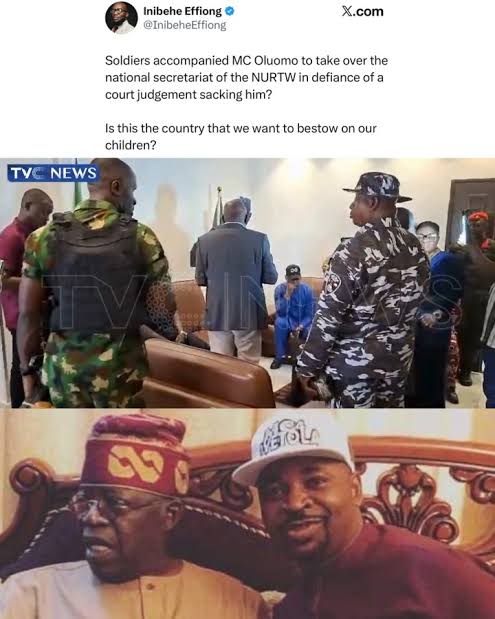

The footage is damning. Soldiers, men and women in the green fatigues of the Nigerian Army, the same uniform worn by those fighting Boko Haram in the Sambisa Forest, escorting Musiliu Akinsanya, better known as MC Oluomo, to seize the national secretariat of the National Union of Road Transport Workers (NURTW). This, after a court judgment had affirmed another faction’s leadership. This, in defiance of the rule of law. This, under the watch of President Bola Ahmed Tinubu’s administration.
Barrister Inibehe Effiong’s question, “Is this the country that we want to bestow on our children?”—hangs in the air like a funeral dirge. But the answer is already written in the blood of Nigeria’s trampled constitution and the tears of a people abandoned to the wolves. No, we do not want this country. But this is the country Tinubu is building.

The Anatomy of Impunity: A Court Judgment Reduced to Toilet Paper
On March 23, 2026, Tajudeen Ibikunle Baruwa, relying on a Court of Appeal judgment affirming his leadership, moved to take control of the NURTW national secretariat in Abuja. His faction waited two years for compliance that never came . Baruwa’s action was not a “forceful takeover,” as the government’s apologists would later claim. It was, by his own account, an attempt to enforce what the judiciary had already decreed: “We have waited for about two years, but they refused to comply” .
What happened next is the story of Nigeria under Tinubu, distilled into a single, obscene act of state-sponsored lawlessness.
The very next day, MC Oluomo, a figure whose name has become synonymous with Lagos political thuggery, arrived at the secretariat. He was not alone. According to reports, he came with a heavy escort of soldiers and police officers . Multiple security agencies, the Nigerian Army, Police, Immigration Service, Nigeria Security and Civil Defence Corps (NSCDC), and even the Department of State Services (DSS), descended on the premises, sealed it, and effectively handed it over to MC Oluomo’s faction .
An operative at the gate, speaking with the casual arrogance of men who know they will face no consequences, told journalists: “You can’t enter the premises. I think it will last a week or two… maybe tomorrow” .
Let that sink in. Armed men in state uniforms, paid with taxpayers’ money, were deployed not to protect life and property, not to secure citizens from terrorists, but to enforce the political will of a faction loyal to a transport union boss, a boss whose own legal standing was, at best, contested.
This is not governance. This is gangsterism wearing the state’s badge.
The Rule of Law: A Corpse Dressed in Judicial Robes
The Tinubu administration has perfected a particular brand of selective justice. When the courts issue judgments favorable to the government or its allies, they are celebrated as the triumph of democracy. When they issue judgments that are inconvenient, as in the NURTW case, they are ignored, and state power is weaponized to nullify them.
Baruwa’s faction had a court judgment. MC Oluomo had soldiers. In Tinubu’s Nigeria, the latter trumps the former every single time.
This is not hyperbole. The Trade Union Congress of Nigeria (TUC) warned against this exact pattern as far back as August 2023. In a statement that now reads like prophecy, the TUC described the police’s occupation of NURTW offices as “an act of impunity, irresponsibility, and a rape of the constitution” . They invoked Section 43 and 44 of the Constitution, which guarantee the right to acquire and own property, and warned that the government’s actions were “encouraging lawlessness and disorder” .
That was nearly three years ago. Nothing has changed. If anything, the impunity has metastasized.
The Militarization of Politics: Soldiers as Enforcers for Transport Union Bosses
Let us be clear about what we witnessed at the NURTW secretariat. It was not a routine security operation. It was not a response to a threat to public order. It was the armed forces of the Federal Republic of Nigeria, the same armed forces constitutionally mandated to defend the nation from external aggression, being used as glorified bouncers for a political ally.
This is an abomination.
Even Lieutenant General Tukur Buratai (retd.), a former Chief of Army Staff and no stranger to the military’s internal security role, has warned that the increasing deployment of soldiers for such duties is “weakening the Nigeria Police Force and other civilian security agencies” and “perpetuates a cycle of dependency” . Buratai, speaking in January 2026, cautioned that the military’s widespread presence across Nigeria’s 36 states “erodes the growth and effectiveness of the police and internal intelligence institutions that are constitutionally expected to lead internal security operations” .
His warning is specific and devastating: the trend “overstretches the military, diverts defence budgets to routine policing duties and reduces the Armed Forces’ preparedness for conventional threats” .
In other words, every soldier standing guard at a transport union secretariat in Abuja is a soldier not fighting Boko Haram in Sambisa Forest. Every military vehicle deployed to escort MC Oluomo is a vehicle not hunting bandits in the North-West. Every minute of a soldier’s time spent enforcing political impunity is a minute stolen from the nation’s existential struggle against terrorism.
This brings us to the question that should burn in the conscience of every Nigerian:
What of Sambisa? What of the Dead?
While soldiers were busy sealing off a transport union office in Abuja for a faction aligned with the ruling party, terrorists and insurgents continued their grim harvest across the country.
The African Democratic Congress (ADC), in a March 2026 statement, painted a picture of catastrophic insecurity: “Recent reports indicate that in this month of Ramadan alone, up to 500 Nigerians may have been killed by terrorists in Borno, Yobe, Adamawa, and Kebbi” . The party noted that despite the Ministry of Defence exceeding its budget performance at 113.45 percent, largely due to emergency funding, insecurity has “continued to spread” .
A detailed analysis from December 2025 catalogued the scale of the horror. The National Human Rights Commission (NHRC) reported “570 killings and 278 kidnappings in April 2025 alone,” warning of an “unprecedented surge in human rights violations” . Between November 17 and 24, 2025, over 402 people, “predominantly schoolchildren, were abducted across Northern states,” including the seizure of approximately 315 students and staff from St Mary’s Catholic School in Niger state .
And the trend is worsening: data shows “a 49% increase in deaths between January–April 2024 and January–April 2025” .
The ADC’s conclusion is as damning as it is undeniable: the Tinubu government has “proven that to them everything is about politics and power for its own sake” . The administration’s focus, the party charged, is less on governing than on securing a second term in 2027.
The 2027 Obsession: A Government That Has Abandoned Its Primary Duty
The ADC’s accusation is not mere opposition rhetoric. It is borne out by the administration’s actions and its inactions.
Consider the budget crisis. The ADC alleges that the federal government is “running three national budgets at the same time while implementing none” . As of the third quarter of 2025, only 17.7 percent of the capital component of the 2024 budget had been released, with overall implementation below 30 percent . Ministries crucial to human capital development—Power at 3.6 percent, Communications Technology at 8.9 percent, Education at 23.5 percent—have been left “largely unfunded while select government officials continue to live in obscene opulence in the midst of unprecedented poverty and human misery” .
The only ministry that exceeded its budget performance was Defence—and even that, as we have seen, has not translated into security for Nigerians.
Meanwhile, the government has borrowed more aggressively than any previous administration, yet contractors remain unpaid and projects remain stalled . Nigerians are asking: “What is this government doing with all the money that accrues from all the loans, all the revenues, and all the increased taxes? Why are we worse off today than we were three years ago?” .
The answer, however uncomfortable, is that the government’s primary energy is directed not at governance but at political consolidation. As TheCable’s political analysis noted in December 2025, the APC under National Chairman Professor Nentawe Goshwe Yilwatda has been quietly but “firmly tightening its internal structures” and “aligning the party’s internal rhythm with President Tinubu’s broader re-election strategy” . The roadmap to 2027, the analysis states, is “already being drawn with precision”
It is a damning portrait of an administration that sees its first duty not as securing the lives and property of citizens but as securing its own political future.
The Constitutional Subversion: When Soldiers Become Policemen
The militarization of internal security under Tinubu is not just a tactical error; it is a constitutional crisis in slow motion.
Buratai’s January 2026 lecture at the National Defence College was explicit: “The extensive deployment of the Armed Forces of Nigeria in internal security provides immediate stability, but it also perpetuates a cycle of dependency that weakens civil police capacity and strains defence resources” . He reminded Nigerians that the armed forces’ constitutional role is “to defend against external aggression, protect territorial integrity, suppress insurrection, and assist civil authorities when required”—not to serve as a substitute for policing .
Security analyst Ambassador Abdullahi Bakoji Adamu, himself a retired Army Captain, echoed Buratai’s concerns in a January 2026 interview. “The military was created to defend the country from external threats, not to carry out day-to-day policing,” he said . He warned that “today, in many parts of Nigeria, the first security presence citizens see is soldiers, not police officers,” and that this reliance on the military is eroding the police’s capacity to develop “the intelligence, investigative and community-policing skills required in a democratic system” .
Adamu’s warning about the consequences for civil liberties is particularly chilling: “Soldiers are trained for combat and end domination of threats, while police officers are trained for arrest, investigation and the protection of citizens’ rights. When these roles are mixed, accountability becomes blurred and civilian harm becomes more likely” .
The NURTW incident is a perfect case study. What possible threat to national security could a transport union secretariat pose that required the deployment of soldiers, DSS, NSCDC, Immigration, and police? The answer is none. The deployment was not about security; it was about power. It was about signaling to anyone who might challenge the administration’s allies that the full weight of the state, including its armed forces, would be brought to bear against them.
This is not the behavior of a democratic government. This is the behavior of a regime that treats state institutions as its personal property.
The Scandal of Priorities: IDP Camps and Abandoned Citizens
Let us speak plainly. While soldiers were being deployed to settle a transport union dispute, Nigerians were dying.
The ADC’s report that “up to 500 Nigerians may have been killed by terrorists in Borno, Yobe, Adamawa, and Kebbi” during Ramadan alone should shake the conscience of any government worthy of the name . Instead, what do we see? Silence. Indifference. A government whose primary concern appears to be its re-election.
Governor Muhammadu Yahaya, Chairman of the Northern States Governors’ Forum (NSGF), captured the tragedy of this abandonment when he said the North is confronted with “the grim reality of insecurity and poverty that seeks to undermine our very existence” . He identified the underlying drivers as “underdevelopment, illiteracy, poor resource management, climate change and the abandonment of millions of Almajiri and out-of-school children” .
Where is the Tinubu administration’s holistic strategy to address these drivers? Where is the serious investment in education, in economic development, in the structural reforms that would make communities resilient to the lure of banditry and extremism?
Instead, we get soldiers at transport union secretariats. We get a government that, according to the ADC, has “argued that the arrangement is a ‘deliberate strategy’ and a ‘transition cost’ meant to ensure that multi-year capital projects are completed”—a “blatant falsehood” that leaves critical sectors underfunded .
The pattern is unmistakable: governance is neglected; political consolidation is prioritized; state resources are deployed not to protect citizens but to protect political allies.
The Ransom Economy: A Government That Rewards Criminality
The insecurity crisis has spawned a grotesque economy: the kidnap-for-ransom industry. And here, too, the Tinubu administration’s response has been anemic at best, complicit at worst.
As a December 2025 analysis noted, while victims are sometimes released, “the process has repeatedly been achieved without the immediate arrest, capture, or neutralization of the bandit groups, leading to widespread suspicion of ransom payments” . The government’s explanation that “when abductors realise that superior power is coming, they can abandon their victims and flee” is “critically flawed” . It suggests that “the vast ungoverned spaces and the criminal ecosystem remain intact,” and that criminals face no consequences for their actions .
Human Rights Watch (HRW) has emphasized that “this failure to pursue and prosecute the bandits effectively strengthens their financial and operational viability,” ensuring that “the kidnap-for-ransom trade remains a low-risk, high-profit venture, guaranteeing the continuity of the crisis” .
This is the context in which the Tinubu administration deploys soldiers to protect a transport union faction. The message to criminals is clear: if you are politically connected, the state will protect you. If you are a bandit in the North-West, the state will simply hope you flee when soldiers approach.
The Resignation That Meant Nothing: Badaru’s Exit and the Illusion of Accountability
In December 2025, Minister of Defence Alhaji Mohammed Badaru Abubakar resigned, officially due to “ill-health” but widely believed to have been forced out by “intense public and political pressure amid the massive surge in kidnappings” . President Tinubu swiftly nominated General Christopher Gwabin Musa, the recently retired Chief of Defence Staff, to replace him—a man with “formidable” credentials and “deep, practical knowledge of Nigeria’s security threats” .
On paper, this looked like accountability. In practice, it was the same old game.
As the December analysis noted, “if the failure was structural—rooted in chronic under-funding, corruption in procurement, and political interference—a mere change in personnel, even one as highly decorated as General Musa, may not resolve the deep-seated issues” . Moreover, appointing “a recently retired CDS, effectively the military’s top uniformed officer, to the top civilian policy position risks blurring the lines of civilian oversight” and “signaling the complete militarization of Nigeria’s security response” .
Six months later, with soldiers escorting transport union bosses and insecurity continuing unabated, it is clear that the structural problems remain untouched. The NURTW incident is proof that the militarization trend has only deepened.
The DSS’s Selective Conscience: Freeing Journalists While Silencing Critics
The administration’s record on civil liberties is equally troubling. In October 2025, the DSS arrested two journalists from Jay 101.9 FM in Jos during President Tinubu’s visit to Plateau State for the burial of the mother of the APC national chairman . The reporters were released only after the DSS Director-General learned of their arrest and “ordered their immediate release,” with a source saying the new DG “treasures the importance of a free press in a democracy” and “is correcting the wrongs he inherited” .
This is the pattern of the Tinubu administration: occasional gestures toward reform to maintain a veneer of democratic legitimacy, while the underlying structures of impunity remain intact. The same government that releases two journalists in October deploys soldiers to enforce a transport union’s political dominance in March.
The Opposition’s Lament: A Coalition That Cannot Stop the Machine
The opposition, for its part, has been reduced to watching from the sidelines. The ADC has emerged as a potential rallying platform for a “grand opposition alliance” that includes names like Atiku Abubakar, Nasir El-Rufai, and Peter Obi . There is talk of former President Olusegun Obasanjo playing the role of “political midwife” for a new coalition .
But as TheCable’s analysis noted, “public denials follow private meetings, as is customary in Nigerian politics. One minute, there is no discussion; the next, spokespersons admit that conversations are ongoing. It is the old dance: deny by day, negotiate by night” .
Meanwhile, the APC under Professor Yilwatda has been “quietly but firmly tightening its internal structures,” making decisions “informed by voter data, electoral trends, demographic shifts, and ground-level intelligence rather than gut feelings and godfather instincts” . The party machinery, the analysis states, “worked like a well-oiled engine, quiet, efficient, and effective” .
This is the reality of Tinubu’s Nigeria: a ruling party that has weaponized the state and perfected the mechanics of political domination, facing an opposition that cannot find its footing, in a country where the primary victims are ordinary citizens abandoned to insecurity and poverty.
The Unseen Hands: A President Unmoved
TheCable’s analysis, written by a special adviser to the APC national chairman, paints Tinubu as a man unperturbed by the shadows gathering around him. “The hunter who knows the forest does not fear the shadows,” it concludes. “Tinubu knows this forest. And while the unseen hands grope in the dark, the man at the centre of the storm appears very much at home” .
This self-portrait of a confident, calculating political operator is meant to reassure. But for the Nigerian people, it should terrify.
The hunter who knows the forest does not fear the shadows—but the people living in that forest, the ones whose children are abducted, whose farms are raided, whose futures are stolen by insecurity and poverty, they have every reason to fear. Because the hunter is not hunting on their behalf. He is hunting for his own survival. He is deploying the resources of the forest not to clear it of predators but to secure his own position.
Conclusion: The Inheritance of Ruin
Barrister Inibehe Effiong asked: “Is this the country that we want to bestow on our children?”
The answer is no. But the Tinubu administration is giving it to them anyway.
We are bestowing on our children a country where court judgments are enforced not by law but by soldiers. A country where the armed forces, meant to defend the nation from external aggression, are reduced to political enforcers for transport union bosses. A country where terrorists kill hundreds in a single month while the government’s attention is fixed on the next election. A country where the primary duty of government, the security of life and property, is treated as an afterthought, if it is treated at all.
This is the inheritance of the Tinubu era. It is an inheritance of impunity, of militarized politics, of abandoned citizens, of a state that has forgotten its purpose.
The question Effiong poses is not rhetorical. It demands an answer. And that answer must come not from lawyers or politicians alone, but from every Nigerian who refuses to accept that this is the best we can do. It must come from a citizenry that demands accountability, that rejects the weaponization of state institutions, that insists that the rule of law apply to all, especially to those with power.
Because if we do not answer this question now, our children will answer it for us. And their answer will be written not in words, but in the ruins of a country that could have been great but was instead sacrificed to the insatiable appetites of men who saw power as an end in itself.
• This analysis is based on reporting from Vanguard, The Guardian, Ripples Nigeria, The Eagle Online, New Telegraph, TheCable, Daily Nigerian, and Daily Post Nigeria, covering events through March 2026. The views expressed are a critical analysis of the facts as reported and reflect the implications of the Tinubu administration’s actions for Nigeria’s democratic institutions and security architecture.
Facebook Comments

GIPHY App Key not set. Please check settings