

By Chukwudi Abiandu
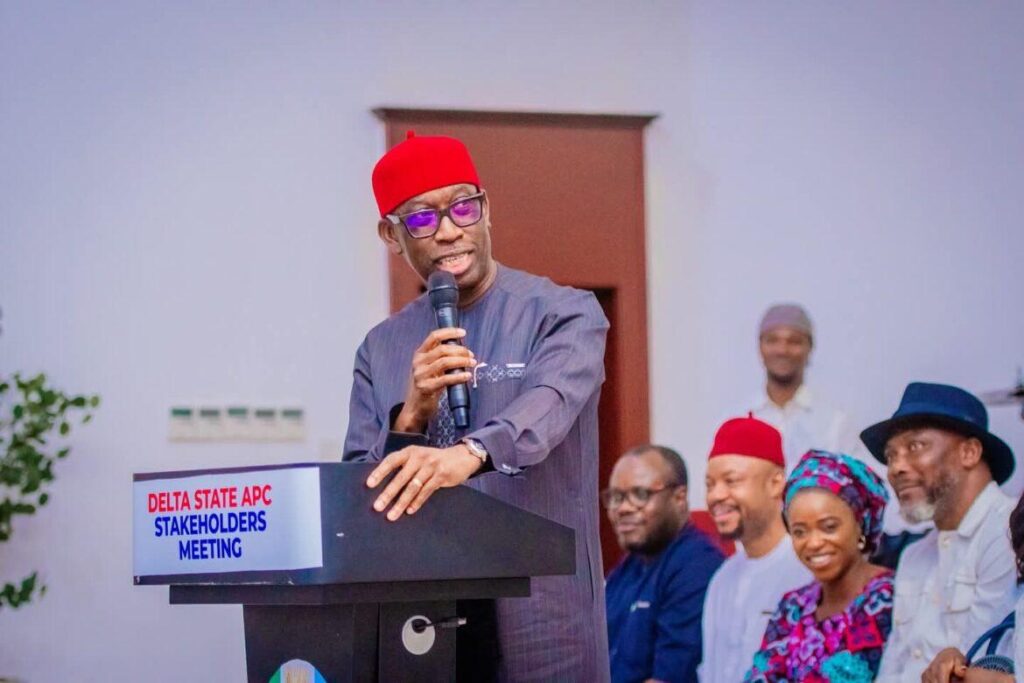
It takes a special kind of irony for a former vice-presidential candidate who campaigned against the All Progressives Congress (APC) to suddenly become its loudest cheerleader. Yet, that’s exactly what played out in Asaba on Sunday, October 12, 2025, when Dr. Ifeanyi Okowa, former Delta State governor and one-time Peoples Democratic Party (PDP) vice-presidential candidate to Atiku Abubakar, mounted the podium at an APC meeting and hailed President Bola Tinubu’s economic reforms as “bold and tough but necessary steps to rescue Nigeria’s economy.”
The remark, dripping with political expediency, provoked not applause but disbelief. For millions of Nigerians crushed under the weight of hunger, unemployment, and insecurity, Okowa’s statement came off as a diabolical joke, the cruel humour of a man seeking political acceptance in a new party he once vilified.

Praising pain as policy
To describe Tinubu’s economic policies as “necessary” is to mock the suffering of ordinary Nigerians. The removal of fuel subsidy without immediate cushioning measures for its effects, the chaotic floating of the naira, and incessant taxation have together unleashed one of the worst cost-of-living crises in Nigeria’s history.
Inflation has soared beyond imagination, food prices have quadrupled, and transport costs have crippled households. The naira’s freefall has rendered salaries worthless, while businesses, both small and large, continue to fold. Families now ration meals; parents withdraw children from school.
Just last week, the World Bank sounded the alarm, declaring that Nigeria’s poverty rate has risen sharply, with tens of millions pushed below the poverty line due to the Tinubu administration’s fiscal and monetary policies. The report noted that over 60 percent of Nigerians now live in multidimensional poverty, a figure that underscores the devastating human cost of these so-called “reforms.”
Yet, Dr. Okowa wants us to believe this is the “right path.” These are not reforms — they are economic punishments dressed in policy language. To cheer them on is to applaud the misery of the people.
Okowa’s political conversion and self-preservation
Okowa’s sudden warmth toward Tinubu’s government is not a matter of conviction but convenience. Having defected to the APC after his bruising loss in 2023, he appears desperate to prove loyalty, to ingratiate himself with the same political machinery he fought fiercely only two years ago.
But in his eagerness to be seen as a “team player,” Okowa has insulted the intelligence of Deltans. While he sings praises of Tinubu’s reforms, the federal roads across Delta North remain death traps — from Benin through Agbor to Igbodo, Onicha-Ugbo, Ubulu-Okiti, and Asaba to the Onitsha Head Bridge. He made no mention of the collapsing Agbor–Abavo road — a stretch through his maternal hometown that has become unmotorable and notorious for kidnappings.
Even the once-bubbling Oyoko market in Abavo now lies comatose due to poor road access, but these realities meant little to Okowa that Sunday. His focus was not on his people’s plight but on pleasing his new political hosts.
Insecurity ignored, herdsmen emboldened
If Dr. Okowa truly wished to “help our people understand” anything, he might have started with the insecurity ravaging Delta’s farmlands. Fulani herdsmen continue to occupy farmlands and forests, driving farmers away despite the anti-open grazing law still in force. In parts of Anioma, communities live in fear, unable to harvest crops or access their farms.
Did Okowa raise these issues before the APC faithful or urge President Tinubu to act as Commander-in-Chief? Of course not. The new convert preferred to flatter rather than challenge — to play politics instead of leadership.
Transactional leadership at its worst
Okowa’s comments in Asaba illustrate Nigeria’s greatest tragedy; leadership without conviction. Politicians who shift allegiances like sand in the wind, motivated not by service but by survival.
Tinubu’s government, built on transactional politics, has mastered the art of shifting burden to the people while shielding the political class from sacrifice. Nigerians are told to tighten their belts, but politicians loosen theirs to enjoy the spoils of office.
The World Bank’s latest poverty report is a stinging indictment of this leadership model, one where the masses pay for elite comfort. It confirms what every market woman, bus driver, and civil servant already knows: the so-called reforms are sinking Nigeria deeper into economic quicksand.
If this is what Dr. Okowa now considers “bold and necessary,” then Nigerians must brace for more suffering disguised as reform.
Okowa no try
Deltans have a simple way to summarize Okowa’s new gospel of hardship: “Okowa no try.”
He failed to speak for his people, failed to challenge injustice, and failed to show compassion. His newfound praise of Tinubu’s anti-people policies is not leadership; it is opportunism, pure and simple.
And as history has shown, Nigerians have long memories for those who choose power over principle.
- Chukwudi Abiandu, a veteran journalist and Editor-in-chief, is a political commentator and public affairs analyst. He writes on governance, leadership ethics and citizen welfare in Nigeria.
Facebook Comments

GIPHY App Key not set. Please check settings