

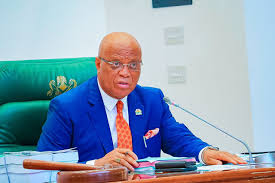
Governor Umo Eno’s attempt to rewrite the political rulebook in Akwa Ibom has hit its first major wall. What was sold in June as a bold, bipartisan reimagining of governance, “Akwa Ibom United, is now giving way to the far more familiar language of party loyalty, political pressure, and disciplinary sackings.
It is said that by dismissing two appointees for attending the PDP national convention, the governor has effectively closed the chapter on the unity doctrine he championed only months ago. And the symbolism is hard to miss: the same governor who defected from the PDP to the APC while insisting he would “uphold his values” has now punished his own aides for exhibiting the very political duality he once embodied.
Cracks in the Cross-Party Experiment
According to political observers, at the heart of the current turbulence is a gamble that seemed clever on paper but reckless in practice. The governor tried to join the APC without surrendering influence in the PDP — a dual-party strategy that required discipline, loyalty, and silence from everyone around him. He got none of that.
The airport incident involving former Governor Udom Emmanuel opened the floodgates. For months, the Akpabio-aligned APC faction pressed hard, portraying some of Eno’s appointees as saboteurs and demanding action. The governor resisted at first, even publicly defending the same aides he has now fired.
That reversal speaks volumes. This is not an administrative reshuffle, it is political recalibration.
The Governor Caught Between Two Structures
The PDP’s swift dissolution of its Akwa Ibom chapter made clear that Eno could not defect and still hold the keys to the house he left. And within the APC, stakeholders remain wary of a governor they view as an outsider trying to assume ownership.
As a result, Eno now occupies political no-man’s-land: distrusted by his old party, not fully embraced by his new one, and surrounded by a cabinet whose loyalties are split between past and present benefactors. His recent warnings that “No man can serve two masters” confirm the new reality.
The unity doctrine is dead.
Loyalty tests are back.
2027: A Hard Road Ahead
What happens next will shape the state’s politics heading into 2027. The governor must now choose a direction and build a structure that reflects it. Until he does, he risks leading an administration defined not by reform or inclusion, but by internal suspicion, shrinking political territory, and the pressures of competing power blocs.
Governor Eno set out to govern above party lines.
But in Akwa Ibom’s fiercely structured political culture, the experiment has collapsed under its own weight.
The question now isn’t whether the governor still believes in “Akwa Ibom United.”
It’s whether he still has the political capital to rebuild what has fallen apart.
• Source: Premium Times
Facebook Comments

GIPHY App Key not set. Please check settings