

By Our Correspondent
ABUJA — Presidential candidate Peter Obi has declared that Nigeria’s 2027 elections must be a referendum on leadership, competence and results, warning that the country cannot afford another cycle of poor governance amid worsening poverty, insecurity, unemployment and economic hardship.
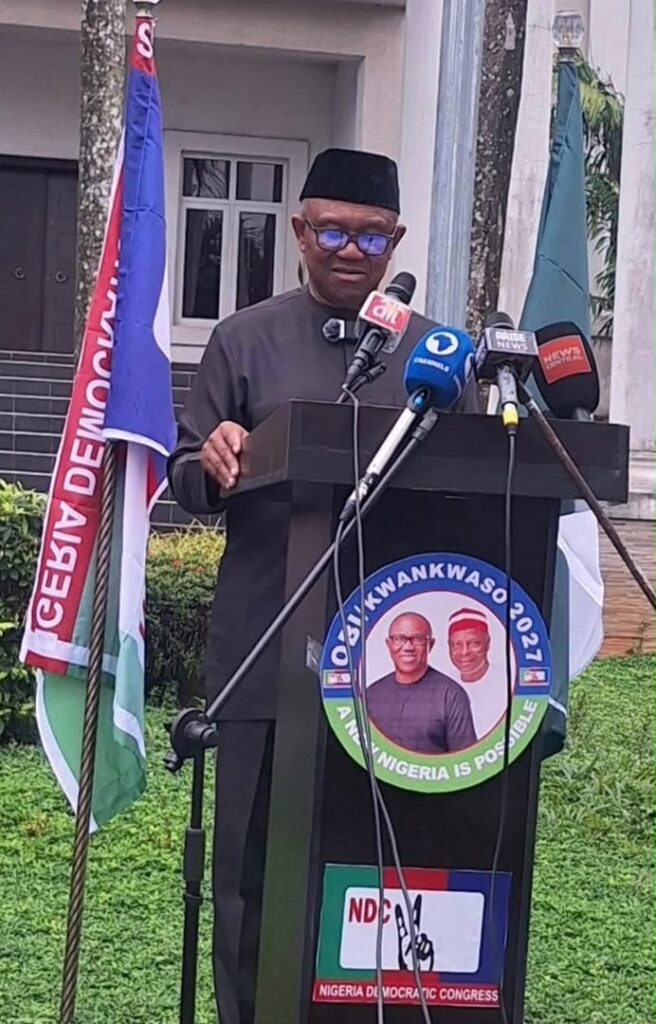
Obi made the declaration in an address to Nigerians and the media on Friday, August 21, 2026 to mark the commencement of campaigns for the 2027 Presidential and National Assembly elections.

The former Anambra State governor said the campaign period offers Nigerians a critical opportunity to scrutinise the records, ideas and programmes of all presidential contenders before deciding who deserves their mandate.
He said he was entering the contest with a simple but firm conviction: “Nigeria can work, and Nigeria must work.”
Obi painted a grim picture of the country’s economic and security challenges, citing figures attributed to the International Monetary Fund which indicate that 63 per cent, or more than 140 million Nigerians, live at or below the national poverty line.
He also noted that humanitarian agencies estimate that about 35 million Nigerians would require food assistance during the 2026 lean season, while approximately 3.6 million people remain internally displaced, largely as a result of conflict and insecurity.
According to him, millions of young Nigerians enter the labour market every year, yet too many are unable to secure productive employment, while poor infrastructure, unreliable electricity, insecurity and the high cost of doing business continue to cripple households and enterprises.
“These are more than statistics,” Obi said. “They reflect the daily realities of Nigerian families, farmers, workers, students, and businesses.”
However, Obi rejected the notion that Nigeria is incapable of overcoming its difficulties, arguing that the country possesses the human resources, natural resources, market, talent and entrepreneurial spirit required to build a prosperous nation.
He said the fundamental challenge was to transform those advantages into security, productivity and shared prosperity through competent and accountable leadership.
‘PUBLIC OFFICE IS NOT A REWARD’
Obi insisted that leadership must be judged by measurable results rather than rhetoric, stressing that public office should be treated as a responsibility to citizens rather than a personal reward.
Drawing from his experience in the private sector, his policy and business education and his tenure as Anambra governor, he said government must manage public resources responsibly, establish clear priorities and measure the outcomes of its policies.
“Public office is not a reward; it is a responsibility to the people,” he declared.
Obi pointed to education, healthcare, infrastructure, fiscal discipline and institutional capacity as areas he prioritised during his tenure as governor of Anambra State.
He acknowledged that his administration’s record was not perfect, but maintained that Nigerians could examine the record and draw their own conclusions.
The presidential candidate also highlighted the governing experience of his running mate, Senator Rabiu Musa Kwankwaso, describing their experiences as different but complementary.
According to Obi, Kwankwaso’s administration in Kano State placed significant emphasis on education, technical training, scholarships, infrastructure and human-capital development.
He argued that the experience demonstrated the importance of investing in people as the most valuable long-term resource available to any state or country.
“Our experiences are different, but our conclusion is the same: Nigeria must invest in its people and manage public resources with discipline,” he said.
OBI: ASK THE HARD QUESTIONS
Turning to the economy, Obi argued that Nigeria requires more than short-term or reactive reforms, insisting that government policies must ultimately be measured by their impact on ordinary citizens.
He challenged Nigerians to ask whether they are better off than they were four years ago, whether families can afford food, education and healthcare, and whether businesses can produce, expand and create jobs.
He also questioned whether young Nigerians can find productive employment and whether farmers can operate safely and transport their produce to markets.
For Obi, those questions should form the basis of the national conversation as political parties and candidates begin the long road to the 2027 elections.
He maintained that the election should not merely be a contest for political power, but an opportunity for Nigerians to demand a government capable of turning the country’s enormous potential into tangible improvements in the lives of its citizens.
The former governor’s message effectively places competence, accountability, economic productivity and human capital development at the centre of his 2027 campaign, while challenging voters to judge political leaders by what they have achieved rather than what they promise.
As campaigns gather momentum, Obi urged Nigerians to critically examine the records and plans of those seeking their votes, insisting that the country can no longer afford leadership that fails to deliver measurable results.
“Nigeria can work, and Nigeria must work,” he reiterated.
Facebook Comments

GIPHY App Key not set. Please check settings