

By Chukwudi Abiandu
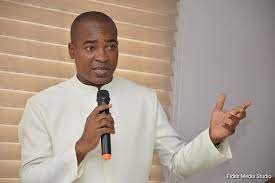
When Rev. Fr. Michael Banjo, Secretary General of the Catholic Secretariat of Nigeria (CSN), welcomed Directors of Communications from Catholic dioceses across the country to their General Assembly in Abuja, his speech was more than a ceremonial address. It was a profound reflection on the purpose of communication and a timely intervention in a society increasingly threatened by misinformation, propaganda and the abuse of information.
His message was directed at Catholic communicators, but its implications extend far beyond the Church. It is a challenge to journalists, public relations practitioners, broadcasters, editors, political communication strategists, government spokespersons, social media influencers, bloggers and, indeed, every Nigerian who publishes, shares or amplifies information.

At the centre of his address was a question that should trouble every communicator: “What kind of society do we want our communications to help build?” It is a simple question, yet one that exposes the moral crisis confronting modern communication.
Today, communication is often measured by the number of followers amassed, the number of views generated, or how quickly a story trends. Success is increasingly determined by algorithms rather than ethics, engagement rather than enlightenment, and virality rather than veracity. Rev. Fr. Banjo challenged this dangerous trend. “Our ambition,” he said, “must be far greater than increasing followers on social media or producing attractive programmes. Our communications must become instruments for the transformation of society.”
Those words deserve careful reflection. Communication is not merely the transmission of information. It is the transmission of values. Every headline, press release, editorial, television programme, radio broadcast, podcast, photograph and social media post contributes, positively or negatively, to shaping public opinion and influencing human behaviour.
When communication is anchored on truth, it builds trust. When it is driven by falsehood, it destroys confidence in institutions, weakens democracy and tears societies apart. This is precisely why the timeless wisdom contained in Exodus 23:1 remains astonishingly relevant in today’s digital age:
“You shall not spread a false report. You shall not join hands with a wicked man to be a malicious witness.”
This commandment predates the internet by thousands of years, yet it speaks directly to the ethical challenges confronting today’s communication industry.
Long before the emergence of social media, artificial intelligence, clickbait journalism and coordinated disinformation campaigns, God had already established a clear code of conduct for those who communicate.
The command is not simply “Do not lie.” It goes much deeper. It says “Do not spread a false report.” In other words, do not become a conveyor belt for lies. Do not manufacture falsehood. Do not amplify falsehood. Do not lend your voice, your pen, your camera or your platform to deception. Do not collaborate with those who manipulate truth for selfish or destructive purposes.
In today’s language, Exodus 23:1 is a divine warning against fake news, misinformation, disinformation, malicious propaganda, character assassination and every deliberate attempt to distort reality.
Unfortunately, Nigeria has become increasingly vulnerable to these dangers. The country’s digital space is saturated with fabricated stories, doctored videos, manipulated images and misleading narratives. Political actors routinely deploy falsehood as a campaign strategy. Ethnic and religious sentiments are inflamed through carefully crafted propaganda. Reputations built over decades are destroyed overnight by unverified allegations circulated at the speed of a click. Perhaps nowhere is this more evident than during election seasons.
Political communication, which ought to educate voters and deepen democratic participation, often degenerates into campaigns of misinformation, hate speech and outright falsehood. Supporters become willing distributors of unverified claims simply because such stories favour their preferred candidates.
Professional communicators sometimes sacrifice integrity on the altar of political loyalty. Public relations practitioners occasionally confuse reputation management with the defence of indefensible conduct. Journalists face relentless pressure to prioritise speed over accuracy. Yet no amount of political advantage can justify falsehood. No election victory is worth the moral cost of systematically deceiving citizens. Democracy itself depends on informed choices, and informed choices are impossible where information has been deliberately manipulated.
This is why Rev. Fr. Banjo’s insistence that communication should promote truth over falsehood, integrity over corruption, dialogue over division, hope over despair and justice over oppression is not merely a religious aspiration. It is a national necessity.
Perhaps the most penetrating observation in his address was his assertion that Nigeria suffers not merely from an information deficit but from a formation deficit. That statement captures the tragedy of our age.
Never before have Nigerians had access to so much information. Millions carry smartphones. Breaking news arrives every minute. Artificial intelligence can generate content within seconds. Everyone with an internet connection has become a potential publisher. Yet despite this explosion of information, wisdom appears increasingly scarce.
Many people know what is happening around them. Far fewer know how to distinguish truth from falsehood. Many consume information. Few critically evaluate it. Many react emotionally. Few verify responsibly. The problem, therefore, is not the absence of information. The deeper problem is the absence of moral formation.
Rev. Fr. Banjo rightly observed that children need stories that teach virtue, honesty and compassion. Young people require guidance to navigate the digital world with wisdom and integrity. Families need communication that strengthens marriage and moral values. His concern extends beyond religious instruction. It touches the very foundation upon which every stable society is built. No nation can long survive when falsehood becomes normal and truth becomes optional.
For journalists, Exodus 23:1 should serve as a daily ethical compass. The first duty of journalism is not speed. It is truth. It is verification. It is fairness. It is accuracy.
The credibility of the media is built not on breaking stories first, but on getting the facts right. The same applies to public relations practitioners. Ethical public relations is not the art of manufacturing deception. It is the discipline of communicating truthfully, responsibly and transparently on behalf of organisations and institutions.
The best communication professionals are not merely persuasive. They are trustworthy. Their greatest asset is credibility. Once credibility is lost, every subsequent message becomes suspect.
The digital revolution has made communication easier than ever before. Unfortunately, it has also made the spread of falsehood easier than at any other time in human history. One careless post can ignite violence. One fabricated report can destroy businesses. One manipulated video can inflame ethnic tensions. One malicious headline can permanently damage an innocent person’s reputation.
Words possess extraordinary power. They can heal. They can divide. They can inspire. They can destroy. This is why communication can never be morally neutral. Every communicator, whether journalist, editor, broadcaster, blogger, political consultant or social media influencer, exercises enormous influence over society. That influence must be exercised with humility, integrity and a profound sense of responsibility.
Ultimately, however, there is an accountability higher than professional codes of ethics. Editors answer to publishers. Reporters answer to editors. Government spokespersons answer to political leaders. Public relations practitioners answer to clients. But above every earthly authority stands the Almighty God, the God of truth, before whom every communicator will one day give an account.
That reality should not produce fear. It should produce integrity. It should give communicators the courage to reject propaganda, resist manipulation, verify facts before publication and refuse to become instruments of deception.
The future of Nigerian journalism and communication will not be secured merely through better technology, faster internet, artificial intelligence or more sophisticated digital platforms. It will be secured by communicators whose consciences are formed by truth, whose professionalism is anchored in integrity and whose commitment to society outweighs every temptation to manipulate public opinion.
Rev. Fr. Michael Banjo’s address is, therefore, much more than a speech to Catholic communicators. It is a national call to recover the soul of communication.
As Nigeria journeys towards another election cycle and continues to grapple with the corrosive effects of misinformation, his challenge deserves to echo in every newsroom, every communication office, every radio and television station, every government information department and every digital platform across the country.
Before asking whether a story will trend, every communicator should first ask whether it is true. Before asking whether it will generate clicks, ask whether it will build society. Before asking whether it will satisfy political interests, ask whether it serves the common good.
For nations are not destroyed only by bullets, bombs or economic hardship. They are also weakened by lies deliberately manufactured, recklessly amplified and shamelessly defended.
If Nigeria truly desires to become more peaceful, more just and more prosperous, then our communication must cease to be an instrument of manipulation and become an instrument of truth.
For the ancient command of Exodus 23:1 remains as relevant today as when it was first given: “You shall not spread a false report.” It is not merely a religious instruction. It is God’s enduring code of ethics for every communicator—and perhaps the moral foundation upon which a better Nigeria can still be built.
Facebook Comments

GIPHY App Key not set. Please check settings