

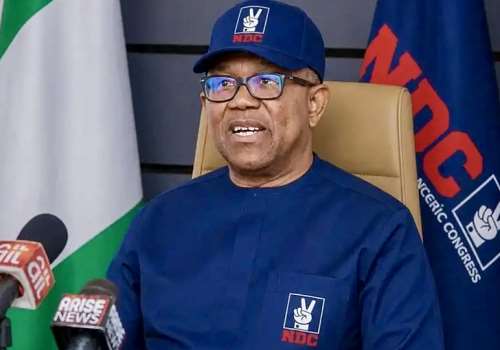
Former presidential candidate Peter Obi has issued a stark warning over Nigeria’s fiscal direction, revealing that the country’s debt servicing bill under President Bola Ahmed Tinubu is now nearly three times the combined budget for health, education, and poverty reduction.
In a detailed statement released on Monday, Obi cited President Tinubu’s recent declaration that Nigeria will spend approximately $11.6 billion on debt servicing. By contrast, the proposed 2026 budget allocates just ₦2.46 trillion for health, ₦2.56 trillion for education, and ₦865 billion for poverty alleviation, a combined total of roughly ₦5.885 trillion.
Based on current exchange rate assumptions, Obi noted, the $11.6 billion debt servicing figure converts to approximately ₦17–₦18 trillion, dwarfing the government’s entire human capital investment.

“This imbalance highlights a troubling fiscal reality in which debt obligations increasingly crowd out investment in human capital and poverty reduction,” Obi wrote.
The former Anambra State governor stressed that borrowing is not inherently harmful, pointing to countries such as Japan, the UK, the US, the UAE, Singapore, and Indonesia, where high debt levels fund education, healthcare, infrastructure, and innovation. But he warned that Nigeria’s trajectory is different.
Obi noted that a significant portion of the debt now being serviced was accumulated under the Tinubu administration, which has continued borrowing at a rapid pace. Recent external loan commitments include roughly $6 billion from First Abu Dhabi Bank and UK Export Finance via Citibank London, a further $1.25 billion under consideration from the World Bank, and an additional $516 million arranged through Deutsche Bank, bringing known external loans to about $7.8 billion. Domestic borrowing through monthly bond issuances has further swelled the debt stock.
“A huge proportion of past borrowing has been directed toward consumption, with limited visible or sustainable developmental outcomes,” Obi said. “Without measurable productivity, inclusive growth, and improved living standards, debt servicing shifts from being a temporary fiscal obligation to a long-term structural burden that constrains development and deepens economic vulnerability.”
Obi concluded that a “New Nigeria is Possible” but warned that the current fiscal path risks undermining the nation’s future. He called for borrowed funds to be tied to tangible returns in human capital and infrastructure – not simply consumed or misappropriated.
Facebook Comments

GIPHY App Key not set. Please check settings