

“Intelligence was always at the edge,” Prof Chiemeke faults Abuja-centric governance, says communities already governing themselves”
By Our Correspondent
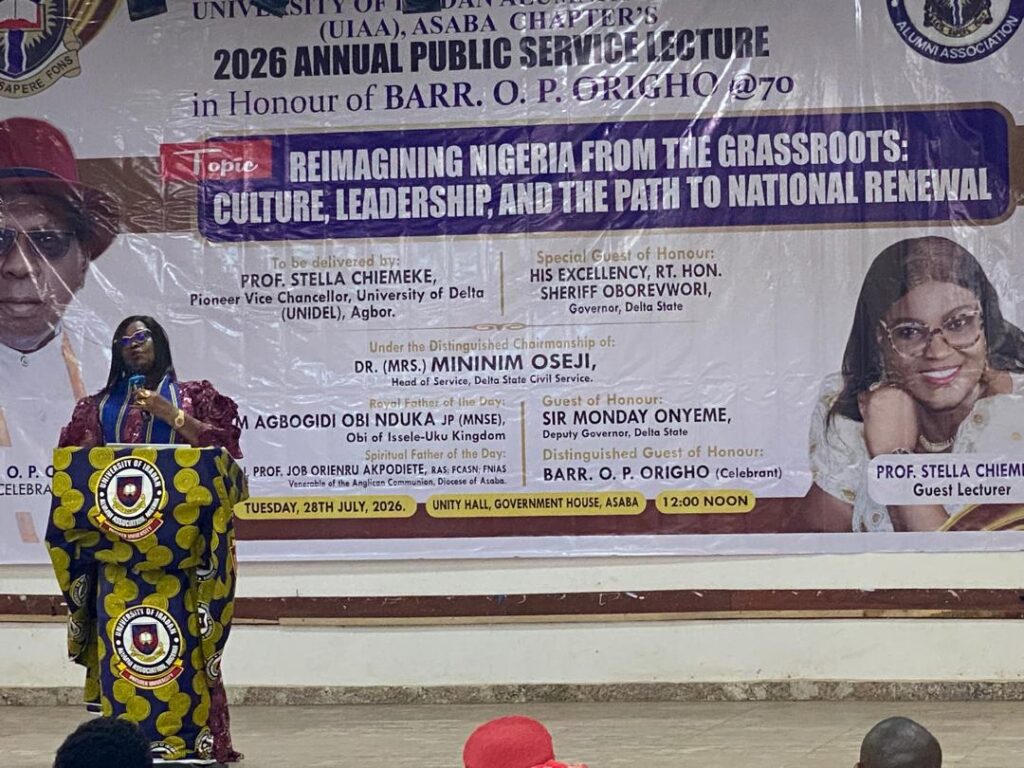
ASABA — Pioneer and Immediate Past Vice-Chancellor of the University of Delta (UNIDEL), Agbor, Prof. Stella Chinye Chiemeke, has declared that Nigeria’s long-awaited national renewal cannot be achieved through policies formulated in Abuja alone, insisting that genuine transformation must begin at the grassroots through cultural reorientation, accountable leadership and community-driven governance.

Delivering the 2026 Annual Alumni/Public Service Lecture of the University of Ibadan Alumni Association (UIAA), Asaba Chapter, on Tuesday, at the Unity Hall, Government House, Asaba, Prof. Chiemeke argued that decades of centralized governance have failed to address Nigeria’s developmental challenges because they ignored the people and communities where governance should have its greatest impact.
Speaking on the theme, “Reimagining Nigeria from the Grassroots: Culture, Leadership, and the Path to National Renewal,” the renowned computer scientist said Nigeria’s future depends on rebuilding the country “from the grassroots up” rather than relying solely on federal directives and top-down reforms.
Using her background in computer science and digital forensics, Chiemeke likened Nigeria to a malfunctioning computer system whose poor outcomes are products of faulty design rather than accidents.
“A system produces exactly what it is architected to produce,” she said. “Nigeria’s poverty, unemployment, weak institutions and governance failures are outputs of the system we have built. If we want different outcomes, we must redesign the architecture.”
She described culture as the nation’s “operating system,” arguing that no policy, however brilliant, can succeed if it conflicts with the values, traditions and behavioural patterns of the people.
According to her, Nigeria’s enormous cultural diversity, comprising over 250 ethnic groups, more than 521 languages and over 1,150 dialects, should be viewed as a strategic asset rather than a source of division.
She pointed to indigenous governance traditions such as the Igbo village square consensus model and the Yoruba Oba-in-Council system as evidence that democratic accountability existed long before colonial rule.
However, she warned that ethnicity, religious extremism, nepotism and godfatherism have distorted these cultural strengths, replacing merit with patronage and weakening public institutions.
“When communities celebrate politicians for dispensing private favours instead of demanding public accountability, culture itself begins to normalise bad governance,” she warned.
Drawing from her experience as pioneer Vice-Chancellor of UNIDEL, Chiemeke recounted how she encouraged academic staff to ignore ethnic considerations during faculty elections and vote strictly on competence.
“They chose merit over kinship,” she said, describing the experience as proof that cultural attitudes can change when leaders deliberately promote excellence above primordial sentiments.
The professor maintained that leadership should not be measured only by presidents and governors but by every public official, traditional ruler, administrator and community leader whose decisions affect people’s daily lives.
She identified the personalization of political power, absence of ideological commitment and weak citizen participation in policymaking as major reasons Nigeria’s leadership architecture continues to fail.
Chiemeke also lamented the weakening of local government administration through state interference, saying most of Nigeria’s 774 local government councils have been reduced to “fiscal appendages” incapable of driving development.
She welcomed the Supreme Court judgment granting financial autonomy to local governments, describing it as a historic opportunity to restore grassroots governance if faithfully implemented.
The former UNIDEL Vice-Chancellor further argued that Nigeria’s real governance already exists outside formal government institutions through traditional rulers, community development associations, religious organisations, market associations and youth groups that provide security, resolve disputes and deliver social services.
“Our informal institutions are already doing much of the work government should be doing. Rather than ignoring them, we should strengthen them and build formal accountability around them,” she said.
Citing successful community-driven initiatives, including the Fadama Projects and Community and Social Development Projects, Chiemeke noted that development projects owned by local communities consistently outperformed centrally imposed programmes because they enjoyed local participation and ownership.
She also referenced regional security initiatives such as Amotekun and neighbourhood watch groups as evidence that communities often respond more effectively to local security challenges than centralized structures.
On economic development, Chiemeke urged Nigeria to urgently diversify beyond oil by investing heavily in agriculture, technology, solid minerals and vocational education.
She described economic diversification as not merely an economic necessity but a moral obligation to communities that have borne the environmental consequences of decades of oil exploration.
The professor also made a passionate case for greater inclusion of women and young people in governance, insisting that no nation can achieve its full potential by excluding significant segments of its population from decision-making.
“A system that processes only half its inputs cannot produce a whole result,” she said, encouraging women to continue breaking barriers in leadership and science.
Reflecting on her stewardship at the University of Delta, Chiemeke cited the institution’s rapid growth from “bare ground” to producing over 1,600 graduates at its maiden convocation as evidence that transformative leadership rooted in community partnership can achieve remarkable results.
“If a university can be raised from bare ground in Agbor, then a nation can be rebuilt from the grassroots up. The scale differs; the principle does not,” she declared.
She challenged members of the University of Ibadan Alumni Association to leverage their intellectual heritage in bridging the gap between grassroots realities and national policymaking.
Calling on leaders at all levels to embrace humility, accountability and community participation, Chiemeke concluded that Nigeria’s renewal is already taking place in local communities across the country.
“Nigeria is already being reimagined, not first in Abuja, but in community development associations, traditional institutions, youth organisations, market cooperatives and ordinary citizens solving problems where government has failed,” she said.
“The question is whether those who hold formal power have the vision to learn from what is already working and build the nation from the grassroots upward.”
Facebook Comments

GIPHY App Key not set. Please check settings