

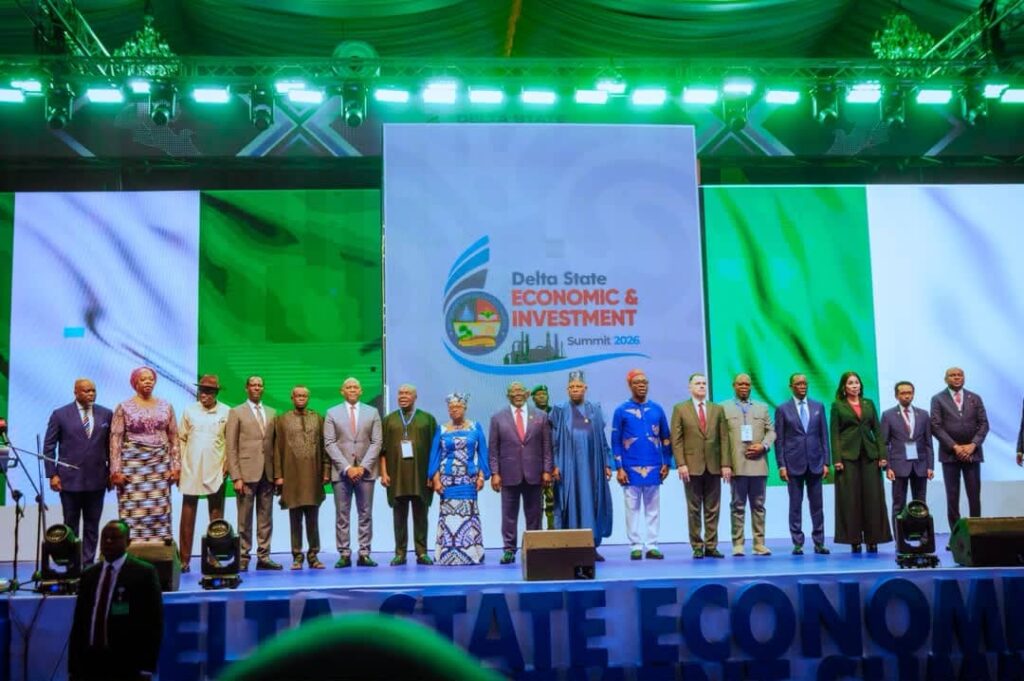
WTO Director-General says global economic shifts have created a once-in-a-generation opportunity for Delta to attract industries, build export-driven economy and rival Lagos as a major engine of Nigeria’s growth.
By Chukwudi Abiandu
ASABA — Director-General of the World Trade Organization (WTO), Dr. Ngozi Okonjo-Iweala, on Monday declared that Delta State possesses all the ingredients to emerge as Nigeria’s next great industrial hub, urging the state government to seize unprecedented global economic opportunities to transform the oil-rich state into a diversified, export-oriented economy.
Delivering the keynote address at the ongoing Delta Economic and Investment Summit in Asaba, the former Nigerian Minister of Finance said the changing dynamics of global trade, supply chain diversification and the African Continental Free Trade Area (AfCFTA) have opened a rare window of opportunity for Delta State to position itself as a preferred destination for global investment.
Speaking on the theme, “Harnessing Our Strengths and Unlocking Our Potential for Economic Development,” Okonjo-Iweala commended Governor Sheriff Oborevwori for announcing a $100 million investment de-risking fund, describing the initiative as exactly the kind of bold intervention needed to unlock private sector investments.
“The reason I came is because you take action. The fund you just announced, over 100 million dollars, to de-risk investment is exactly the kind of thing we need,” she said.
The WTO chief noted that although the global economy is facing mounting challenges arising from geopolitical tensions, unilateral tariffs, technological disruptions and climate shocks, international trade has remained remarkably resilient, creating fresh opportunities for emerging economies.
According to her, global trade in goods and services reached a record $34.65 trillion last year, while African merchandise exports grew by over 10 percent, driven largely by minerals, metals and agricultural commodities.
“The headlines may focus on global disruptions, but beneath them lies a stable core of opportunities. Those opportunities are there for Delta State, Nigeria and Africa. The question is whether we will seize them or allow them to go elsewhere,” she declared.
She explained that multinational companies are increasingly relocating production and diversifying supply chains away from overdependence on traditional manufacturing centres, creating what the WTO describes as “re-globalisation”, a trend that favours new investment destinations like Nigeria.
Okonjo-Iweala said Delta State stands in a strong position to benefit from the shift because of its abundant natural gas reserves, coastline, seaports, fertile agricultural land, solid minerals, youthful population and strong fiscal performance.
“I’m convinced that Delta has the ingredients to become Nigeria’s next great industrial home, standing alongside Lagos as an engine of the national economy,” she said.
She praised the state’s fiscal discipline, noting that Delta ranks among Nigeria’s strongest-performing states in debt sustainability, while urging the government to sustain prudent financial management.
“I was very happy when I heard that the state is not rushing to borrow. Keep that fiscal prudence because without it, you will not build the Delta State we all desire,” she advised.
The WTO Director-General, however, stressed that natural resources alone would not guarantee development, insisting that execution, prioritisation and effective governance remain the real determinants of economic transformation.
“Endowments alone do not add value. Budget allocations alone do not build roads or maintain infrastructure. Execution is what matters,” she stated.
She identified the accelerated development of Special Economic Zones as one of Delta’s most urgent priorities, describing such industrial parks as proven catalysts for manufacturing, exports and job creation.
Drawing lessons from the Lekki Free Zone in Lagos and the Glo-Djigbé Industrial Zone in the Republic of Benin, Okonjo-Iweala urged Delta to develop world-class industrial zones with uninterrupted electricity, roads, rail links, water supply, digital connectivity and efficient regulatory services.
“You need Special Economic Zones that run like clockwork, where everything works and investors don’t have to leave the zone to obtain approvals or essential services,” she said.
Beyond industrial parks, she urged the state to focus on only a few strategic value chains instead of spreading resources too thinly.
She recommended agro-processing, the blue economy, marine logistics, oil and gas value addition, digital infrastructure and artificial intelligence as sectors capable of driving sustainable growth.
On agriculture, she challenged Delta to identify two or three priority crops and develop complete value chains from production through processing, quality assurance and export marketing.
Regarding the blue economy, she lamented Nigeria’s huge annual fish import bill of nearly $900 million, arguing that Delta could become Nigeria’s fisheries and aquaculture powerhouse if investments are made in fish landing sites, cold-chain facilities and marine research.
“Imagine if Delta could replace almost one billion dollars spent every year importing fish into Nigeria,” she said.
She also called for greater investments in marine logistics, ship repairs and port services, insisting that the state’s coastline and maritime infrastructure provide a natural competitive advantage.
In the oil and gas sector, Okonjo-Iweala stressed the need for improved gas pipeline infrastructure to power industries and Special Economic Zones, saying industrialisation would remain difficult without reliable energy supply.
She equally urged the state to prioritise digital infrastructure, warning that the future of global commerce would increasingly be driven by artificial intelligence and digital trade.
“The world is going digital. Young people are already trading online, women entrepreneurs are doing business digitally, but they need reliable connectivity. Every development plan must place digital infrastructure at its centre,” she said.
The WTO chief described the convergence of global supply-chain diversification, the AfCFTA market of 1.4 billion people and growing economic reforms within Nigeria as a “golden opportunity” for ambitious states.
She maintained that national economic transformation would increasingly be driven by states willing to create jobs, attract investment and provide modern infrastructure.
Expressing confidence in Delta’s future, Okonjo-Iweala urged political and business leaders to remain focused on long-term development.
“I am a Delta State optimist. I am also a Nigeria optimist,” she declared.
Quoting celebrated Delta-born author Ben Okri, she concluded with a stirring challenge: “Don’t neglect the gold in your own backyard.”
“The true wealth of Delta State has never been just oil and gas. It is its people. Delta can and will transform itself from a resource-rich state into a diversified, inclusive and resilient economy,” she said to loud applause.
Facebook Comments

GIPHY App Key not set. Please check settings