

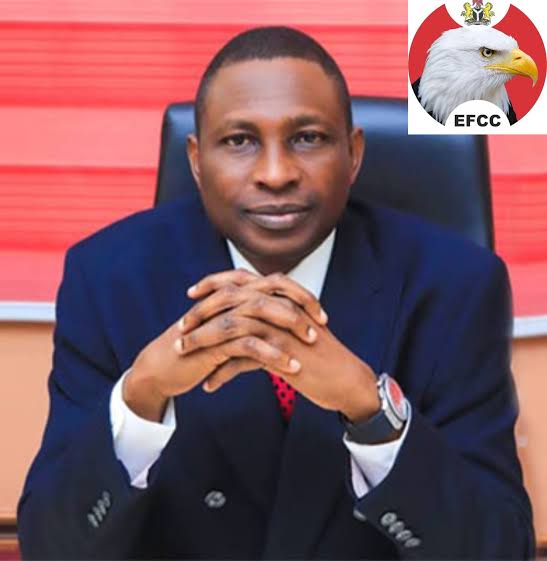
Anti-graft agency’s “unprecedented partisanship” exposes corruption of Nigeria’s democratic institutions
ABUJA — The Accord Party has unleashed a blistering attack on EFCC Chairman Ola Olukoyede, demanding his immediate resignation after President Bola Tinubu was forced to publicly rebuke the anti-corruption agency’s politically timed assault on Osun State’s government accounts.
“Having demonstrated unprecedented partisanship in Osun State politics, assaulted the sensibilities of fellow compatriots and brought the nation to ridicule and disrepute before the international community, Accord Party has lost confidence in the current leadership of the EFCC,” thundered National Chairman Maxwell Mgbudem at a Friday press conference in Abuja.
TINUBU’S HUMILIATING REBUKE EXPOSES EFCC AS POLITICAL WEAPON
The president’s directive ordering the EFCC to immediately unfreeze Osun State’s accounts, a mere eight days before the August 15 governorship election, reads as a stinging indictment of Olukoyede’s judgment and the commission’s compromised integrity.
Tinubu admitted he had not been “fully briefed” on the investigation into alleged N11 billion in misappropriated Ecology Funds, Intervention Funds, and FAAC allocations. His acknowledgment that the timing was “inappropriate” and that no federal institution should “create the impression” of election interference is a damning admission that the EFCC had become a political cudgel.
NIGERIANS RISE IN FURY: OLUKOYEDE’S CREDIBILITY IN TATTERS
The court of public opinion has already delivered its verdict. Social media platforms are ablaze with condemnation, with Nigerians across the political spectrum questioning whether the EFCC chairman is a corruption fighter or a partisan operative.
Samuel Omogor accused the commission of “selectively targeting opposition-controlled states,” while Onatoye Temitope Michael openly questioned Olukoyede’s “integrity and competence.”
The president’s own intervention has effectively acknowledged what ordinary Nigerians have long suspected: that Nigeria’s premier anti-corruption agency has become a tool for political score-settling rather than an impartial institution committed to justice.
EFCC’S EMBARRASSMENT UNDERMINES NIGERIA’S DEMOCRATIC STANDING
Mgbudem was unambiguous in his condemnation: the commission’s action has “embarrassed the Presidency, undermined public trust in the anti-corruption agency and projected Nigeria negatively” on the international stage.
The timing couldn’t be more damaging. With international observers watching, the EFCC has handed Nigeria’s critics a propaganda victory, reinforcing narratives of a democracy where federal institutions are weaponized against political opponents.
RESIGN OR BE SACKED: ACCORD PARTY DELIVERS ULTIMATUM
“No individual should be treated as untouchable,” Mgbudem declared, delivering a stark warning that Olukoyede must “toe the path of honour by resigning,” failing which President Tinubu should “dismiss him to restore public confidence in the country’s anti-corruption fight.”
The party’s demand for the immediate release of approximately 60 Accord Party members allegedly detained in Abuja, Osun, and Nasarawa states adds another layer of urgency to the crisis.
OSUN SHOWDOWN: DEMOCRACY OR OPPRESSION?
As the state hurtles toward its crucial gubernatorial election, the stakes have never been higher. Mgbudem’s warning resonates beyond partisan politics: “Electoral contest is not warfare. It should not be militarised by deploying federal apparatus to suppress, subdue and oppress political opponents and their supporters to favour a party that has been rejected by the people.”
The coming days will test whether Nigeria’s democratic institutions can withstand the assault on their credibility, or whether the EFCC’s latest scandal will become another chapter in the nation’s tragic history of institutional corruption.
Facebook Comments

GIPHY App Key not set. Please check settings