

By Comrade Cromwell Umebese
INTRODUCTION: THE PARADOX OF OIL WEALTH AND MASS POVERTY
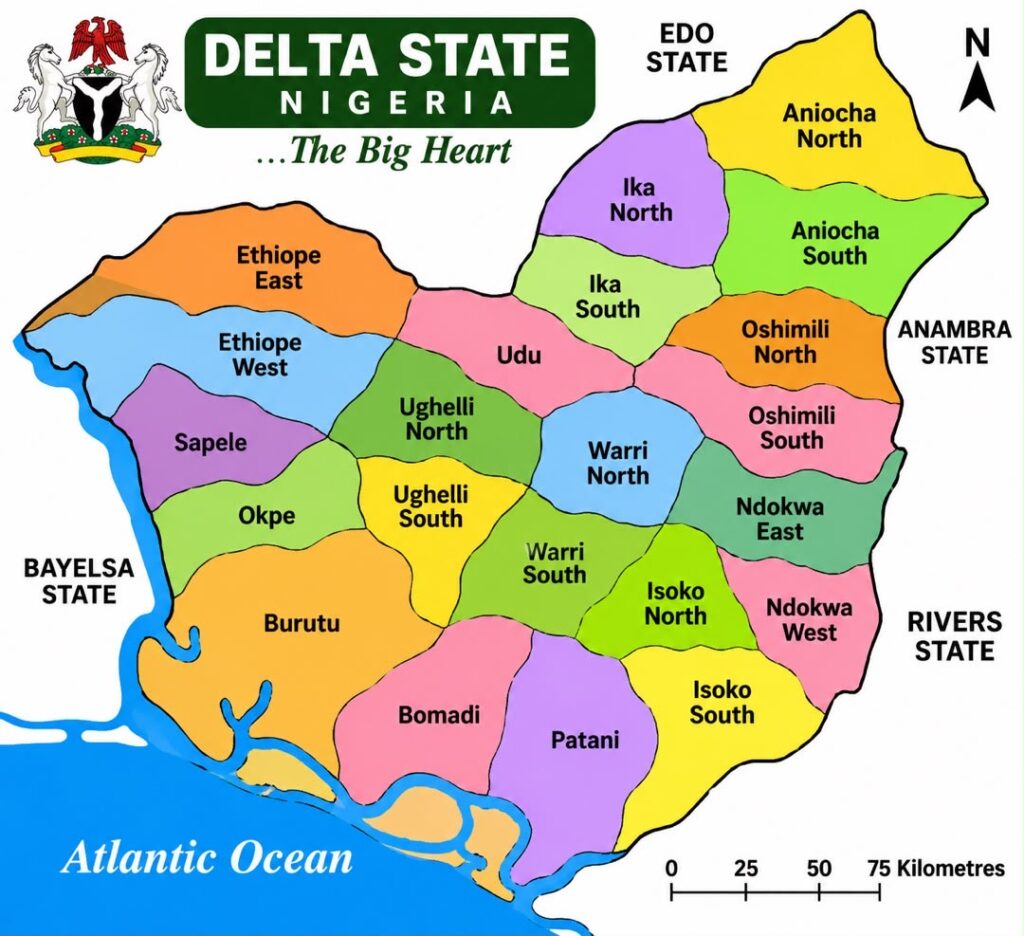
Delta South Senatorial District occupies a strategic position in the economic and geographical landscape of Delta State. With its enormous oil and gas resources, extensive waterways, fishing communities, agricultural potential, commercial centres and maritime opportunities, the district ought to be one of the most economically prosperous parts of Nigeria.

Yet, across several communities, residents continue to confront difficult questions about the relationship between the wealth extracted from their land and the quality of life they experience.
From Warri South, Warri South-West and Warri North to Ughelli South, Isoko South, Isoko North, Patani, Bomadi, Burutu and the coastal communities of the district, the central question remains: How much has the wealth of Delta South translated into better roads, reliable electricity, potable water, quality education, affordable healthcare, productive employment and a dignified life for ordinary citizens?
Since assuming office on May 29, 2023, Governor Sheriff Oborevwori has had the responsibility of demonstrating how his administration’s policies and expenditure are improving the lives of Deltans.
Although the government has announced and undertaken infrastructure projects across the state, the existence of projects alone cannot settle the question of performance. Their distribution, quality, completion, accessibility and impact on ordinary residents must also be examined.
An objective assessment of Delta South must therefore look beyond government publicity and political declarations. It must examine the condition of communities, the effectiveness of public services and the extent to which development reaches people who have historically struggled with neglect.
1. ROADS AND BRIDGES: THE DAILY NIGHTMARE OF COMMUTERS
Road infrastructure remains one of the most visible measures of government performance because it directly affects the movement of people, agricultural produce, commercial goods and essential services.
In parts of Delta South, the condition of rural and urban roads continues to raise questions about the adequacy of infrastructure maintenance and the equitable distribution of public investment.
In Warri and its adjoining communities, the condition of urban roads, drainage infrastructure and access routes deserves sustained attention. Failed road surfaces, potholes, flooding and traffic congestion impose costs on motorists, traders, transport operators and residents.
In the riverine local government areas of Burutu, Bomadi, Patani and Warri South-West, the challenges are more complex. Communities separated by rivers, creeks and difficult terrain often require a combination of durable roads, bridges, jetties and dependable water transportation infrastructure.
For residents of such communities, an inaccessible road is not merely an inconvenience. It can mean delayed medical treatment, higher transportation costs, difficulty getting children to school and reduced access to markets.
Farmers and fishermen may produce goods for which markets exist, yet poor transportation links can erode their earnings before their products reach consumers.
The state government should therefore publish a comprehensive account of road and bridge projects undertaken in Delta South since May 2023, identifying those completed, those under construction and those yet to commence.
It should also explain the maintenance arrangements for completed projects and the criteria used to determine which communities receive priority.
The fundamental issue is not the number of contracts announced but the number of communities enjoying dependable access to essential services and economic opportunities.
In Isoko North there have been complains about the deteriorating condition of the Ellu- Ovrode- Ofagbe-Orie-Irri- Okpe Isoko road. The Iyede – Aradhe road is almost impassable. Otor Iyede roads are very difficult to access just as The Owhelogbo, Ofagbe and Ellu internal roads do not show that government cares about them .
In Isoko North, we can see similar deteriorating road conditions in the Igbide- Olomoro Road , Enuto- Emede road, Uzere- Asaba-Ase Road and Oteri- Emede road
In Warri south west , Ogbe-Ijoh , Oporoza, Okerenkoko and Kurutie do not have good roads .
In Patani we have dilapidated roads at the Patani – Agoloma – Toru- Apelebiri- Angiama- Uduophori corridor. Roads serving Ekenibiri and Tamukunou have collapsed while the Ogbeinwari- Taiwari marine road corridor has become a nightmare.
In Burutu, the Ayakaromo bridge which connects to Egbo-Ide in Ughelli South LGA has experienced delays . Still on Burutu , indigenes are worried about internal roads in Burutu town , deteriorating conditions of Ojobo roads and neighboring communities. We can go on and on but the fact remains that roads in Delta South do not meet the threshold of development
1. WARRI AND ITS ENVIRONS: URBAN DEVELOPMENT UNDER SCRUTINY
Warri remains one of Delta State’s most important commercial and industrial centres. Its economic importance makes the condition of its roads, drainage systems, public facilities and business environment a matter of statewide concern.
Warri and its adjoining urban communities should be able to benefit from their commercial significance through improved transportation, effective waste management, functioning drainage systems and infrastructure capable of supporting business expansion.
However, urban development cannot be assessed solely by the announcement of major projects. The everyday experiences of residents must also count.
Are neighbourhood roads accessible during the rainy season? Are drainage systems adequate to manage runoff? Can small businesses operate without excessive costs arising from unreliable public infrastructure? Are markets, public schools and health facilities adequately supported?
These questions require answers supported by inspections, project records and testimony from residents.
The Oborevwori administration should also demonstrate how its urban renewal efforts are improving conditions in less prominent neighbourhoods, rather than concentrating public attention on selected roads and high-profile infrastructure.
Warri’s importance to Delta’s economy makes sustained infrastructure maintenance and inclusive urban planning essential.
1. RIVERINE COMMUNITIES: DEVELOPMENT MUST NOT STOP AT THE WATERFRONT
The riverine communities of Delta South face distinctive developmental challenges. Their geography demands public investment that takes waterways, flooding, erosion, transportation costs and the difficulty of delivering services to dispersed settlements into account.
In communities across Burutu, Bomadi, Patani and Warri South-West, access to roads alone may not adequately address mobility problems. Depending on the location, residents may require safe jetties, dependable boat transportation, navigable access routes, bridges and well-equipped public facilities.
A child who must travel a considerable distance by water to attend school does not enjoy the same practical access to education as a child living near a functioning school.
Similarly, a pregnant woman who must navigate creeks to reach a properly equipped hospital faces a different set of risks from someone living near a major urban medical facility.
These challenges are not new. That is precisely why the public deserves to know what the present administration is doing to address them.
The government should provide a breakdown of capital expenditure and completed projects in riverine communities, including their locations, contract sums, completion dates and actual benefits to residents.
It should also explain how it coordinates with local governments, federal agencies and other relevant institutions where responsibilities overlap.
The geographical difficulties of riverine communities should not become a permanent justification for their limited access to development. Rather, they should inform the design of more effective public policies.
1. ELECTRICITY: OIL AND GAS WEALTH WITHOUT RELIABLE POWER?
Reliable electricity is essential for industrial development, commercial activity, healthcare delivery, education and household welfare.
Delta South’s oil and gas resources create an obvious reason to examine how electricity infrastructure and the wider energy economy can contribute to local development.
However, the presence of oil and gas installations does not automatically guarantee reliable electricity for surrounding communities. Generation, transmission, distribution, local infrastructure and regulatory arrangements all influence what consumers receive.
The relevant question for the Oborevwori administration is what practical steps it has taken, within its powers and in collaboration with relevant institutions, to improve electricity access across Delta South.
Has the government identified communities with persistent supply problems? What investments have been made in electricity infrastructure? Are public institutions, including hospitals, schools and water facilities, adequately powered? What arrangements exist to support communities that remain underserved by the national grid?
The state should also explain its plans for viable electricity alternatives, including properly designed renewable-energy projects and other lawful supply arrangements where appropriate.
For small businesses, unreliable electricity increases operating costs and reduces competitiveness. For health facilities, it can affect the storage of medicines and the delivery of essential services. For students, it can undermine study time and access to digital learning.
The people of Delta South deserve measurable progress rather than general assurances.
1. POTABLE WATER: A BASIC NECESSITY, NOT A LUXURY
Access to safe drinking water is fundamental to public health and human dignity.
Yet water supply remains an important issue requiring close examination in communities across Delta South, particularly where residents depend on private boreholes, purchased water or other sources whose quality and reliability may vary.
The challenges are especially important in coastal and riverine locations, where the availability of surrounding water does not necessarily mean that safe drinking water is readily accessible.
Water quality, treatment facilities, distribution infrastructure and regular monitoring all matter.
The state government should publish an inventory of functioning public water schemes in Delta South, identifying the communities served, the number of people reached and the resources allocated to maintenance.
It should also explain the status of abandoned or non-functional schemes and the measures being taken to restore them.
A water project should not be counted as a successful intervention simply because a borehole was drilled or a treatment facility was commissioned. Its real value lies in whether residents receive safe water consistently.
If public investment in water infrastructure is to improve living conditions, government must demonstrate the results through functioning facilities and verifiable access.
1. ENVIRONMENTAL DEGRADATION AND THE BURDEN ON OIL-BEARING COMMUNITIES
Environmental protection is particularly important in a district whose economy and communities are closely connected to oil and gas production, fishing, farming and waterways.
Oil spills, gas-related environmental concerns, erosion, flooding and damage to aquatic ecosystems can have serious implications for livelihoods and public health.
Fishermen depend on healthy aquatic environments. Farmers depend on productive land. Coastal communities depend on the stability of their surroundings and the continued viability of their traditional economic activities.
Where pollution or environmental damage occurs, affected residents need transparent investigations, appropriate remediation and access to the institutions responsible for enforcement and compensation.
The state government should explain how it monitors environmental risks, works with relevant federal regulators and operators, and supports affected communities within its jurisdiction.
It should also provide information about erosion-control measures, flood-management projects and environmental restoration initiatives undertaken since 2023.
The assessment must distinguish between responsibilities belonging to the state government, federal regulatory agencies and private operators. Nevertheless, overlapping responsibilities should not leave residents without information, coordination or effective avenues for seeking redress.
The people of oil-bearing communities deserve more than the extraction of resources from their environment. They deserve environmental protection, accountability and opportunities for sustainable livelihoods.
1. EDUCATION: WHAT FUTURE AWAITS THE CHILDREN OF DELTA SOUTH?
Education is one of the most important investments a government can make in its people.
A meaningful assessment of education in Delta South must go beyond the construction or renovation of school buildings. It should examine teacher availability, classroom conditions, learning materials, technical education, examination performance and the affordability of schooling.
Particular attention should be paid to riverine communities, where transportation difficulties and the distance between settlements and schools can create additional barriers to learning.
The government should publish information on the condition of public primary and secondary schools across the district, including staffing levels, infrastructure requirements and the availability of essential learning resources.
It should also explain how its education policies are preparing young people for employment in sectors relevant to the district’s economy, including maritime services, agriculture, technology, manufacturing and skilled trades.
For tertiary education, the affordability of fees and other educational expenses deserves careful attention. Admission alone does not guarantee that a student from a low-income household can complete a programme successfully.
A government that prioritises education must demonstrate that its investments are producing accessible, functional and effective learning opportunities.
The children of Delta South should not be disadvantaged because they live in rural, coastal or riverine communities.
1. HEALTHCARE: WHEN DISTANCE AND COST BECOME BARRIERS TO TREATMENT
The quality of healthcare available to ordinary residents is another important measure of public-sector performance.
In Delta South, the assessment should examine the availability of functional primary healthcare centres, qualified medical personnel, essential medicines, maternal and child health services, emergency care and referral arrangements.
For residents of remote communities, the location of a health facility is only one part of the problem. The facility must also be adequately equipped, staffed and supplied.
Where transportation depends on waterways, emergency referrals may require special arrangements to prevent avoidable delays.
The government should publish information on the operational status of primary healthcare facilities across the district, including staffing levels, available equipment and the services provided.
It should also provide evidence of how its health insurance and other intervention programmes are improving access to affordable treatment.
Public healthcare buildings should not become monuments to expenditure while residents remain unable to obtain essential medical attention.
The appropriate measure is whether people can receive timely, affordable and effective treatment when they need it.
1. YOUTH UNEMPLOYMENT, POVERTY AND THE COST OF LIVING
Delta South’s economic potential should create opportunities for young people to acquire skills, establish businesses and participate productively in the economy.
However, the existence of natural resources and commercial activity does not, by itself, guarantee employment for residents.
The government must demonstrate how its youth empowerment programmes translate into sustainable livelihoods rather than temporary publicity.
How many young people have received vocational training? How many beneficiaries have established viable businesses? What proportion of supported enterprises remains operational? How many jobs have been created, and what independent evidence supports the reported figures?
These are reasonable questions for citizens to ask.
The cost of living also places pressure on households through food, transportation, rent, electricity, healthcare and education expenses.
Although inflation and other macroeconomic conditions are influenced by national policies and wider economic forces, state government has meaningful responsibilities in agriculture, rural infrastructure, skills development, public services and the creation of a more enabling business environment.
In fishing and farming communities, improved access to storage, processing facilities, transport links and markets could help residents retain more of the value generated by their work.
The administration should therefore provide evidence of the practical impact of its employment, enterprise and poverty-reduction programmes in Delta South.
The public deserves to know not only how much money was allocated to these programmes but also what measurable improvements the expenditure produce
Facebook Comments

GIPHY App Key not set. Please check settings