

The Oil-Rich Heartland Abandoned to Decay, Poverty and Broken Promises
By Comrade Cromwell Umebese
INTRODUCTION: THE HEART OF DELTA, THE SYMBOL OF GOVERNMENTAL FAILURE
Delta Central Senatorial District occupies a strategic position in the economic, political and cultural life of Delta State. From the commercial nerve centres of Warri, Effurun and Sapele to the agricultural communities of Ughelli, Udu, Okpe and Ethiope, the district represents a significant component of the wealth, productivity and political influence of the state.
Yet, beneath its enormous economic potential lies a troubling reality: widespread infrastructure deficits, deteriorating roads, flooding, unemployment, poverty, inadequate public services and communities struggling to secure the dividends of governance.
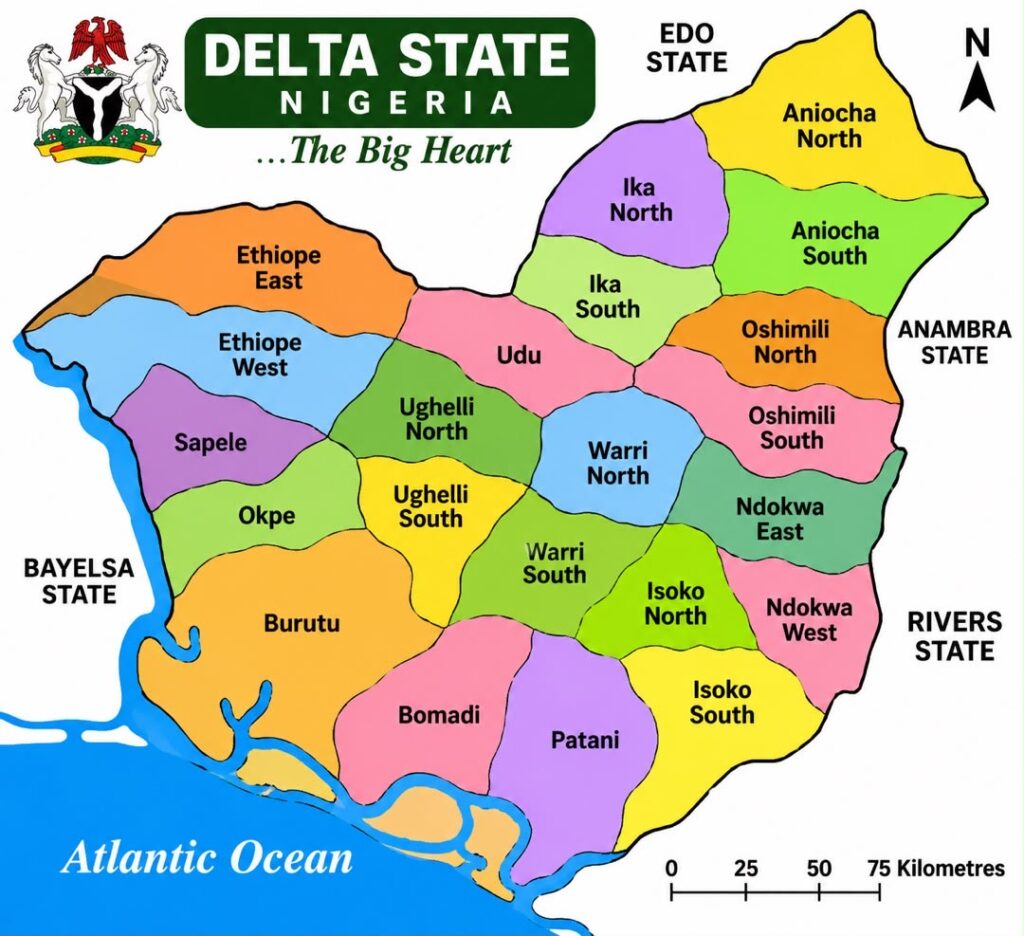
The eight local government areas of Delta Central—Ethiope East, Ethiope West, Okpe, Sapele, Uvwie, Ughelli North, Ughelli South and Udu—provide a revealing picture of the challenges confronting the Oborevwori administration.
The question is no longer whether Delta Central deserves development. The question is whether the government has demonstrated the urgency, vision and accountability required to translate the district’s enormous resources and human capital into a better standard of living for its people.
The administration’s MORE Agenda—was presented as a promise of transformation.
But for many residents, the pressing question remains: Where is the MORE in their daily lives?
1. WARRI, UVWIE AND THE CRISIS OF URBAN DECAY
Warri and Effurun are among the most important urban centres in the Niger Delta. They are commercial hubs, industrial corridors and gateways to numerous oil and gas facilities.
Yet, the urban experience of many residents is defined by traffic congestion, deteriorating roads, flooding, poor drainage and the growing cost of transportation.
Several roads within the Warri-Effurun metropolis have remained sources of frustration to motorists, traders, commuters and residents.
Refinery Road, Jakpa Road, Airport Road, sections of the Warri-Sapele Road and numerous internal roads have featured prominently in public complaints about road conditions and traffic difficulties.
The government itself has acknowledged the seriousness of some of these challenges. In October 2025, it flagged off the reconstruction of a section of the Warri-Sapele-Benin Road in Uvwie and Okpe, describing the intervention as necessary to address hardship caused by the deplorable condition of the route.
The project was subsequently listed as ongoing, with a stated completion period of 12 months.
While such interventions are welcome, they also raise an important question: why must residents endure prolonged hardship before critical infrastructure receives the attention it deserves?
On October 25, 2026, the State Executive Council approved additional rehabilitation works on Airport Road, Jakpa Road and Refinery Road, alongside the first phase of the Warri Ring Road.
These approvals demonstrate that the infrastructure challenges remain significant enough to demand further government intervention.
The people of Warri and Uvwie deserve more than repeated announcements of road rehabilitation. They deserve a comprehensive urban renewal programme that addresses drainage, flooding, road maintenance, traffic management, waste disposal and the orderly development of their communities.
A government cannot claim meaningful urban transformation when residents continue to struggle with basic mobility and environmental challenges.
1. UGHELLI NORTH: DEVELOPMENT PROMISES AND THE BURDEN OF DAILY SURVIVAL
Ughelli North is one of the most populous and commercially active local government areas in Delta State.
Ughelli town serves as a major transportation and commercial centre linking Delta Central with other parts of the state and the wider Niger Delta.
However, the district’s economic importance has not eliminated the infrastructure challenges confronting its residents.
The Otovwodo Junction area has long been associated with traffic congestion, while several adjoining roads and alternative routes have struggled under the pressure of increasing vehicular movement.
The construction of the Otovwodo flyover is a major government intervention. But infrastructure development must be assessed not merely by the size of the project or the publicity surrounding its commencement, but by its eventual impact on the lives of ordinary people.
During construction, residents and commuters have raised concerns about the condition of alternative routes and the hardship associated with traffic diversions.
In September 2026, reports described flooding along sections of the Agbarho-Ughelli corridor, with motorists experiencing severe delays and some sections becoming difficult to navigate.
The situation highlights the urgent need for effective drainage systems, proper road maintenance and coordinated traffic management.
The people of Ughelli North should not have to choose between enduring traffic gridlock and navigating deteriorated alternative roads.
Beyond the flyover, the government must demonstrate that development extends to residential communities, rural roads, healthcare facilities, schools and employment opportunities.
The question is whether the administration’s interventions are sufficiently comprehensive to improve the overall quality of life in Ughelli North.
1. UGHELLI SOUTH: COMMUNITIES STILL WAITING FOR BASIC INFRASTRUCTURE
Ughelli South is home to numerous communities whose economic activities are closely connected to agriculture, commerce and the oil and gas industry.
Yet, many communities continue to face challenges associated with road access, drainage, electricity, healthcare and other basic amenities.
The administration’s 2026 budget address listed several projects in the district, including the rehabilitation of the Ekakpamre-Ekrokpe-Usieffurun-Orhuwhorun Road and the construction of a bridge across the Orere River with access roads.
These projects are important because they address connectivity challenges affecting communities in Ughelli South and neighbouring Udu.
However, the existence of a project in a budget or official announcement is not the same as its completion or delivery of measurable benefits.
Residents deserve transparent information about project costs, contractors, timelines, progress and completion status.
Communities should not be compelled to celebrate the award of contracts when what they urgently need is functional infrastructure.
The people of Ughelli South deserve roads that remain passable during the rainy season, bridges that connect communities reliably and public facilities that serve their needs.
1. UDU: THE CONTRADICTION OF INDUSTRIAL WEALTH AND COMMUNITY HARDSHIP
Udu occupies a strategic position within the industrial and commercial landscape of Delta State.
The presence of major industrial facilities and the proximity of communities to economic infrastructure should ordinarily translate into improved living conditions, employment opportunities and sustainable development.
Yet, the experience of many residents continues to raise questions about the distribution of the benefits of economic activity.
Road deterioration, flooding, inadequate drainage and unemployment remain major concerns.
The administration’s 2026 budget address listed the rehabilitation of the Ekakpamre-Ekrokpe-Usieffurun-Orhuwhorun Road and the construction of Bezi Road in Aladja, alongside the reconstruction of Opete Road leading towards Opete Waterside.
These projects demonstrate that significant infrastructure needs remain in the area.
The people of Udu deserve a development strategy that goes beyond road construction.
Government must address the challenges of youth unemployment, vocational training, industrial development, environmental protection and access to essential services.
It is unacceptable for communities located within an economically strategic corridor to continue struggling with basic infrastructure and limited economic opportunities.
1. OKPE: THE NEGLECT OF COMMUNITIES BEYOND THE URBAN CENTRES
Okpe Local Government Area occupies an important position between the Warri-Effurun metropolis and other commercial corridors in Delta State.
While parts of the area benefit from their proximity to urban centres, several communities continue to face infrastructure and environmental challenges.
The government has listed road reconstruction and drainage interventions in parts of Okpe, including the Warri-Sapele-Benin Road project and the reconstruction of the Egbeleku Junction-Adeje corridor.
The latter was listed as an ongoing project in 2026, with a scheduled completion date in May 2027.
The question is whether these interventions form part of a comprehensive development strategy or remain isolated projects in a district with extensive infrastructure needs.
Communities in Okpe require functional rural roads, improved drainage, reliable access to healthcare and educational facilities, and a stronger commitment to economic development.
Government must also ensure that communities outside the most visible urban corridors are not left behind.
1. ETHIOPE EAST AND ETHIOPE WEST: AGRICULTURAL POTENTIAL WITHOUT ADEQUATE SUPPORT
Ethiope East and Ethiope West possess considerable agricultural and commercial potential.
Their communities contribute to food production, local trade and the wider economy of Delta State.
However, agricultural development cannot thrive where farmers face poor access roads, limited storage facilities, inadequate processing infrastructure and restricted access to affordable finance.
Rural communities require dependable roads that enable farmers to transport produce to markets without excessive losses.
They also need modern agricultural support, irrigation, extension services, access to equipment and opportunities for agro-industrial development.
The Oborevwori administration must demonstrate how its development agenda is improving the productive capacity of these communities.
Government should be judged by the number of farmers lifted out of poverty, the volume of agricultural production supported, the jobs created and the improvement in rural living conditions.
The people of Ethiope East and Ethiope West deserve a development model that recognises agriculture as an economic opportunity rather than merely a campaign talking point.
1. FLOODING AND ENVIRONMENTAL NEGLECT: A RECURRING GOVERNANCE FAILURE
Flooding has become a major concern across several parts of Delta Central.
In Warri, Effurun, Ughelli, Udu, Sapele and surrounding communities, residents have repeatedly faced the consequences of inadequate drainage, poor urban planning and insufficient environmental management.
Flooding destroys household property, disrupts businesses, damages roads and exposes residents to health risks.
It also places additional financial burdens on families already struggling with the rising cost of living.
The September 2026 flooding reported along the Agbarho-Ughelli corridor illustrates the vulnerability of critical transport infrastructure to heavy rainfall and inadequate drainage systems.
The government must move beyond emergency responses to develop a comprehensive flood-control strategy.
Such a strategy should include drainage construction and maintenance, desilting of waterways, enforcement of planning regulations, protection of natural drainage channels and sustainable urban development.
A government that cannot protect residents from predictable environmental challenges must explain why its planning and preparedness remain inadequate.
FAILURE OF INDUSTRIES IN DELTA CENTRAL
One of the most painful industrial losses in Delta Central is the grounding of Delta Steel Company, Ovwian/ Aladja. Originally designed to produce 1 million tonnes of liquid steel , The company was to supply billets to the inland rolling mills apart from producing quality iron rods from its rolling mill. Many of the company’s engineers were trained in Germany and Italy and were to be part of an Industrial Revolution story. All that went down the drain .
Also the AT& P Sapele which was once the pride of West Africa because of the quality timber and ancillary products that came out of its bowels is now a shadow of its past. The Sapele Port remains moribund just as the vast array of rubber business in Delta Central, especially in Sapele has turned this once bustling city to a glorified village .
The Delta Glass factory which used to employ thousands of Deltans is now moribund just as the Otorogu gas facility is barely functioning
1. POVERTY, UNEMPLOYMENT AND THE FAILURE TO UNLOCK DELTA CENTRAL’S ECONOMIC POTENTIAL
Perhaps the most troubling contradiction in Delta Central is the coexistence of enormous economic potential with widespread hardship.
The district is strategically positioned for industrial development, commerce, agriculture, maritime activities and services.
Yet, many young people continue to struggle to secure decent employment.
Small businesses face rising operating costs, unreliable infrastructure and limited access to affordable finance.
Families are confronted with increasing expenses for food, transportation, healthcare and education.
The central question is whether the administration has developed a credible economic strategy capable of transforming the district’s potential into opportunities for its people.
But from whatever angle we look at if we are confronted with a grim reality : Oborevwori is superintending over a failed state
Facebook Comments

GIPHY App Key not set. Please check settings