


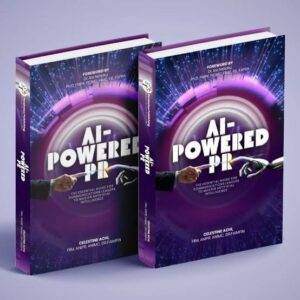
Celestine Achi (2025), AI-Powered PR: The Essential Guide for Communications Leaders to Master Artificial Intelligence. Lagos: Parakletus Publishing. ISBN: 978-978-775-090-2
By Chido Nwakanma
The global public relations community gathers in Abuja at a defining moment. From 15 November 2026, Nigeria hosts the 13th World Public Relations Forum alongside the 37th African Public Relations Association Conference, under the theme Responsible Communication: The Voice of the World. This is a timely moment to examine a book that challenges practitioners to rethink their craft in the age of artificial intelligence.

Celestine Achi’s AI-Powered PR (Parakletus Publishing, 2025) is a timely intervention. At 542 pages, it links AI’s technological possibilities to the strategic, ethical and operational demands of contemporary PR. Its central proposition is consequential: AI is no longer optional but an essential capability for professionals who intend to remain relevant and effective. Crucially, Achi insists that the future is not about replacing professionals with machines but about augmenting human capabilities—improving decision-making and creating room for strategic thinking, creativity and relationship-building. NIPR President Dr Ike Neliaku’s foreword emphasises relevance and effectiveness in the AI-accelerated VUCA economy.
Questions for the Profession
As delegates arrive in Abuja, the questions extend beyond technology. What constitutes responsible communication in the AI age? How do organisations build trust when information can be generated, manipulated and distributed at unprecedented speed? How can practitioners use data without compromising privacy, authenticity and human dignity? How should professional institutes prepare practitioners for a future where technological competence shapes relevance? And how can Africa contribute its knowledge and innovations to the global definition of responsible communication? These are questions about the identity, purpose and social responsibility of public relations.
Understanding the Book
The book is organised into four parts across 16 chapters. Part I lays the foundations—machine learning, NLP and generative AI—in plain language, making the case for urgent adoption. Part II explores applications: ethics and governance, media monitoring, content creation, media relations and personalisation. Part III addresses strategic integration: crisis communications, measurement and analytics, the TABS-D adoption framework, team building, the AI PR tech stack, case studies, the African opportunity and future trends. Part IV offers practical resources: templates, glossaries, references and advanced workflows using the Model Context Protocol and agent-to-agent collaboration.
Of particular significance is the TABS-D model, a framework for integrating AI into PR across five interdependent considerations: Technology (identifying appropriate tools), Application (where and how AI improves operations), Business Objectives (ensuring adoption advances organisational priorities), Skills (developing human competencies) and Data (establishing the information foundation for reliable applications).
The Significance for PR
One of the book’s strongest arguments concerns the changing character of PR work. Practitioners have long invested time in research, monitoring, content development, reporting and stakeholder communication. AI is changing the speed, scale and sophistication of these activities.
Achi identifies several evident transformations. First, the shift from media monitoring to media intelligence—analysing millions of conversations to detect shifts in public sentiment. Second, content development: AI assists with brainstorming, research, drafting, editing and adaptation, though judgement, accuracy, context and creativity remain the professional’s responsibility. Third, media relations: understanding journalists’ interests, matching stories to platforms and personalising outreach. Fourth, crisis management: AI-enabled listening can detect emerging reputational threats and support faster decisions, shifting crisis communication from reactive to anticipatory. Finally, measurement: AI-powered analytics can move practitioners beyond superficial exposure metrics towards sentiment, engagement, influence and outcomes. Collectively, these reinforce the case for PR to become more intelligence-driven, measurable and strategically integrated.
An African Perspective
Perhaps the book’s most distinctive contribution is its attention to the African context. Achi recognises that African practitioners face infrastructure limitations, uneven technology access, skills gaps, linguistic diversity and resource constraints—but sees these alongside considerable opportunities. Africa’s youthful population, expanding digital economy and growing tech ecosystem provide a foundation for innovation. Rather than importing solutions, African professionals can develop applications tailored to local media environments, languages, cultures and stakeholder expectations.
His discussion of indigenous innovations is instructive: VoxPR and Vox Analyst as Nigerian AI-powered solutions for media intelligence and sentiment analysis, and MetricWire (formerly DigitalPRWire) for news distribution and monitoring. These demonstrate that Africa should not remain merely a consumer of technological innovation but must help develop the tools, datasets and knowledge systems shaping the future of communication. The book also examines the National Orientation Agency’s AI-enabled initiatives, Cihan Media Group, and international examples involving Edelman, FleishmanHillard and Procter & Gamble. This mix of global and African perspectives makes it particularly relevant to Abuja—and raises a question for African practitioners: how can the continent harness AI while ensuring its cultural intelligence and indigenous knowledge are represented in the global digital ecosystem?
Ethics, Trust and the Human Imperative
Achi devotes considerable attention to the risks of AI: misinformation, algorithmic bias, privacy, transparency, accountability and the potential loss of the human touch. His discussion of explainable AI is especially relevant: professionals must understand, interrogate and take responsibility for the outputs of systems they deploy. Responsibility for an inaccurate statement, misleading campaign or insensitive communication cannot be transferred to an algorithm—particularly when public trust is under pressure from disinformation, deepfakes and declining confidence in institutions.
The author advocates clear organisational AI policies, human oversight, professional training and transparency in AI-generated material. These resonate with the Abuja theme. Responsible communication must encompass accuracy, integrity, accountability, respect for audiences and commitment to public trust. Technology can improve efficiency, but it cannot supply the moral judgement required to communicate responsibly. The more powerful our tools, the greater the responsibility of those deploying them.
A Critical Assessment
What the Book Does Well
1. It fills a genuine gap—African context without condescension. Most AI-in-PR literature assumes reliable broadband, abundant data and enterprise budgets. Achi writes from and for a context where these assumptions fail. His treatment of “leapfrogging” is grounded in concrete examples: a Nigerian government agency deploying a multilingual chatbot, a local agency using AI to map journalists across Ghana, Kenya and Nigeria. This matters for a forum where delegates from 126 countries will ask whether “responsible communication” can be universal when access is not.
2. The TABS-D framework is genuinely useful. Unlike many consultant acronyms, it holds together as a diagnostic and planning tool. Its emphasis on business objectives as the anchor—rather than technology for its own sake—aligns with WPRF’s focus on PR’s strategic value, while its inclusion of skills and data acknowledges that tools are worthless without trained people and clean, representative datasets.
3. Ethics receives serious, sustained attention. Chapter 3 tackles misinformation, deepfakes, algorithmic bias, privacy and the “black box” problem with clarity and case examples (Microsoft’s Tay, Levi’s AI models backlash). Achi’s insistence on human oversight and transparency echoes the Global Alliance’s principles almost point for point. For attendees operationalising “responsible communication,” the checklists and policy templates offer a starting point.
Where the Book Falls Short
1. The AI landscape has moved faster than the text. Published in early 2025, its tool references—ChatGPT, Jasper, Synthesia, specific monitoring platforms—already feel dated by late 2026. More significantly, agentic AI and A2A collaboration appear in an appendix rather than throughout, understating how rapidly multi-agent workflows are reshaping PR. A WPRF 2026 attendee would benefit from a text treating agent orchestration as central.
2. The African evidence base remains thin. Case studies are instructive but often rely on fictional or semi-fictional composites (the “HealthyAfrica Alliance” example). Real, documented, measurable African PR campaigns using AI at scale remain scarce. This is not entirely Achi’s fault—the field is young—but a WPRF audience expecting rigorous evidence may find the book long on frameworks and short on verified outcomes.
3. The “responsible communication” framing is implicit, not explicit. Given that WPRF 2026 will produce an Abuja Declaration updating the Mexico 1978 principles for the AI era, a book published the year before could have anticipated this conversation more directly. Achi addresses ethics thoroughly but does not situate his work within the broader global governance conversation the Global Alliance is driving. The book is practical for practitioners but less engaged with the profession’s collective standard-setting project.
4. Some chapters feel padded. Sections repeat principles (human-in-the-loop, transparency) without adding insight, and the extensive prompt examples, while useful for beginners, may feel redundant to experienced practitioners. A more ruthless edit would have strengthened the argument.
Abuja and the Future of Responsible Communication
Achi’s book provides a useful foundation for addressing core questions in PR today. It reminds practitioners that the future belongs neither to those who resist change nor to those who embrace automation without reflection, but to professionals who combine technological competence with strategic intelligence, ethical judgement and a deep understanding of human relationships. For the Nigerian Institute of Public Relations, the Global Alliance and APRA, this is an opportunity to translate the conversations in Abuja into professional standards, capacity-building and practical programmes for the next generation of communicators.
Verdict: A Valuable Addition to the Contemporary PR Library
AI-Powered PR is a timely and substantial contribution. It will serve WPRF 2026 delegates—particularly those from Africa and other emerging markets—as a practical entry point to AI adoption. Its strengths lie in its accessibility, African grounding, and insistence that ethics and human judgement anchor technological enthusiasm. Its weaknesses reflect its moment: it captures a snapshot of a field moving too quickly for any book to stay current, and its evidence base remains largely illustrative rather than proven at scale.
For a communications leader who has not yet begun their AI journey, this book offers a credible roadmap. For those deep in implementation, it may be better suited as a reference for training junior staff than as a source of new strategic insight. In a forum debating what “responsible communication” means in an AI-saturated world, Achi’s contribution reminds us that responsibility begins with practical capability—and that capability, in much of the world, is still being built.
As the world gathers in Abuja, perhaps the most important lesson is this: the future of public relations will not be determined simply by who has access to artificial intelligence, but by who has the wisdom, competence and integrity to use it responsibly. That is the challenge before the global PR community—and an opportunity Africa must seize
Facebook Comments

GIPHY App Key not set. Please check settings