

NDC governorship candidate unveils plans to revive moribund factories, develop cassava-to-ethanol industry, tackle electricity challenges
By Staff Correspondent
The Delta State governorship candidate of the Nigeria Democratic Congress (NDC), Deacon Chris Iyovwaye, has unveiled an ambitious industrialisation agenda for the state, promising to revive moribund industries, establish new manufacturing concerns and create employment opportunities for thousands of young people.
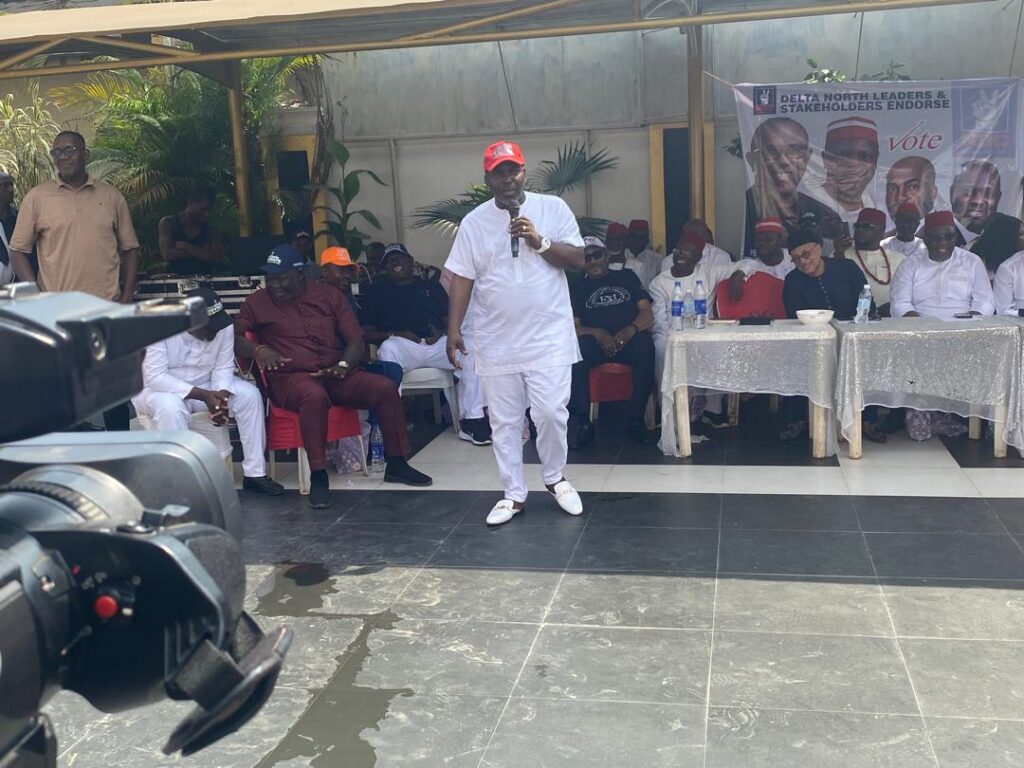
Iyovwaye, who spoke at the inauguration of the Delta North NDC Elders, Leaders and Stakeholders Council at the party’s governorship campaign office in Asaba on Monday, November 23, 2026, said his private-sector background and over 30 years of business experience had equipped him with the capacity to reposition Delta’s economy.
He argued that Delta needed a departure from the traditional career-politician approach to governance, insisting that the state’s enormous natural and economic resources had not translated into commensurate development for its people.
According to him, successive administrations since 1999 have failed to adequately harness the state’s economic potential, leaving several industries moribund, unemployment widespread and young people increasingly uncertain about their future.
The NDC candidate said his administration, if elected, would prioritise industrialisation as a sustainable solution to unemployment, poverty and insecurity.
“Taking Delta State to the next level requires a private-sector person. From 1999 until now, those who have managed the affairs of Delta State have largely been career politicians. For almost three decades, they have taken us nowhere,” he declared.
He noted that Delta, particularly the Delta North Senatorial District, was richly endowed with natural and agricultural resources but lacked the necessary leadership and economic initiatives to transform these advantages into prosperity.
Iyovwaye lamented the closure of several industries across the state, warning that the situation posed a serious threat to the future of young people, who constitute a significant proportion of Delta’s population.
He maintained that industrialisation would not only create direct employment but also stimulate economic activities across different sectors, reduce dependence on federal allocations and provide a more sustainable revenue base for the state.
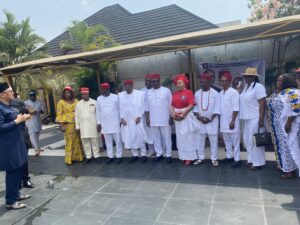
Unveiling his economic blueprint, the NDC candidate said his government would pursue the revival of existing industries through engagements with their present owners and other relevant stakeholders, while establishing new ones, particularly in the agricultural sector.
He disclosed that a number of the proposed industries would be located in Delta North to ensure that the Anioma people benefit substantially from the anticipated industrial transformation.
On agriculture, Iyovwaye identified cassava, pepper, maize, groundnuts and tomatoes as some of the commodities with enormous but largely untapped economic potential in Delta State.
He expressed particular interest in developing the cassava-to-ethanol value chain, describing it as a major opportunity for the state to participate in the expanding global biofuel market.

According to him, converting cassava into ethanol would create a market for farmers, stimulate agricultural production, attract investment and generate employment across the value chain.
He also promised to address insecurity affecting farmers, noting that agricultural industrialisation would remain difficult if rural farmers could not safely access their farms.
On electricity, which he described as indispensable to industrial growth, Iyovwaye said Delta had sufficient power-generating assets to support its industrial ambitions but had failed to adequately translate that advantage into electricity supply for its people.
He listed the Utorogu, Ughelli and Okpai power-generating facilities as strategic assets that should benefit the state, while also promising to revisit the abandoned Ogwashi-Uku Dam project.
He particularly questioned why electricity generated at the Okpai power plant could not be adequately stepped down for local consumption, despite the facility supplying power to seven states.
“Industrialisation runs on the wheels of power. Okpai supplies electricity to seven states, yet Delta itself does not adequately benefit from the facility. That is an anomaly we intend to correct,” he said.
The governorship hopeful further promised to make government more accessible to ordinary citizens, arguing that leadership should be measured by the ability to respond to people’s needs rather than the concentration of power and privileges around political officeholders.
He identified security of lives and property, accessible healthcare, employment opportunities for graduates and reliable electricity as fundamental responsibilities of government.
On healthcare, Iyovwaye expressed concern over the condition of primary healthcare facilities across the state, claiming that many of Delta’s 478 centres were in deplorable condition and required urgent rehabilitation.
He said improving healthcare delivery was also essential to restoring investor confidence, stressing that a functional health system was part of the infrastructure required to attract and sustain investments.
Drawing from his business experience, Iyovwaye cited the growth of Wellmann Group, which he said started with zero capital and developed into a major player across the African continent, as evidence of the capacity he intended to bring into public administration.
He also referenced his company’s involvement in major projects, including the Dangote Refinery, saying the experience had given him practical knowledge of industrial development, project execution and enterprise management.
The NDC candidate argued that Delta must begin preparing for a future beyond revenues from natural resources, warning that dependence on oil-related income and federal allocations was not a sustainable economic strategy.

He also questioned the economic wisdom of distributing cash to citizens without creating productive enterprises that could generate lasting employment.
Using the proposed ₦50,000 cash distribution by the present administration as an example, Iyovwaye argued that substantial public funds could instead be invested in small and medium-scale enterprises capable of creating jobs and sustaining economic activities.
He maintained that Delta’s entrepreneurial population needed an enabling environment, infrastructure, electricity and government support to thrive.
“Whether we like it or not, China’s economic success is largely driven by small and medium-scale enterprises. Even today, SMEs account for about 30 per cent of economic activity in Europe,” he said.
He expressed confidence that his party’s manifesto contained practical proposals capable of transforming Delta’s economy, insisting that the state deserved a government that would turn its abundant resources into opportunities and improved living standards.
Iyovwaye assured the Delta North NDC leaders and stakeholders that the Anioma people would have a significant place in his administration’s industrialisation plans, urging them to support the party’s vision of a more productive, economically diversified and prosperous Delta State.
Facebook Comments

GIPHY App Key not set. Please check settings