

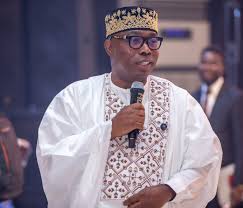
SDP presidential candidate promises overhaul, condemns alleged corruption in justice administration
By Our Correspondent
Social Democratic Party (SDP) presidential candidate, Prince Adewole Adebayo, has condemned what he described as a criminal justice system that allows wealthy individuals and corrupt public officials to escape accountability while poor Nigerians suffer disproportionately harsh punishment for minor offences.

Adebayo, who promised to overhaul the system if elected president in 2027, declared that the country could not sustain a credible justice system if those responsible for administering it were themselves perceived by the public as corrupt.
“We cannot have a criminal justice system run by criminals,” he said.
The SDP candidate spoke in an address delivered on his behalf by his campaign’s Chief Media and Communications Adviser, Comrade Mark Adebayo, at the All Activists Congress organised by the Committee for the Defence of Human Rights (CDHR) at the Airport Hotel, Ikeja, Lagos, on Thursday, October 15, 2026.
The event, themed “Understanding Human Rights Beyond Emotions and Personal Interests,” examined the relationship between human rights, the administration of justice and the responsibilities of civil society.
In his address, titled “The Counter-Intuitive Architecture of Human Rights,” Adebayo argued that Nigeria’s justice system had become a source of public distrust because of perceived inequalities in the treatment of suspects and defendants, particularly between the wealthy and the poor.
He contrasted the treatment of a poor person accused of stealing bread worth ₦1,000 with that of wealthy individuals accused of looting public funds worth trillions of naira, arguing that the latter often enjoy privileges unavailable to ordinary citizens.
“The current system helps rich criminals and corrupt public officials to escape justice while the innocent or a petty criminal who steals a one thousand Naira bread is sentenced to 10 years in jail,” he said.
“The one who steals trillions from the treasury is taken to and from court in luxury jeeps.”
Adebayo said his administration would reform the criminal justice system to guarantee equal treatment before the law, punish offenders and protect innocent citizens, particularly the poor and vulnerable.
He stressed, however, that human rights must remain universal and should not be withdrawn from anyone merely because an allegation against them provokes public anger.
According to him, the integrity of the justice system depends on its ability to uphold due process even in cases involving individuals accused of particularly heinous crimes.
“Human Rights are designed to protect the individual precisely when it is most unpopular to do so,” he said, warning against the use of human rights arguments as instruments of sentiment or personal interest.
The lawyer maintained that defending an accused person did not amount to endorsing the alleged crime, explaining that defence counsel served as a necessary check on state power and ensured that the prosecution established guilt beyond reasonable doubt.
He cited the principles of fair hearing, procedural due process and the right to a robust defence as indispensable safeguards against arbitrary convictions.
Adebayo warned that when the state was permitted to circumvent the law to convict an unpopular defendant, it could establish a precedent that might eventually be used against innocent citizens.
He argued that a society’s commitment to human rights should be measured not by how it treats popular or respected individuals, but by whether it protects the fundamental rights of those widely condemned by public opinion.
Adebayo challenges civil society over alleged government abuses
Beyond the criminal justice system, the SDP candidate challenged Nigerian human rights organisations and civil society groups to intensify their interventions against what he described as worsening governance failures and violations of citizens’ rights.
He questioned whether contemporary activism had maintained the selflessness and courage associated with earlier generations of human rights campaigners, suggesting that some activists had become compromised by personal interests.
“Has the activism of today not been infected with gratuitous prebendalism?” he asked, urging activists to reflect on whether their activities remained consistent with the principles they professed.
Adebayo said Nigeria’s governance challenges demanded sustained civil society engagement, particularly on education, electoral integrity and the protection of citizens exercising their constitutional rights.
He cited the reported 18.3 million out-of-school children in Nigeria, arguing that the scale of the crisis required more direct and sustained public action by activists and civil society organisations.
He also criticised what he described as inadequate civil society mobilisation against electoral legislation and alleged restrictions on peaceful protests.
According to him, protests against controversial electoral laws and the treatment of demonstrators should not be isolated events but part of a sustained campaign to defend constitutional freedoms.
He urged civil society groups to stand up for citizens facing alleged harassment, arrest and imprisonment for peacefully expressing dissent against the government.
Warns against alleged electoral manipulation ahead of 2027
Turning to the 2027 general election, Adebayo alleged that the administration of President Bola Tinubu was preparing a machinery to manipulate the electoral process because, in his view, it could not secure victory through a free, fair and credible contest.
He accused the government of presiding over poor governance and claimed that its electoral preparations raised concerns about the credibility of the forthcoming polls.
The allegations were part of Adebayo’s political assessment of the administration and were not independently established in the address.
He called on activists and civil society organisations to make electoral integrity a central priority, arguing that the right of Nigerians to freely choose their leaders must be protected against any attempt to subvert their votes.
The SDP candidate invoked the legacy of the late Afrobeat musician and activist, Fela Anikulapo-Kuti, whose criticism of electoral manipulation included the expression “authority stealing” to describe the usurpation of the people’s electoral mandate.
Adebayo warned that civil society would bear a heavy historical responsibility if it failed to mobilise against the recycling of what he described as retrogressive leadership.
“Our most noble responsibility as activists in the current dispensation on the African continent, particularly in Nigeria, is to lead a process that will ensure that the people have the freedom to choose who leads them,” he said.
He concluded that defending human rights required activists to place constitutional principles above political loyalties, personal benefits and emotional considerations.
Adebayo also commended the CDHR for sustaining its human rights advocacy over the years and praised its current leadership under Comrade Debo Adeniran, one of the organisation’s founding activists.
He urged the organisation and the wider civil society community to renew their commitment to defending citizens’ rights and holding those in authority accountable.
Facebook Comments

GIPHY App Key not set. Please check settings