

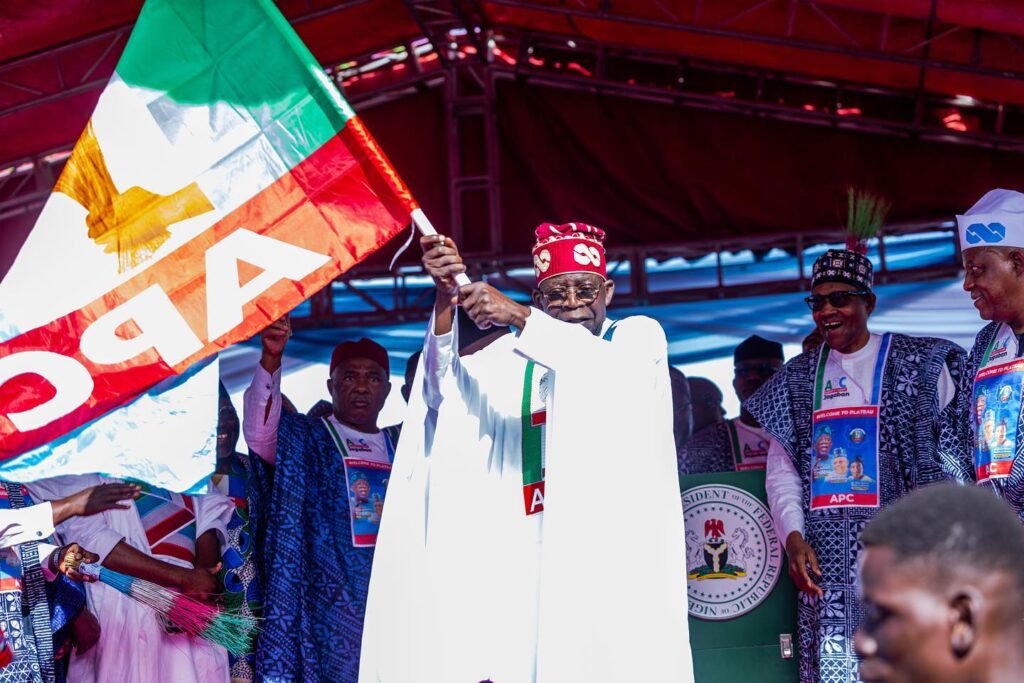
From renewed hope to renewed hunger, from economic reform to economic agony, from electoral promises to political betrayal, the ruling party has accumulated more than enough reasons to be rejected at every level of government in 2027.

If there is one political message Nigerians should send to President Bola Ahmed Tinubu and the All Progressives Congress (APC) in 2027, it is this: You have had your opportunity. You have made your choices. You have imposed your policies. You have offered your explanations. Now, let the people have their verdict.

No amount of political theatrics, rented crowds, choreographed endorsements, defections, campaign rice, cash inducements or the increasingly tiresome invocation of Renewed Hope can erase the grim reality confronting millions of Nigerians.
A government must ultimately be judged not by the magnificence of its promises but by the material conditions of the people who entrusted it with power.
And on that fundamental test of democratic accountability, Tinubu and the APC have an enormous burden to discharge.
The most damning indictment of this administration may not come from opposition politicians, whose criticisms the ruling party can conveniently dismiss as politically motivated. It comes from the market woman who can no longer replenish her stock, the civil servant whose salary disappears into food and transportation, the farmer who cannot safely reach his farm, the unemployed graduate whose certificate has become a framed reminder of frustrated expectations, and the millions of households for whom survival has become a daily exercise in economic arithmetic.
These Nigerians do not need an economic summit in London to understand the meaning of inflation. They do not need a presidential broadcast to explain the cost of living. They do not need government spokesmen to tell them that the economy is recovering when their pockets, kitchens and bank balances tell a different story.
They are living the evidence.
That is precisely why the proposition that Tinubu and the APC deserve another four years in power must be challenged with the full force of political argument, public accountability and democratic reason.
The question is not whether Tinubu and the APC have the constitutional right to seek re-election. They do. The question is whether their performance has earned them another mandate. The right to ask for another term is not the right to be returned to power.
The Emir of Katsina delivers a message the APC cannot afford to ignore
Perhaps one of the most devastating commentaries on the Tinubu administration’s political predicament came from an unexpected quarter: the palace of the Emir of Katsina, Alhaji Abdulmumini Kabir Usman.
In remarks attributed to him during a courtesy visit by APC campaign leaders, the traditional ruler reportedly confronted the visiting politicians with questions that cut through the elaborate language of party manifestoes and electoral calculations.
The central accusation was simple: those who hold power have forgotten ordinary people.
According to the account of his remarks, the Emir complained that politicians remembered the palace when they needed prayers, blessings and electoral support but disappeared after securing power. He questioned whether the palace was merely a place to visit when elections approached, only to be abandoned once the votes had been harvested.
That is not merely an indictment of political manners. It is an indictment of the transactional foundation upon which much of Nigeria’s contemporary politics has been built.
The Emir was also reported to have contrasted the ruling party’s promise of Renewed Hope with the hunger experienced by ordinary people, while drawing attention to insecurity, school closures, restrictions on farming and the political elite’s preoccupation with the struggle for tickets ahead of 2027.
His reported question about whether the politicians should be discussing campaign appointments or the security emergency confronting Katsina was particularly telling.
What business does a politician have campaigning for another term when the people he seeks to govern are asking whether they can safely travel, farm, attend school or sleep without fear?
What is the value of political continuity to a community in which insecurity prevents farmers from cultivating their land and parents fear for the safety of their children?
What does a campaign slogan mean to a family that must choose between buying food and meeting another essential expense?
These are not abstract questions. They go to the heart of the social contract between the governed and those who govern.
The reported remarks of the Emir should not automatically be treated as a scientific representation of every Nigerian’s opinion. But their force lies in the fact that they articulate grievances that extend well beyond Katsina: the perception that political leaders demand loyalty from the people while treating accountability as an inconvenience.
The palace confrontation, if accurately reported, should have embarrassed the visiting politicians into reflection. Instead of treating it as an obstacle to their campaign, they should recognise it as a warning about the fragility of public trust.
A government that must repeatedly beg for the support of people who feel abandoned should first ask itself what it has done to deserve their continued confidence.
The Emir’s reported message to the political class was even more consequential: if politicians practise selfishness, voters may respond by putting their own interests first.
That is a warning the APC should take seriously. Voters are not obliged to reward a party simply because it distributes food or money during an election campaign. They are entitled to accept assistance without surrendering their conscience, their political independence or their right to vote according to their judgment.
If the ruling party has taught Nigerians to expect transactions rather than service, it should not be surprised when voters begin to question the value of its promises.
Tinubu’s economic reforms: Who is celebrating the recovery?
Former President Olusegun Obasanjo has supplied another formidable argument against the proposition that Nigerians should automatically return Tinubu to power.
Speaking at the Financial Times Africa Summit 2026 in London, Obasanjo criticised the sharp depreciation of the naira following the economic reforms introduced by the Tinubu administration in 2023.
He argued that the currency’s movement from roughly ₦500 to the dollar to around ₦1,500 represented a massive erosion of Nigerians’ purchasing power, leaving the population substantially poorer in dollar terms.
Obasanjo rejected the suggestion that Tinubu merely needed more time to see his policies through, insisting that he did not see the economy getting better and questioning the wisdom of continuing policies he considered harmful to Nigerians.
His intervention strikes at the heart of the ruling party’s defence of its record.
The APC cannot reasonably expect Nigerians to regard the continuation of its administration as an unquestionable virtue. If the government claims that its reforms are working, it must demonstrate how those reforms are translating into better lives, stronger purchasing power, productive employment, affordable food and greater economic security.
It is not enough to point to improved macroeconomic indicators while millions of citizens remain under severe pressure.
Nor is it intellectually honest to dismiss the pain of households as the inevitable price of reform without showing that the sacrifice is producing tangible, fairly distributed benefits.
There is an important distinction between a reform that is difficult because it is necessary and a reform whose costs are imposed on the public without adequate protection, credible implementation or convincing results.
Subsidy removal and exchange-rate liberalisation may be defended as measures intended to correct longstanding economic distortions. But the legitimacy of those measures depends not merely on their theoretical appeal. It also depends on how competently they are implemented, how their costs are distributed, what safeguards protect vulnerable citizens and whether the promised benefits eventually materialise.
The government’s own figures deserve scrutiny. Finance Minister Taiwo Oyedele reportedly said that subsidy removal saved ₦15.8 trillion between June 2023 and December 2025. That is a substantial sum.
But Nigerians are entitled to ask: How much of those savings has translated into better public transport, reliable electricity, stronger primary healthcare, improved education, food security and targeted relief for struggling households?
Where the government claims savings, the public has a right to demand transparent accounting for the money and measurable evidence of the benefits.
Savings are not the same as shared prosperity. A policy announcement is not a household income. An increase in government revenue does not automatically put food on the table.
If the administration has achieved significant fiscal gains, it must explain why so many citizens continue to experience the economy as a relentless struggle for survival. That is the question Tinubu must answer before asking Nigerians to renew his mandate.
The poverty argument cannot be wished away
Obasanjo’s description of Nigeria as the poverty capital of the world was a sweeping political assessment, not a statistical ranking that should be repeated without qualification. Nevertheless, the underlying question he raised is too serious to be brushed aside.
How can a country endowed with enormous human and natural resources continue to struggle with widespread deprivation?
How can an economy be declared to be growing while millions of citizens remain unable to translate that growth into a more secure standard of living?
The figures supplied in the report present a complicated picture. Headline inflation reportedly declined to 14.63 per cent in September from 20.98 per cent a year earlier, while food inflation stood at 19.59 per cent. Real GDP growth was reported at 4.43 per cent in the second quarter.
Those numbers matter, and a responsible assessment must acknowledge them. Falling inflation means prices are rising more slowly; it does not mean prices have returned to previous levels or that households have recovered the purchasing power they lost. Economic growth, likewise, does not guarantee that its benefits reach the poorest citizens.
The question is not whether every indicator is moving in the wrong direction. It is whether the totality of the government’s performance justifies another mandate.
For a family whose income has not kept pace with the cost of food, transport, rent, medicine and school fees, the distinction between a lower inflation rate and affordable living is painfully obvious.
The APC cannot campaign on the language of economic recovery while expecting Nigerians to suspend their own judgment about the meaning of recovery.
If the economy is improving, let the improvement become visible in the lives of ordinary people. Let workers recover purchasing power. Let farmers produce without fear. Let businesses expand rather than merely struggle to remain open. Let young people find opportunities that do not depend on political connections. Until then, claims of progress must remain open to the scrutiny of those who are being asked to pay for it.
The ultimate measure of economic reform is not how elegantly it is defended by its architects, but whether it makes the lives of the people better. And that is the central question confronting Tinubu and the APC as they contemplate another electoral contest: why should Nigerians grant them another four years when the administration has yet to convince millions of citizens that the sacrifices they have endured are producing sufficient improvements in their lives?
The answer cannot be another slogan. It cannot be another promise to deliver tomorrow what citizens desperately need today. The government must demonstrate that it deserves another opportunity. Until it does, the demand for re-election remains a political request—not a democratic entitlement.
• To be continued in Part 2: The APC governors who defected, the politics of stomach infrastructure, and the dangerous assumption that Nigerians’ mandates can be transferred like private property.
Facebook Comments

GIPHY App Key not set. Please check settings