

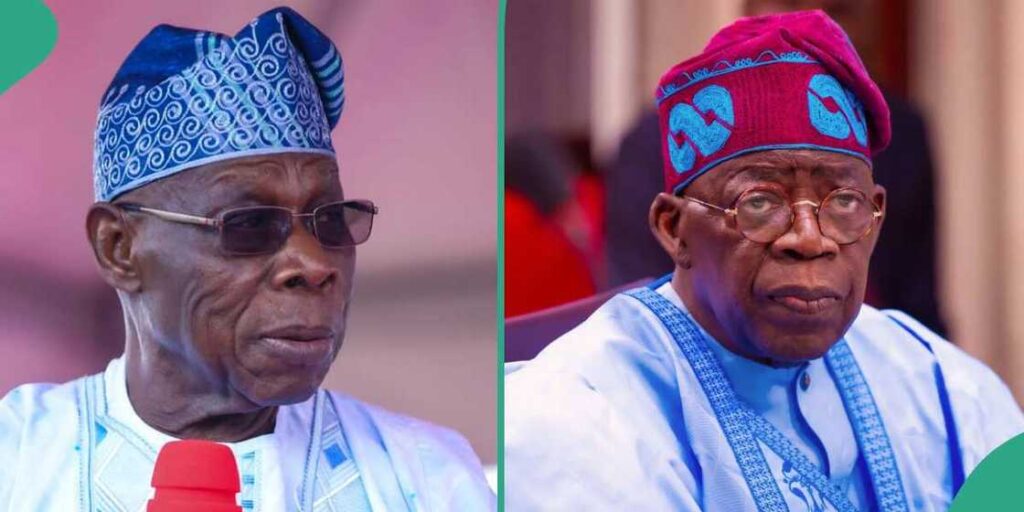
‘You impoverish your people, and you want to see impoverishment through?’ former president asks, faults naira devaluation and economic reforms
Former President Olusegun Obasanjo has challenged President Bola Tinubu to explain what more time would achieve for Nigerians under his economic reform programme, declaring that he sees no convincing evidence of an improvement in the country’s economic fortunes.
Obasanjo, who spoke on Wednesday at the Financial Times Africa Summit 2026 in London, questioned the rationale for allowing the administration more time to implement policies which, in his assessment, had impoverished Nigerians and undermined their purchasing power.
“For the economy, I don’t see anything getting better. What policies are you seeing through? You impoverish your people, and you want to see impoverishment through?” the former president asked.
His remarks amounted to a sharp challenge to the Tinubu administration’s economic direction, particularly its controversial foreign-exchange reforms and removal of petrol subsidy, which have significantly reshaped the cost of living since 2023.
Obasanjo accused Tinubu of making Nigerians poorer through the sharp devaluation of the naira, arguing that the currency’s loss of value had inflicted severe economic hardship on citizens.
“We do not live in isolation as a country. We interact with the rest of the world. And overnight, you devalue the currency by 300 per cent. The naira went from N500 to a dollar to N1,500 to a dollar. What that meant was that every Nigerian is made poor by 300 per cent,” he said.
The former president described Nigeria as “the poverty capital of the world,” arguing that the scale of poverty made it difficult to defend the economic consequences of the administration’s policies.
“You cannot say to me that that is good for Nigeria. You cannot say to me that that is good for us in any sense,” he added.
Obasanjo also dismissed the argument that the Tinubu government needed more time for its reforms to deliver results, insisting that the programmes introduced so far were not in the best interests of Nigerians.
“The programmes that he has put in place are not in the best interest of Nigerians. Nobody can deny that,” he said.
The Cost of More Time
At the heart of Obasanjo’s criticism is the question of what Nigerians stand to gain from continuing economic reforms whose immediate effects have included a sharp depreciation of the naira and increased pressure on household budgets.
The Central Bank of Nigeria unified the foreign-exchange windows on June 14, 2023, as part of efforts to reform the currency market. Before the move, the official exchange rate stood at about N460.8 to the dollar.
The naira subsequently weakened significantly, with the official rate reaching approximately N1,333.54 to the dollar on October 19, while it fell to a low of about N1,607.05 in early May 2025.
Obasanjo argued that the currency’s depreciation had eroded the economic standing of Nigerians, making imported goods and other dollar-linked expenses more expensive.
Although his claim that every Nigerian became 300 per cent poorer expresses his assessment of the impact of devaluation rather than a standard statistical measure of individual wealth, his central concern was the loss of purchasing power and the hardship experienced by citizens.
Subsidy Savings Versus Nigerians’ Hardship
The former president also criticised the handling of petrol subsidy, arguing that corruption accounted for a substantial portion of what Nigeria previously spent under the subsidy system.
He maintained that the government should prioritise tackling corruption, wastefulness and unnecessary luxury while boosting domestic production.
“A country in a very bad economic situation must curb corruption, wastefulness and unnecessary luxury and produce,” was the thrust of his argument.
The Federal Government has defended subsidy removal on the grounds of the savings it has generated. Finance Minister and Coordinating Minister of the Economy Taiwo Oyedele said on August 19 that the policy saved N15.8 trillion between June 2023 and December 2025.
However, the size of the savings has continued to fuel questions about how effectively the resources have translated into improved living conditions for ordinary Nigerians.
Economic Indicators Present Mixed Picture
Data from the National Bureau of Statistics show that headline inflation stood at 14.63 per cent in September, down from 20.98 per cent a year earlier. Food inflation, however, remained high at 19.59 per cent.
The economy also recorded real GDP growth of 4.43 per cent in the second quarter.
While these figures indicate improvements in some macroeconomic indicators, easing inflation does not necessarily mean that prices have fallen. It means prices are rising more slowly, while the high cost of food and other essentials may continue to weigh heavily on households.
It is against this backdrop that Obasanjo questioned the argument for giving Tinubu more time, demanding, in effect, to know what further continuation of the policies would accomplish for a population already struggling with economic pressures.
Facebook Comments

GIPHY App Key not set. Please check settings