

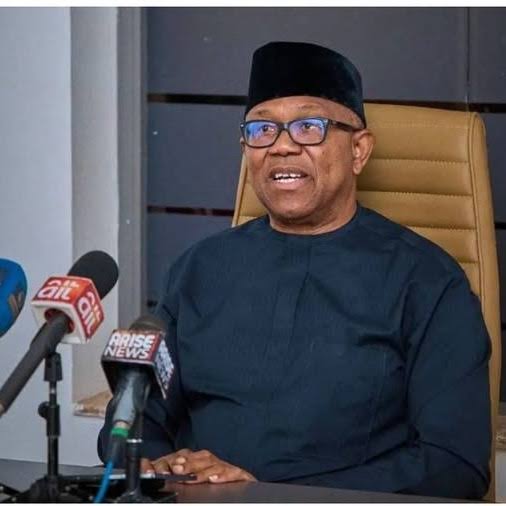
Former presidential candidate, Peter Obi, has announced his decision to quit the African Democratic Congress (ADC), citing what he described as a toxic political environment, deepening internal crises, and alleged infiltration of the party by forces linked to the Nigerian state.
In a deeply personal and reflective message posted on X (formerly Twitter) on Sunday morning, Obi painted a grim picture of a political system riddled with intimidation, suspicion, and internal sabotage, conditions he said have made it increasingly difficult for sincere leadership and nation-building to thrive.
Obi made it clear that his exit was not driven by personal grievances against key figures within the party, including its National Chairman, David Mark, or former Vice President, Atiku Abubakar , both of whom he described as respected leaders.

Instead, he pointed accusing fingers at what he termed a recurring pattern of political destabilisation allegedly orchestrated by the state, similar to the crisis that rocked the Labour Party and forced his earlier exit.
According to him, the same forces have now crept into the ADC, triggering “endless court cases, internal battles, suspicion, and division,” thereby derailing the party from focusing on pressing national issues.
“We now live in an environment that has become increasingly toxic,” Obi lamented, adding that the system meant to protect citizens has instead become a source of pressure, hostility, and discouragement.
In a tone that blended frustration with resolve, Obi also decried what he described as a culture where integrity is punished and humility misconstrued as weakness. He noted that even within political spaces where one labours sincerely, individuals are often treated as outsiders and scapegoated for systemic failures.
The former Anambra State governor revealed that his decision to step away was partly to allow peace within the party, even as he continues to face criticism and character attacks despite his efforts to engage constructively.
Obi’s statement underscores a broader indictment of Nigeria’s political climate, where he said politics is increasingly driven by “control and exclusion” rather than service and national interest.
Despite his departure from the ADC, Obi reiterated that he is not driven by personal ambition for political office but by a desire to see a Nigeria that works, where insecurity is addressed, poverty reduced, and citizens can live with dignity.
“I am not desperate to be President,” he stated, “but desperate to see a society that works for everyone.”
His exit adds another layer of uncertainty to Nigeria’s already volatile opposition landscape ahead of the 2027 general elections, raising fresh concerns about the capacity of political parties to withstand internal and external pressures.
For Obi, however, the mission remains unchanged: a firm belief that “a new Nigeria is possible,” even if the road to achieving it continues to be fraught with resistance.
Full text of Peter Obi’s X tweet
Fellow Nigerians, good morning.
I woke up this morning after my church service with a deeply reflective heart, and despite every constraint, I felt compelled to share these thoughts with you.
Many people do not truly understand the silent pains some of us carry daily—the private struggles, emotional burdens, and quiet battles we face while trying to survive and serve sincerely in difficult circumstances.
We now live in an environment that has become increasingly toxic, where the very system that should protect and create opportunities for decent living often works against the people—a society where intimidation, insecurity, endless scrutiny, and discouragement have become normal.
More painful is when some of those you associate with, believing you would find understanding and solidarity among them, become part of the pressure you face. Some who publicly identify with you privately distance themselves or join in unfair criticism.
We live in a society where humility is mistaken for weakness, respect is seen as a lack of courage, and compassion is treated as foolishness—a system where treating people equally is questioned simply because you refuse to worship status, tribe, class, or power.
Personally, I have never looked down on anyone except to uplift them. I have never used privilege, position, or resources to oppress others, intimidate the weak, or make people feel small. To me, leadership has always been about service, sacrifice, and helping others rise.
Let me state clearly: my decision to leave the ADC is not because our highly respected Chairman, Senator David Mark, treated me badly, nor because my leader and elder brother, Alhaji Atiku Abubakar, or any other respected leaders did anything personally wrong to me. I will continue to respect them.
However, the same Nigerian state and its agents that created unnecessary crises and hostility within the Labour Party that forced me to leave now appear to be finding their way into the ADC, with endless court cases, internal battles, suspicion, and division, instead of focusing on deeper national problems and playing politics built more on control and exclusion than on service and nation-building.
Even within spaces where one labours sincerely, one is sometimes treated like an outsider in one’s own home. You and your team become easy targets for every failure, frustration, or misunderstanding, as though honest contribution has become a favour being tolerated rather than appreciated.
And when you choose to leave so that those you are leaving can have peace, and you step out into the cold, you are still maligned and your character is questioned. Despite all your efforts to continue working for a better Nigeria and engaging people with sincerity and goodwill, those who do not wish you well continue to attack your character and question your intentions.
There are moments I ask God in prayer: Why is doing the right thing often misconstrued as wrongdoing in our country? Why is integrity not valued? Why is the prudent management of resources, especially when invested in critical areas like education and healthcare, wrongly labelled as stinginess? Why are humility and obedience to the rule of law often taken to be weakness rather than discipline?
Let me assure all that I am not desperate to be President, Vice President, or Senate President. I am desperate to see a society that can console a mother whose child has been kidnapped or killed while going to school or work. I am desperate to see a Nigeria where people will not live in IDP camps but in their homes. I am desperate for a country where Nigerian citizens do not go to bed hungry, not knowing where their next meal will come from.
Yet, despite everything, I remain resolute. I firmly believe that Nigeria can still become a country with competent leadership based on justice, compassion, and equal opportunity for all.
A new Nigeria is POssible. -PO
Facebook Comments

GIPHY App Key not set. Please check settings