

By Our Correspondent
The Delta State Government’s ambitious campaign to market the state as Nigeria’s next investment destination has run into srong criticism, with analysts accusing the Governor Sheriff Oborevwori administration of painting an unrealistic picture of economic progress and deploying the forthcoming Economic and Investment Summit as a pre-election public relations exercise ahead of the 2027 polls.
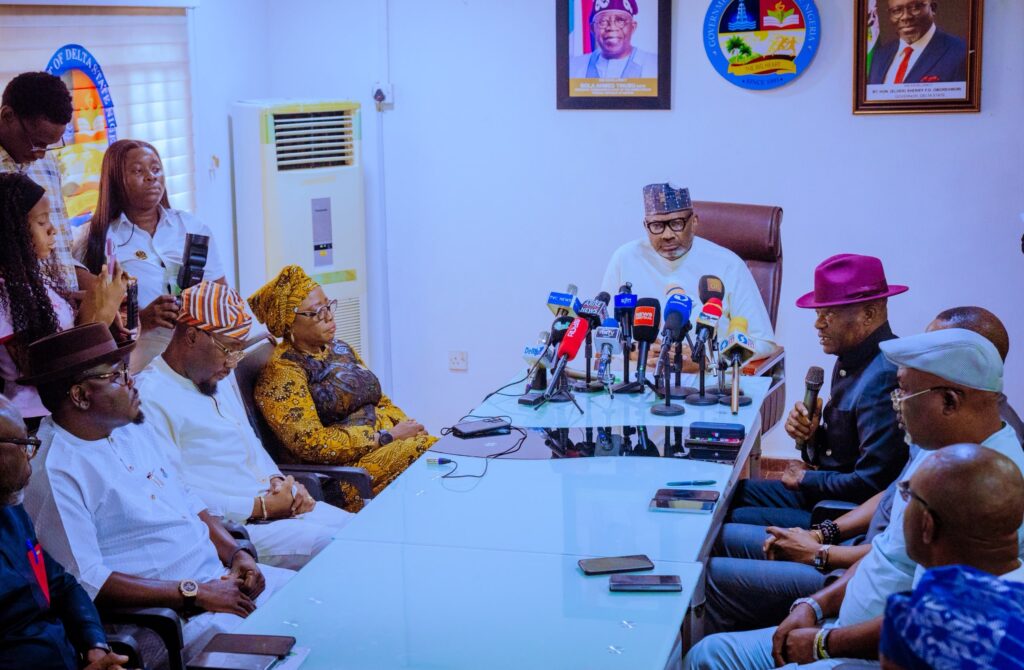
The reactions followed Wednesday’s press briefing by the Secretary to the State Government (SSG), Dr. Kingsley Emu, who declared that Delta was emerging as Nigeria’s next investment destination, citing massive infrastructure development, reliable power supply, the Delta Special Economic Zone, maritime assets, and blue economy opportunities as key attractions for investors.
However, public affairs analyst and commentator, Mr. Fidelis Chimokwu, described the presentation as an attempt to “hoodwink” Deltans ahead of the 2027 general elections.
According to him, the government’s sudden emphasis on attracting investments raises questions about its sincerity after more than three years in office.
“This statement falls short of the real intentions of government. It is simply about hoodwinking the people into believing that the administration is now trying to fulfil the promises on which it has largely underperformed or outrightly failed,” Chimokwu said.
He argued that the renewed investment drive appeared more like a political strategy aimed at securing another term in office than a genuine economic agenda.
“Why has the state government suddenly realised, on the eve of the 2027 elections, the need to aggressively position Delta as an emerging investment destination? Why now? It looks more like an attempt to cajole the people into giving them another mandate after failing woefully,” he stated.
Chimokwu also challenged several of the claims made by the SSG, particularly on infrastructure and electricity.
“The massive infrastructure being talked about is not evident to ordinary Deltans. The abundant natural resources are not being meaningfully harnessed. I also wonder where this reliable power supply and strategic maritime assets exist in practical terms. Perhaps they only exist on paper or inside the conference hall where the presentation was made,” he said.
He maintained that the administration had failed to justify the enormous revenues accrued to the state since assuming office and therefore did not deserve another opportunity to govern.
“The SSG should revisit his records and align them with the reality on the ground. This administration has received enormous resources but has failed to translate them into visible economic transformation,” he added.
In a separate reaction, another economic analyst, who requested anonymity, questioned the government’s long-term industrialisation strategy, arguing that Delta lacked the visionary leadership required to drive manufacturing-led economic growth.
Drawing from personal experience, the analyst recalled an unsuccessful attempt in 2003 to establish a bottling company in partnership with the Delta State Government, backed by more than 400 hectares of pineapple plantations at Edo Ogwashi.
He said despite the support of some government officials at the time, including then Director-General of Agriculture, Henry Onyebetor, and former Commissioner for Economic Development, Clement Ofuani, the initiative never materialised because of what he described as a disconnect between government rhetoric and practical implementation.
According to him, successive administrations have failed to develop a coherent industrial blueprint capable of establishing manufacturing clusters across Delta’s three senatorial districts.
He expressed concern that the current administration appeared to be repeating the same pattern by organising investment summits without first putting in place the structural framework required to attract serious industrial investors.
The analyst acknowledged government efforts to engage foreign investors, including trips to China, but argued that those engagements should have focused more on bringing manufacturers to Delta to take advantage of the state’s vast agricultural resources.
He lamented that huge quantities of agricultural produce continue to waste annually because of the absence of processing industries, storage facilities and value-chain infrastructure.
“What Delta needs is not another political gathering or investment talk shop. What is required is a practical blueprint for industrialisation, strategic partnerships and manufacturing development that can convert the state’s enormous agricultural potential into sustainable jobs and economic prosperity,” he said.
The analysts’ criticisms come just days before the Delta State Economic and Investment Summit, scheduled to hold in Asaba from August 3 to 5, where the Oborevwori administration hopes to attract local and foreign investors by showcasing the state’s economic potential.
While the state government insists that investments in roads, bridges, power infrastructure, the Delta Special Economic Zone and the blue economy have positioned Delta as a preferred investment destination, the critics argue that without visible industrial development and measurable economic outcomes, such projections risk being dismissed as campaign rhetoric rather than evidence of genuine economic transformation.
Facebook Comments

GIPHY App Key not set. Please check settings