

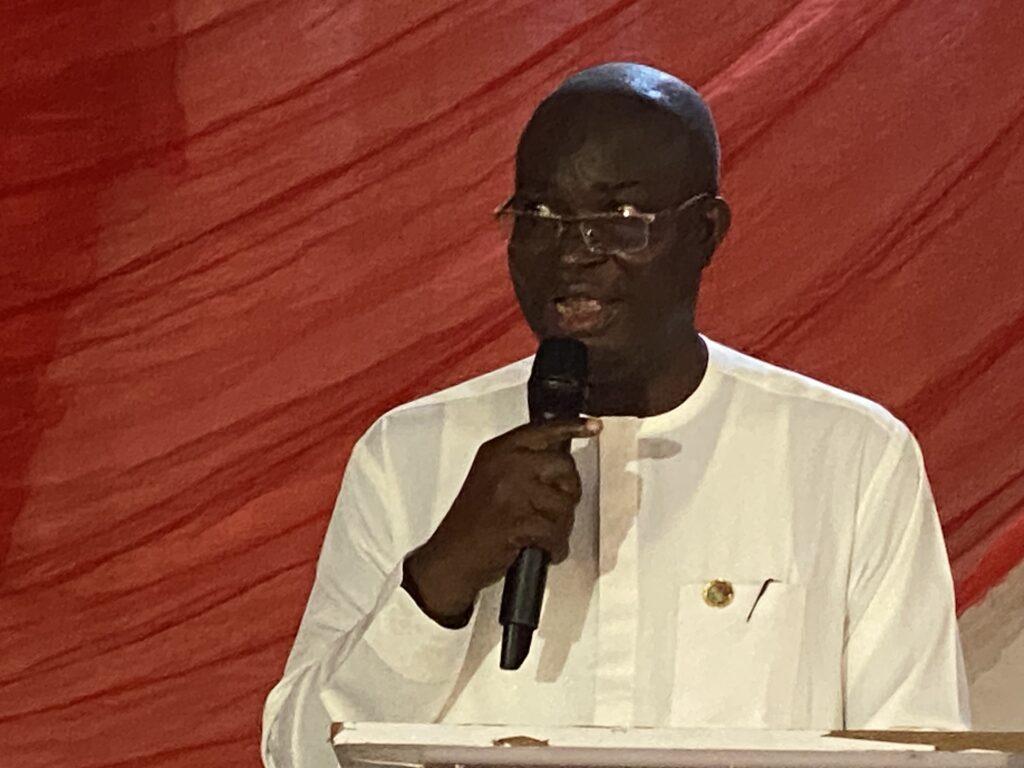
Professor Aghalino warns that nation’s communication professionals must evolve from ‘spin doctors’ to architects of national transformation
By Our Correspondent
ASABA, Delta State – June 25, 2026 – Nigeria stands at a precipice where its vast potential teeters against systemic governance failures, and only a fundamental reimagining of public relations as a strategic instrument of accountability can avert catastrophe, Professor Samuel Ovuete Aghalino declared on Thursday..

Delivering a powerful keynote address at the Nigerian Institute of Public Relations (NIPR) Delta State Chapter’s Annual General Meeting, the Dennis Osadebey University Vice Chancellor issued an urgent call to action, challenging communication professionals to abandon their traditional role as mere image managers and embrace their responsibility as nation-builders.
“Nigeria does not lack capable people; we suffer from a deficit of accountable leadership,” Professor Aghalino told the gathering of distinguished Fellows, policymakers, and corporate leaders at the Asaba event. “If leadership failure is the disease, strategic communication is part of the cure.”
The academic painted a stark picture of what he termed “the Nigerian paradox”, a nation of over 220 million people, blessed with abundant natural resources and immense intellectual capital, yet grappling with poverty amidst abundance, unemployment amidst opportunity, and distrust amidst democracy.
Citing World Bank data indicating that 40% of Nigerians live below the poverty line, Professor Aghalino warned that these statistics represent not just economic deprivation but “human tragedies and a ticking time bomb of social instability.”
“The haunting question is not whether Nigeria can develop, but whether we have the will and the communication architecture to engineer the transformation,” he declared.
Drawing on the Excellence Theory of Public Relations and Transformational Leadership Theory, the Vice Chancellor argued that modern PR must evolve into a strategic governance function that facilitates dialogue, strengthens transparency, and builds trust between citizens and their institutions.
Professor Aghalino did not spare the public relations professionals from criticism, lamenting that many practitioners have reduced public relations to “making bad policies look good” rather than serving as ethical guardians of public interest.
“Too many practitioners reduce PR to spin, making bad policies look good. That is not strategic communication; that is deception dressed in professional jargon,” he said. “We must move beyond propaganda to genuine two-way symmetrical communication that gathers and feeds public sentiment back to policymakers.”
The keynote, titled “Leadership, Accountability and Sustainable Development in Nigeria: The Strategic Intersection of Public Relations for National Repositioning,” proposed a comprehensive policy framework including a National Strategic Communication Policy, a Public Accountability Dashboard for citizen monitoring of budget implementation, and the institutionalization of Citizens’ Dialogues as standard governance practice.
Professor Aghalino cited successful repositioning examples from Rwanda, Singapore, and South Korea as evidence that deliberate leadership reforms combined with strategic national communication frameworks can transform national trajectories. He contrasted these successes with Nigeria’s persistent challenges since 1999: corruption as a governance norm, weak institutions vulnerable to political interference, and declining public trust.
Citing a 2023 Afrobarometer finding that only 23% of Nigerians trust their government, the Vice Chancellor warned: “Trust is the currency of effective leadership. Without it, citizens resist policies, and democratic legitimacy erodes.”
The academic invoked the words of literary giant Chinua Achebe, whose 1983 diagnosis remains tragically relevant: “The trouble with Nigeria is simply and squarely a failure of leadership.”
Professor Aghalino proposed that Delta State, as host to the NIPR gathering, has a unique opportunity to lead Nigeria’s communication revolution through the establishment of a Delta State Strategic Communication and Governance Forum to strengthen public trust and promote evidence-based governance.
The Vice Chancellor concluded with a vision of Nigeria “where public office is synonymous with service, where accountability is expected, where women and youth occupy leadership positions, and where PR professionals sit at decision-making tables as strategic advisers.”
“That future is achievable,” he declared, “but it depends on the choices we make today.”
Facebook Comments

GIPHY App Key not set. Please check settings