

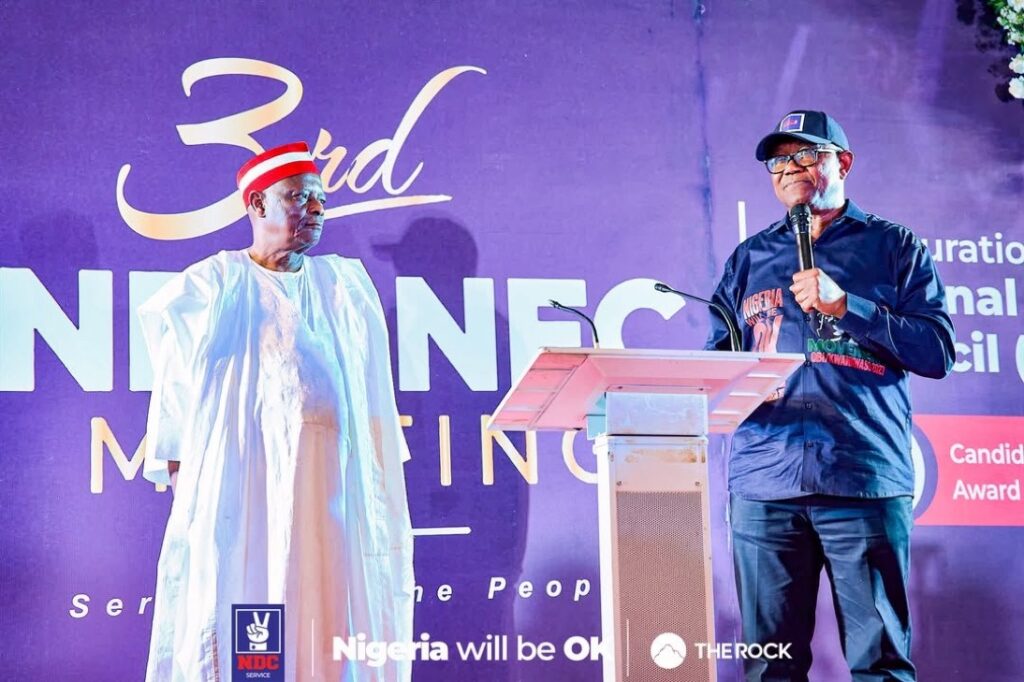
NDC presidential candidate promises electricity reforms, accountable governance and a productive economy
By Our Correspondent

Peter Obi, presidential candidate of the Nigeria Democratic Congress (NDC), has accused President Bola Tinubu’s administration of deepening poverty, insecurity and corruption, claiming that more than 140 million Nigerians are multidimensionally poor.
Obi, who made the allegations in a post on his X account on Tuesday, said Nigeria had become the world’s poverty capital despite its abundant human and natural resources.
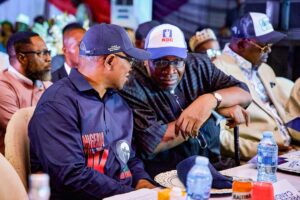
He spoke following the inauguration of the NDC Presidential Campaign Council in Abuja on Monday, October 26, where he outlined his vision for rebuilding the country and called on Nigerians to support his party’s proposed reforms.
According to Obi, more than 60 per cent of Nigeria’s population is multidimensionally poor, while unemployment, inequality and insecurity have worsened under the Tinubu administration.
He also criticised the Federal Government’s economic policies, arguing that the removal of the fuel subsidy and continued borrowing had not produced a corresponding increase in productivity.
Obi put Nigeria’s debt at more than ₦165 trillion and alleged that about 16 million Nigerians had been pushed into extreme poverty in the current year.
He further accused Tinubu of failing to take responsibility for the country’s economic difficulties, citing the President’s reported remarks at the launch of his re-election campaign in Kaduna on Saturday, where he blamed previous administrations and opposition leaders for the prevailing hardship.
The former Anambra State governor questioned the administration’s capacity to address the country’s challenges, alleging that Nigerians were experiencing worsening economic hardship, insecurity and declining public confidence in government institutions.
On electricity, Obi said Nigeria’s power sector remained a major obstacle to economic growth, arguing that unreliable electricity supply was hurting businesses, hospitals, schools and households.
He promised that an NDC-led administration would pursue electricity reforms centred on reliability, affordability, investment and accountability.
According to him, the proposed reforms would involve working with relevant federal and state institutions, regulators, operators and investors to address persistent problems in electricity generation, transmission and distribution.
Obi also raised concerns about what he described as a deterioration in public institutions and national values, alleging that corruption had become pervasive under the All Progressives Congress-led government.
He expressed concern over the credibility of public budgets, the integrity of laws and the state of institutions, insisting that no aspect of national life should be beyond accountability.
The NDC candidate said his engagements with Nigerians across different communities and social groups had reinforced the demand for a country where good governance was visible, institutionalised and reflected in the conduct of public officials.
He said his vision was to build a Nigeria founded on fairness, justice and equity, with greater emphasis on productivity, inclusion, education, security and national development.
Obi, who referred to NDC vice-presidential candidate Rabiu Musa Kwankwaso as his “very dear elder brother,” called on party members and Nigerians to join what he described as a national effort to rebuild the country.
He outlined a vision of a law-abiding society in which citizens have access to quality education, healthcare and opportunities to develop their skills, while government prioritises the security and welfare of the people.
He also pledged that his proposed administration would work towards a country where every child could attend school and acquire basic literacy, no Nigerian would be forced to live in a displaced-persons camp, and corruption would no longer undermine public institutions.
“A New Nigeria is our vision. A New Nigeria is our mission,” Obi declared.
He concluded that a new and productive Nigeria was possible, expressing confidence that the country could overcome its present challenges through accountable leadership, institutional reforms and a renewed commitment to national development.
The poverty, debt and governance figures cited by Obi formed part of his criticism of the Tinubu administration and were not independently verified in his post.
Facebook Comments

GIPHY App Key not set. Please check settings