

By Etim Etim
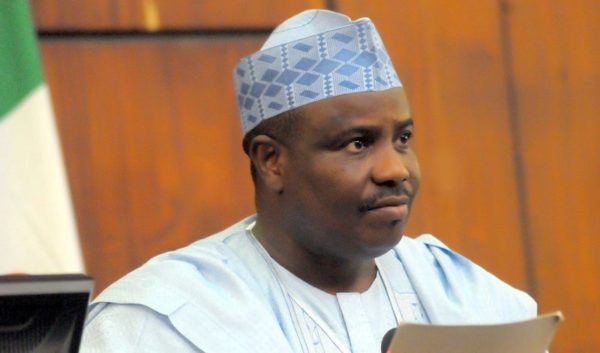
Senator Aminu Tambuwal made an audacious projection Friday night, claiming that the 2027 presidential election will be a replay of the 1979 race in which a fellow Sokoto man, Shehu Shagari, won a controversial contest. Speaking on Channels TV’s Politics Today, Tambuwal said: ‘’for me, I feel that 2027 would be more of a replay of 1979 than 2023. If you look at it, there were five candidates in 1979 – three Northerners and two Southerners – just like what would happen in 2027 when we shall have two dominant contenders from the South…I think the outcome of 2027 would be like what happened in 1979’’. The host, Seun Okinbaloye, had asked the senator if the defection of Peter Obi to NDC would turn the 2027 race to a replay of 2023. Unfortunately, Okinbaloye did not press Tambuwal enough on his theory, perhaps because he was too young in 1979 to recollect what really happened.
There may be some faint similarities between the 1979 contest and what would play out in 2027, but to assume that the outcomes would be similar is to stretch the argument too thin. The two eras and the personalities involved are too different to contemplate a recurrence of the results. In 1979, the leading presidential contenders were Shehu Shagari (NPN, Sokoto); Aminu Kano (PRP; Kano); Waziri Ibrahim (GNPP; Borno); Obafemi Awolowo (UPN, Ogun) and Nnamdi Azikiwe (NPP, Anambra). Shagari won the race convincingly in 12 of the 19 states, but the thirteenth state, Kano, was split between him and Aminu Kano, a prominent native, thus necessitating a long-drawn litigation from Awolowo, the runner-up. The debates and tensions that ensued over what constituted two-thirds of 19 had since guided Nigeria’s military leaders during state creation exercise to guarantee that the number of states in the federation had to be divisible by three. Throughout his first term, Shagari was demonized as a leader who did not win convincingly; but was rather handed the office by the judiciary.
In 2027, the leading candidates would be Bola Tinubu (APC, Lagos); Peter Obi (NDC, Anambra) and Atiku Abubarkar (ADC, Adamawa). Tambuwal is therefore projecting that in 2027, Obi and Tinubu would share the Southern votes while Atiku Abubakar, the only major Northern candidate, would garner all of the votes from his region as it happened in in 1979. The recent entry of Oyo State governor, Seyi Makinde into the presidential race is adding fervor to this conjecture. The Atiku camp believes that Makinde would either win or make a good showing in Oyo State where Tinubu scored 449,884 votes in 2023, and this would further diminish the president’s overall chances. There are those who actually believe that Makinde is actually out to play a spoiler game for Tinubu on behalf of Atiku. The theory further states that if Peter Obi maintains his lead in the South East, as its likely, and puts up a strong fight in Lagos, Tinubu’s chances could be irreversibly upended. This is why the Atiku camp argued in a press statement the other day that Obi’s defection to NDC is actually a defeatist move.
On paper and in TV analyses, these permutations may sound plausible, but in realpolitik, the differences between 1979 and 2027 are so stark that a replay is implausible. The 1979 elections were held after 13 years of military rule and 30 months civil war. Nigerians were then too eager to return to democratic rule and put the past behind them. The Obasanjo military régime was also intent on midwifing a credible transition programme. The Head of the electoral body then (Federal Electoral Commission – FEDECO), Chief Victor Ovie-Whisky, an avuncular retired judge, had a reputation for uprightness and integrity. Things were properly done to achieve a common national objective: Democracy in 1979. On the hand, the 2027 elections would be conducted by an electoral body whose chief executive has recently been mired in partisanship controversies, just as the institution itself has not enjoyed the trust and confidence of a large section of the citizens and the political class.
In 1979, the incumbent head of state was not a candidate in the election. Gen. Olusegun Obasanjo was bent on conducting a free and fair election, hand over to a civilian President and go on to retirement in his farm. Three years earlier, he had escaped assassination during a failed coup. He had played important roles in ending the fratricidal war over a decade earlier. Obasanjo was therefore tired, fatigued and wanted to be out as quickly as possible. But in 2027, the incumbent President would be participating as a politically clever president desirous of a second term. His supporters claim that the Nigerian leader is a merciless contender who takes no prisoner in any electoral battle and knows how to bring the full weight of the resources at his disposal to vanquish his opponents. The President’s supporters seem to be saying something like: ‘’can’t you see how Tinubu snatched victory from the jaws of defeat in 2023? Buhari did not want him; Emefiele did not like him; and the cabal hated him, yet Jagaban prevailed. Now, he’s the president, and he has the army, DSS, police and even INEC. Who is that opposition?’’.
Another fundamental difference between 1979 and 2027 which Tambuwal and the opposition might have overlooked lies in the economic health of the nation. Nigeria was a relatively healthy middle-income nation in 1979 with a population of about 70 million people and a relatively honest ruling class. The middle class was thriving; corruption was not very common (or not as pervasive as we have now) and vote-buying was unheard of. By 2027, the country has descended into economic and social abyss. There are more desperately poor people in Nigeria than elsewhere. People actually go to the polls on Election Day for the sole purpose of selling their votes to buy food for the week. The winner of next year’s election would therefore be the man with the deepest pocket who would be capable of dolling out at least N20, 000 to each voter. There is also the role of the institutions of the state that play certain roles in the electoral process. It was unthinkable in 1979 to accuse Supreme Court justices or judges of the lower courts of delivering questionable judgments. But these days, some politicians claim that all those political injunctions and ex parte rulings flying around are sometimes printed on letter head papers of the lucky political parties.
Elections don’t happen in a vacuum, and more often than not, the economic and political circumstances of the day are the major influencers of the outcomes. Although Nigerians have become hungrier, angrier and more economically desperate, religion, ethnicity; electoral frauds and the immutable North-South rivalry will still matter. I don’t see 1979 reincarnating next year.
Facebook Comments

GIPHY App Key not set. Please check settings