

By Etim Etim
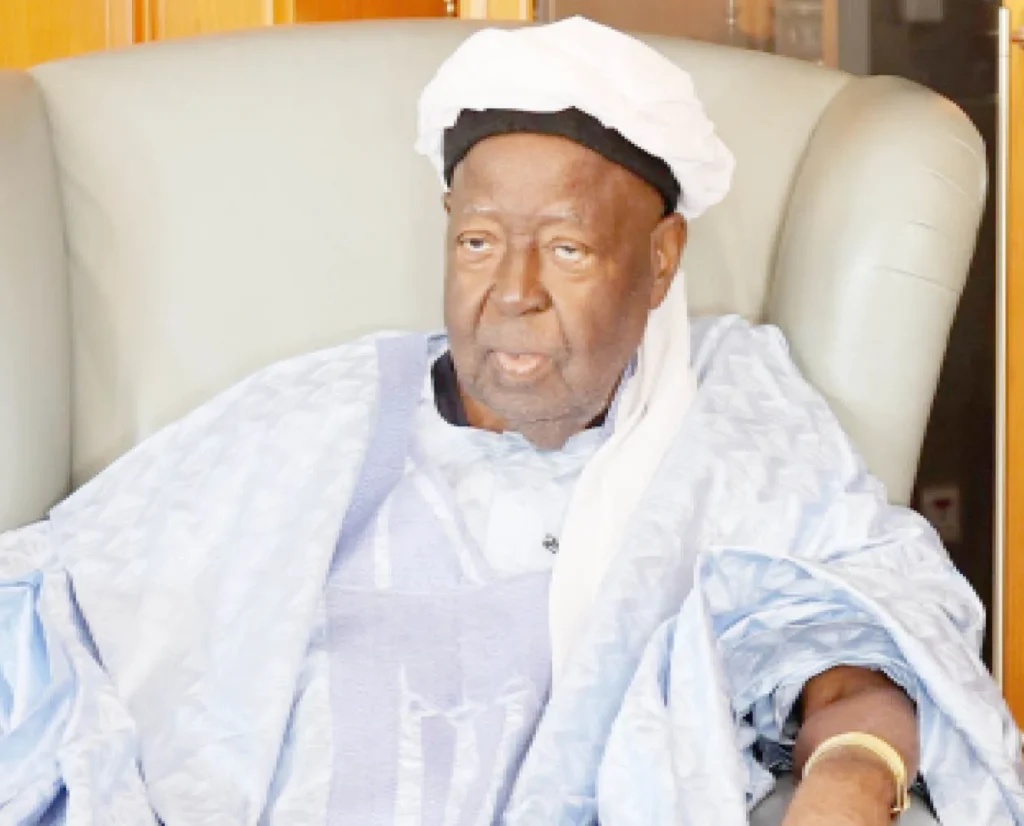
As a young finance journalist in Lagos from late1980s to late 1990s, I grew up in awe of Alhaji Abubarkar Alhaji, one of the most prominent, visible and influential bureaucrats in General Babangida’s military régime. Widely known as Triple A or Alhaji Alhaji, he was voluptuous, dark-skinned, and with bulging eyeballs, his presence was always easily noticeable. Nigerians loathed him as a symbol of the era’s excesses and permissiveness, and blamed him in good measure for the hardship that the régime’s structural adjustment programme wrought on us.
Triple A spoke forcefully, staring menacingly at his guests as he sliced the air with his big hands. He filled the TV screen with his huge frame, almost dominating the news bulletin every evening, largely because of the portfolios and assignments he held. A Sokoto prince, Triple A was one of the redoubtable members of IBB’s cabal. His father was the Chief Livestock Officer in Northern Nigeria, but he requested his son, Alhaji Alhaji, to be posted to Lagos on the young man’s return from UK with two degrees. In Lagos, Alhaji was sent to the Federal Ministry of Finance where he worked with the European Deputy Permanent Secretary, an Englishman named Mr. Cody, as his personal assistant. The Permanent Secretary was Mr. Edward Ogunbowo. Shehu Shagari (who was later elected president) was then Minister of Internal Affairs. Alhaji rose rapidly through the ranks in the federal bureaucracy. In 1977, he went to work as the accountant for FESTAC’77. By the time the festival was over, Shehu Shagari was the Minister of Finance, and requested for Alhaji to be posted back to the Finance Ministry.
Under Gen. Babangida, Alhaji’s career took a different trajectory. This is how he described the turn of events in the last interview he gave to Daily Trust in 2019: ‘’Babangida got a professor to give him a report on civil service. The professor wrote a report saying a permanent secretary could be a director-general; and because I was about becoming a permanent secretary, I went to Babangida and said I would not be a director-general because I had so many directors-general working with me. So, about one week later, he called me and said he wanted to appoint me Minister of State and Economic Adviser. I was (appointed) minister of State for Budget and Planning and Economic Adviser to President Babangida in 1988’’, working with Chief Olu Falae who was the Finance Minister. Falae was first appointed SGF on January 31, 1986 until January 8, 1990 when he was made Minister of Finance.
Triple A was already an influential member of the régime and a well-known figure nationally when I arrived Lagos in January 1988 to begin a career in finance journalism. My beat included the Finance Ministry; Central Bank, manufacturing sector as well as IBB’s Structural Adjustment Program (SAP) and its various components. It was in this role that I covered Triple A, observing his mannerisms and effervescent personality. He was one of the architects of SAP and a visible technocrat in the government, and thus a familiar face in many media events, turning pout quite foppish in his well-cut Italian suits.
It was also certain that I would meet Alhaji Alhaji on the first week day of every January when he would present a breakdown of the year’s budget to the media. IBB did not miss reading the budget speech early in New Year Day; but those of us on the finance beat were certain to have advance copy the night before to write the lead story for the January 1 edition. The breakdown that followed the budget speech was therefore a significant media event that attracted many private sector luminaries, banking executives and foreign correspondents. With the country now operating different budget versions in a year, such events have paled into insignificance. The last one I attended was in 2021 in Abuja.
In addition, Alhaji Alhaiji played prominent roles in the deregulation of the banking sector; abolition of import license; deregulation of the foreign exchange market through the introduction of SFEM (Second-tier foreign exchange market); introduction and implementation of the privatization program and many other reforms that IBB brought. The establishment of Nigeria Deposit Insurance Corporation (NDIC) in 1988; NERFUND (now defunct) in 1989 and the Budget Office of the Federation in 1987 all bore the imprint of Triple A. These agencies facilitated the reforms that swept through the finance industry under IBB. Of course, there were many other highly skilled technocrats and bureaucrats like Mrs Amal Pepple; Mrs Francesca Emmanuel; Chief Olu Falae; Dr. Idika Kalu Idika and Dr. S. P. Okongwu who also shaped the contours of the reforms in those days.
Alhaji Alhaji was also visible in the restructuring of the CBN into a more modern institution and its excision from the Finance Ministry as one of its parastatals. The hallmark of the CBN overhaul was the creation of new departments and introduction of five (later four) deputy governor positions in 1989. He also worked on the establishment of the Cairo-headquartered African Export-Import Bank (Afreximbank) in which Nigeria played a foundational role, serving as both the host in its early days and one of its largest financial contributors.
Triple A served most of his public service career in the Finance Ministry from where he left as Minister in 1991 for London where he became our High Commissioner. He is one of the few Nigerians who accepted ambassadorial position after being a minister, a posting many are wont to consider as a demotion. The others that come to mind are Chief Ojo Madueke who served in Ottawa and Chief Bola Ajibola, SAN, in London. But in the US, a former Vice President, Walter Mondale has served as an ambassador to Japan ( September 1993-December 1996) and in the UK, a former Prime Minister, David Cameron, has recently served as Foreign Affairs Minister (November 2023- July 2024). A Foreign Minister under Goodluck Jonathan once told me then that he left the cabinet because he refused an ambassadorial posting after his ministerial assignment. ‘’That was a demotion; an ambassador is just a civil servant’’, he said with a smirk.
Triple A joined the Nigerian civil service in 1964 and was assistant secretary in the Federal Ministry of Finance in the late 1960s. He served briefly in the Ministry of Industries and was posted back to finance in 1971. In 1975, he became Perm Sec in Ministry of Trade and was there till 1978. The following year, he went back to Finance as Perm Sec, on which role he was involved in managing Nigeria’s relationships with external creditors and was on the country’s negotiating team for the Lome Two Agreements. He was turbaned Sardauna Sokoto in 1990, the previous title holder, Ahmadu Bello, having been killed in the January 1966 coup. Alhaji Alhaji died on July 30, 2026 at the age of 89. His family and descendants should be proud of his service to the country.
Facebook Comments

GIPHY App Key not set. Please check settings