

By Simon Onuka
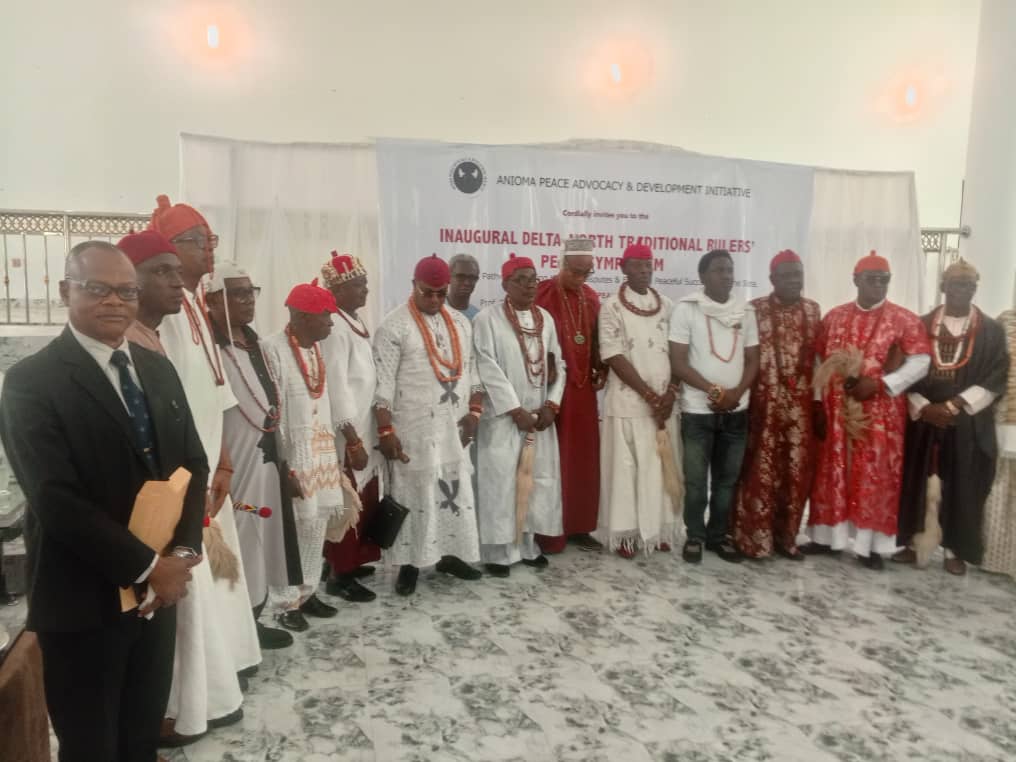
The recent publication by Olokor Michael titled “Okowa Receives Royal Fathers’ Backing for Delta North Senate Bid” has generated considerable public interest and debate across Delta North. While every citizen, including traditional rulers, is entitled to personal political preferences, the public endorsement of a partisan candidate by custodians of the traditional institution raises important questions about constitutional democracy, neutrality, and accountability.
Traditional rulers occupy a revered position in Nigerian society. They are custodians of culture, guardians of communal values, symbols of unity, and fathers to all their subjects regardless of political affiliation. Their influence derives not from electoral mandates but from the respect accorded to their offices by the people. For this reason, traditional institutions are generally expected to maintain political neutrality, serving as stabilizing forces above partisan politics.

When royal fathers openly endorse a particular candidate, especially before the commencement of a formal electoral contest, they risk creating the impression that the traditional institution has become aligned with a political interest. Such actions may alienate sections of their communities who hold differing political views and may ultimately diminish the moral authority of the traditional institution. In a constitutional democracy, traditional rulers are most effective when they serve as impartial custodians of the collective interests of their people rather than participants in partisan political contests.
The choice of the Obi of Owa Palace as the venue for the endorsement has also attracted public attention. This is particularly significant because one of the major criticisms of Senator (Dr.) Ifeanyi Okowa’s eight-year administration as Governor of Delta State was the perceived concentration of government projects and development efforts within Owa communities, to the detriment of many other parts of Delta North.
Many residents of Agbor and other communities within Ika Nation continue to question whether the developmental aspirations of their areas received adequate attention during the Okowa administration. Despite being one of the largest urban centres in Delta North, several roads within Agbor remain in poor condition, while many residents argue that the economic and infrastructural transformation expected during the tenure of a governor from the area did not materialize.
The upgrade of the College of Education, Agbor, into a university is often cited as a landmark achievement. However, many stakeholders maintain that the decision came only after sustained agitation and protests by concerned citizens at home and in the diaspora. Furthermore, concerns remain regarding the pace of development of the institution, particularly the concentration of key faculties in Owa outside Agbor and the abandonment of critical projects such as the Faculty of Medicine infrastructure.
The story is similar in several parts of Ndokwa Nation. Communities continue to grapple with inadequate educational facilities, poor healthcare infrastructure, and limited access to basic social amenities. The long-promised Technology Park, which many believed would serve as a catalyst for economic transformation and youth employment, remains unrealized years after it was announced by Sen. (Dr.) Okowa during his period as Executive Governor of Delta State. For many residents, the project has become symbolic of unfulfilled promises.
Equally concerning is the situation surrounding the Okpai Power Project. Although electricity generated from Okpai contributes significantly to the national grid, many surrounding communities continue to remain in darkness. Residents have repeatedly questioned why the necessary infrastructure to connect host communities to the benefits of the power project was not prioritized during the eight years of Dr. Okowa’s administration. The irony of communities living in darkness while electricity generated from their land powers other parts of the country remains a source of frustration.
These realities raise a fundamental question: on what performance indicators is the current endorsement being based?
Public office should be evaluated on the basis of measurable outcomes rather than political sentiment. Before offering endorsements, community leaders and traditional institutions should honestly assess the developmental impact of a candidate’s previous opportunities to serve. Dr. Okowa served as Governor of Delta State for eight years, wielding substantial executive powers over budgetary allocations, project execution, and policy implementation. If significant portions of Delta North still struggle with poor infrastructure, inadequate social services, and unfulfilled development promises, then the electorate deserves clear explanations.
The Senate is primarily a legislative institution. Senators make laws, provide oversight, and represent the interests of their constituents at the national level. If a leader was unable to fully address the developmental needs of his constituency while occupying the most powerful executive office in the state, voters are justified in asking what new value his return to the Senate would bring. This is not a question of personality; it is a question of democratic accountability.
The people of Delta North deserve a senatorial election driven by issues, performance records, and competing visions for the future, not by endorsements that may compromise the perceived neutrality of respected traditional institutions. Royal fathers should remain fathers to all, preserving their credibility as arbiters of unity, justice, and truth.
Conclusion
Beyond the question of performance, many stakeholders across Delta North are increasingly expressing concern about the apparent concentration of political power within a single family and clan structure. At a time when Delta North is blessed with numerous competent sons and daughters from diverse communities, questions are being asked about a political arrangement in which Dr. Ifeanyi Okowa seeks a return to the Senate, and his daughter is pursuing a seat in the Delta State House of Assembly. To many observers, this raises legitimate concerns about political inclusion, fairness, and the need to broaden opportunities for leadership across the district.
Democracy flourishes when leadership opportunities are open to all and when political offices are not perceived as the preserve of a few individuals, families, or communities. After eight years of occupying the most powerful political office in Delta State, many citizens believe that the priority should be mentoring a new generation of leaders and promoting equitable representation across the various communities that make up Delta North. The growing perception among many residents is that the current political project is less about advancing the collective interests of Delta North and more about preserving political influence within a narrow circle of family and clan associates. Whether this perception is accurate or not, it is one that cannot be ignored and deserves serious reflection by both political leaders and traditional institutions.
Ultimately, the people of Delta North must decide whether the future they desire is one built on broad-based participation, equal opportunity, and inclusive development, or one in which political power continues to revolve around a limited group of individuals. The 2027 election presents an opportunity for voters to make that choice. Royal fathers should remain above partisan considerations and allow the electorate to exercise that democratic choice freely, guided by performance, accountability, and the collective interest of the region. The true test of leadership is not how much power one can accumulate for oneself, one’s family, or one’s clan, but how widely one can spread opportunity, development, and hope across the entire constituency.
• Source: the town hall. com.ng
Facebook Comments

GIPHY App Key not set. Please check settings