

If it can’t be awarded as a construction contract, it isn’t development.
The Straight Talk
By Swill Mavua
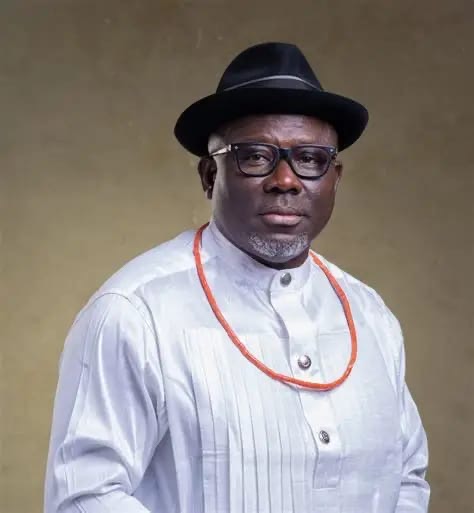
Three years into his MORE Agenda, the ledger of Delta State is heavy on cement and light on substance. Five flyover bridges. Kilometers of roads. And now, the latest: construction of police divisional headquarters in each of the 25 LGAs. Governor Sheriff Oborevwori seem to have found a new policy: _If it can’t be awarded as a construction contract, it isn’t development._
As Deltans watch bulldozers move and commissioning tapes cut, one question hangs over Asaba: _When did governing Delta become synonymous with pouring concrete, and who really benefits?_
The Contract Catalogue: Roads, Bridges, And Now Police Stations. The governor’s scorecard reads like a bill of quantities:
– Five flyover bridges — Enerhen, Otovwodo, Agbor, DSC Roundabout and PTI Junction — costing upwards of ₦200bn for just two of them, according to 2025 State Exco briefings.
– Road rehabilitation across Warri, Ughelli, Asaba corridors.
– 25 Police Divisional Headquarters, one per LGA, announced in June 2026.
On paper, infrastructure is progress. In reality, Deltans are asking: _Progress for whom?_
Delta is an agrarian state. From Isoko to Ndokwa, from Ika to Urhobo land, farming is the mainstay. Yet there is no flagship agricultural programme. No mechanization hubs. No farm-to-market rail. No modern rice mills to rival Kebbi State.
Delta has 5.1 million people under 35. Yet there is no cottage industry programme, no tech hub in Asaba, no creative education curriculum to convert youth energy into enterprise.
Delta schools are crumbling. Primary School pupils still sit on bare floors in Burutu. Science labs in Sapele have no beakers. Teachers in Patani are owed rural allowances.
So when the state announces it will build 25 police stations — facilities under the _exclusive_ purview of the Nigeria Police Force, a federal agency — the outrage is not political. It is logical.
Who Builds Police Stations For the Federal Government? Section 214 of the 1999 Constitution is clear: “There shall be a Police Force for Nigeria… no other police force shall be established.” Funding, construction, and equipping of divisional headquarters fall to the Federal Government through the Police Trust Fund and annual budgets.
States can _support_ with vehicles, fuel, or refurbishment. But _constructing_ 25 divisional HQs from scratch? That is not support. That is usurpation.
So critics are right to ask: _Why is Delta State taking on a federal responsibility when its own responsibilities lie abandoned?_
Though the cost is not yet known but ehy spend ₦1.5b–₦2.0b per station — that’s ₦37.5bn–₦50bn total — when:
– 200 primary schools across Bomadi, Udu, Aniocha South need roofs, desks, and toilets at an average of ₦50m each?
– 10 cassava processing cottage industries at ₦1bn each could employ 5,000 youths and cut post-harvest losses for farmers?
– Teacher training colleges need rehabilitation to produce the manpower for a 21st-century curriculum?
Choosing to build police stations instead of classrooms is not just misplaced priority. It is a statement of what this administration values.
The Question Every Deltana Is Asking: Why Always Construction? There is an old, uncomfortable perception in Nigerian public finance: _Construction contracts are the easiest way for politicians to move money._ They are capital intensive, variation-prone, and difficult for citizens to audit. You cannot count how many bags of cement went into a flyover. But you can count how many desks are missing in a classroom.
This is why analysts keep returning to one question: _Is the preference for brick-and-mortar projects driven by development needs or by the economics of the contract for the governor’s interest?_
We do not have EFCC reports on Delta contracts. We do not have audit queries. But we have a pattern:
– No agricultural plan, yet agriculture employs 60% of Deltans.
– No industrial plan, yet unemployment is 31% and youth are migrating.
– No human capital plan, yet WAEC performance in Delta fell to 54% in 2025.
What we have instead is a pipeline of awards: bridges, roads, now police stations. All concrete. All high-value. All federal-adjacent. When governance becomes procurement, citizens are forced to ask what the real procurement is.
What Delta Actually Needs: Beyond concrete.
– Agriculture: Delta has 17,000 km² of arable land. With ₦20bn, the state could establish 25 LGA-level mechanization centers, give 10,000 farmers tractors on lease, and set up rice, yam, platain and cassava off-take schemes. That is food security. That is jobs.
– Cottage Industries: Warri once had glass and steel, Asaba had textile, Oghara had Songhai. Revive one per senatorial district. Use the police station budget to create 3 industrial clusters. Flyovers don’t employ people after commissioning. Factories do.
– Human Capital: The biggest infrastructure is the mind. Renovate 500 schools. Retrain 10,000 teachers. Introduce coding, welding, and agribusiness into secondary curriculum. A state that can’t read cannot compete, no matter how many bridges it has.
– Security That Makes Sense: If the governor wants to help security, fund D-COMMUNITY POLICING. Buy patrol vehicles. Install CCTV in Asaba and Warri. Pay vigilantes. Don’t build federal buildings while federal police can’t fuel their cars.
Deltans are not against bridges. Nobody says don’t build roads. Sapele Road needed fixing. Enerhen Junction needed decongestion. But development is not a flyover. Development is when a farmer in Ozoro can get his yam to market without bandits. It is when a girl in Kwale can learn coding in school. It is when a graduate in Agbor can work in a factory, not ride keke.
Governor Oborevwori, the MORE Agenda promised _Meaningful development. Opportunities for all. Realistic reforms. Enhanced peace and security._ Three years in, Deltans have seen the cement. They are still waiting for the meaning.
Diverting state funds to build federal police stations while state schools collapse and farms lie fallow does not look like MORE. It looks like less. Less thought. Less priority. Less accountability.
Something is indeed amiss. And until the governor trades press releases for policy, and contracts for content, Delta will remain a state that is rich in oil, rich in concrete, but poor in vision. The bulldozers can keep moving. But Deltans are asking: _When will the economy move?
Facebook Comments

GIPHY App Key not set. Please check settings