

By Our Correspondent
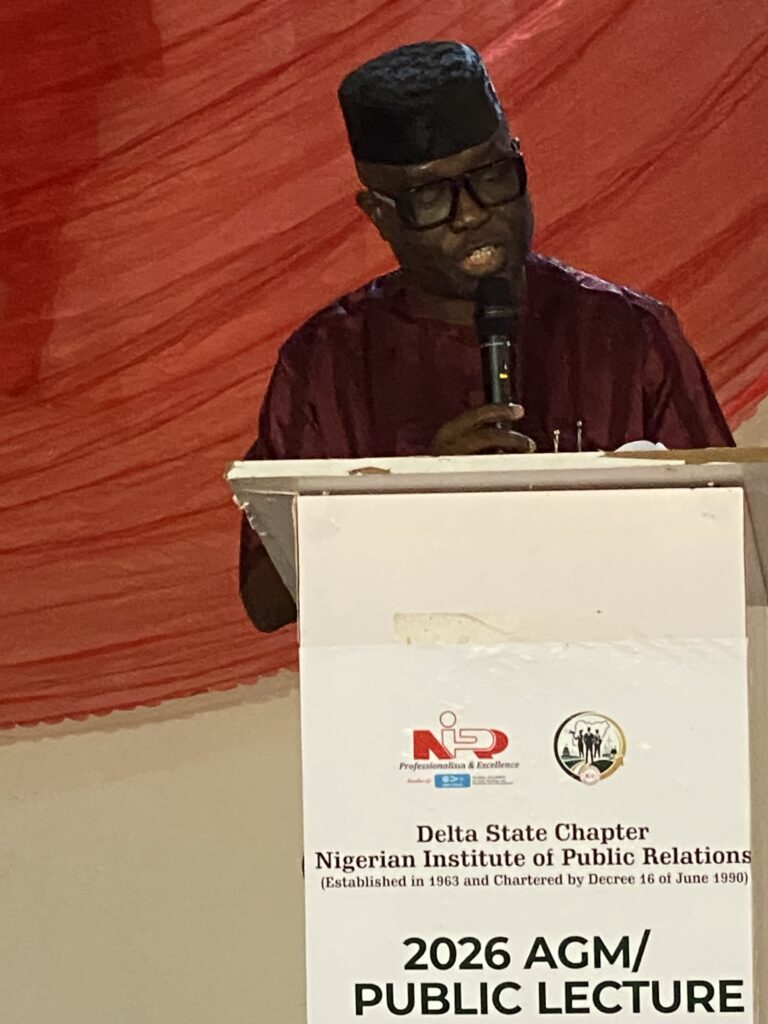
ASABA — Chairman of the 2026 Annual General Meeting (AGM) Public Lecture of the Delta State Chapter of the Nigerian Institute of Public Relations (NIPR), Sir Edwin E. Ogidi-Gbegbaje, on Thursday challenged public relations professionals, policymakers and public institutions to place stakeholder engagement at the heart of governance, declaring that public relations must cease being the “department of last resort” and become the “department of first design” in public policy formulation.
Speaking at the AGM Public Lecture held at the Maryam Babangida Leisure Park, Asaba, Ogidi-Gbegbaje argued that Nigeria’s quest for sustainable development, accountability and effective leadership would remain elusive unless governments deliberately institutionalise citizen engagement, transparency and trust-building mechanisms.

Addressing the theme, “Leadership, Accountability, and Sustainable Development in Nigeria: The Strategic Intersection of Public Relations for National Repositioning,” he said public relations remains a critical instrument for bridging the gap between government and the people, translating policies into actionable narratives and fostering stakeholder partnerships essential for national development.
He commended the Delta State Chapter of NIPR for sustaining a platform that promotes intellectual discourse on governance, leadership, public policy and reputation management, urging other professional bodies to emulate the institute’s commitment to contributing solutions to Nigeria’s challenges.
According to him, leadership and accountability are indispensable pillars of sustainable development, stressing that governance plans alone cannot deliver results without active citizen participation.
“Delta State has ambitious plans under the M.O.R.E Agenda of Governor Sheriff Oborevwori. But plans do not move people, participation does,” he said.
Ogidi-Gbegbaje identified stakeholder engagement as the “missing infrastructure of good governance,” warning that even the best-designed policies could fail when governments operate in isolation from the people they serve.
He explained that effective engagement sharpens governance by bringing grassroots insights into policymaking, rebuilds public trust through transparency and accountability, and guarantees the sustainability of projects by creating community ownership.
“The best policy insight often sits with the last person in the chain, the teacher, the market woman and the local government clerk. Engagement pulls that insight forward and prevents Abuja solutions for Asaba problems,” he stated.
The retired permanent secretary further emphasized that public trust cannot be manufactured through official statements alone but must be earned through openness, prompt admission of mistakes and visible results.
“Trust is not declared in press releases. It is deposited and earned through transparency. When government explains early, admits mistakes quickly and shows results clearly, citizens move from suspicion to partnership,” he said.
He called on governments at all levels to treat communication and stakeholder engagement as essential components of governance rather than ceremonial exercises, insisting that every project and policy should be backed by a clear communication strategy.
“A budget without a communication plan is a plan to fail,” he declared, urging policymakers and legislators to make stakeholder consultations mandatory.
Ogidi-Gbegbaje also challenged technocrats and public servants to communicate government achievements with clarity and measurable evidence.
“Citizens don’t trust statistics they can’t see. Show the bridge, name the contractor, publish the timeline and execute with precision from start to finish,” he advised.
Turning to the media, he urged journalists to balance accountability reporting with constructive coverage of progress, describing the press as both watchdogs and bridge-builders in the democratic process.
To members of the NIPR, he proposed the establishment of a “Delta Dialogue Series”, a monthly platform bringing government officials and citizens together for direct conversations moderated by public relations professionals.
“Let us make transparency fashionable again,” he urged.
He maintained that responsible leadership requires building systems that promote fairness, innovation and long-term growth rather than pursuing short-term achievements, adding that leadership is not exclusive to elected officials but a responsibility shared by all citizens through honesty, accountability and service.
Ogidi-Gbegbaje expressed confidence that the AGM lecture, keynote presentations and discussions would strengthen public engagement and contribute meaningfully to the advancement of good governance, public trust and sustainable development in Delta State and Nigeria.
Facebook Comments

GIPHY App Key not set. Please check settings