

By Our Correspondent
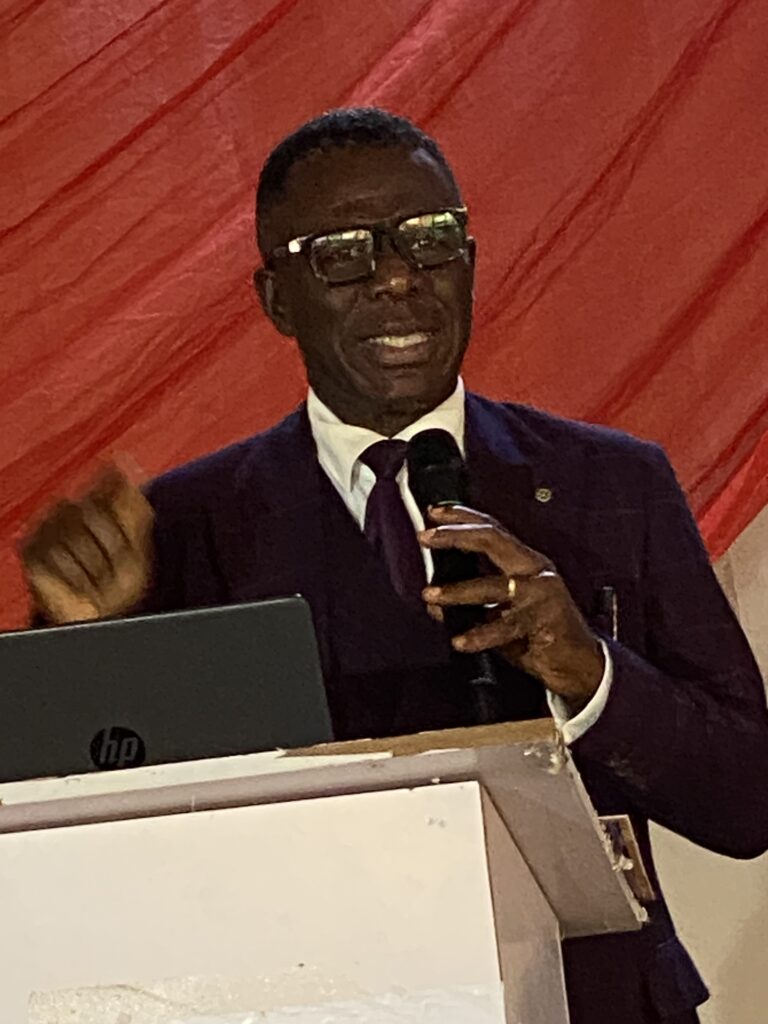
ASABA — Renowned political scientist and former Deputy Vice Chancellor (Academics) of Dennis Osadebay University, Asaba, Prof. Robert Oghenedoro Dode, has delivered a scathing indictment of Nigeria’s political leadership, declaring that the country’s persistent poverty, insecurity, corruption and underdevelopment are direct consequences of failed leadership and the near-total collapse of accountability in governance.
Speaking at the 2026 Annual General Meeting and Public Lecture of the Delta State Chapter of the Nigerian Institute of Public Relations (NIPR) on Thursday, Prof. Dode argued that despite Nigeria’s vast human and natural resources, the nation remains trapped in a cycle of underdevelopment because public officials have consistently evaded responsibility while public institutions have failed to enforce accountability.

Delivering a lecture titled “Leadership, Accountability and Sustainable Development in Nigeria: The Strategic Intersection of Public Relations for National Repositioning,” the professor described accountability in Nigeria as an almost forbidden subject, lamenting that elected and appointed officials often view demands for transparency as an attack rather than a democratic obligation.
According to him, sustainable development can only flourish where visionary leadership, responsible governance and transparent institutions exist.
“Nigeria’s journey towards sustainable development has been hindered by corruption, weak policy implementation, poor governance and the absence of accountability mechanisms. It has almost become heretical to demand accountability from elected and appointed public officials,” he said.
In one of the strongest moments of his address, Dode questioned whether Nigeria’s development crisis had vindicated the late literary icon, Chinua Achebe, who famously blamed the country’s woes on poor leadership.
“Is leadership not a responsibility to serve? If leadership is the engine of development, as at 2026, will it amount to an untruth to state that the Nigerian state engine has completely failed? Do you agree with Achebe that Nigeria’s developmental problems are purely caused by the leadership class?” he asked.
The professor accused successive administrations of failing to account for public resources and cited several controversial national projects and financial scandals that have remained unresolved over the years.
He also criticised what he described as the culture of political blame-shifting, arguing that leaders frequently blame predecessors rather than taking responsibility for current challenges confronting citizens.
Dode expressed concern over worsening insecurity, poverty and infrastructure decay, insisting that no nation can attain sustainable development where corruption thrives and public funds are diverted from their intended purposes.
He further questioned the management of proceeds from the removal of fuel subsidy, arguing that Nigerians deserve clear explanations on how the funds are being utilised.
The scholar also took aim at the enormous cost of governance, describing it as incompatible with the economic realities facing millions of Nigerians.
According to him, prudent management of public resources remains the foundation for quality healthcare, education, infrastructure development and social welfare.
Beyond leadership and accountability, Dode identified public relations as a critical but underutilised tool for rebuilding public trust and repositioning Nigeria for development.
He argued that effective communication between government and citizens is essential for transparency, citizen participation and national cohesion.
“How can a country succeed without the trust of its citizens? Is it possible to achieve sustainable development without transparent public communication? Can a government build public trust without public relations?” he queried.
The professor maintained that public relations practitioners have a strategic responsibility to bridge the widening gap between government and the governed through accurate information dissemination, stakeholder engagement, crisis management and the promotion of national unity.
He noted that strategic communication can help combat misinformation, strengthen democratic participation and encourage citizens to actively engage in governance.
Drawing from Transformational Leadership Theory, Dode advocated for leaders capable of inspiring citizens, promoting ethical conduct and mobilising society toward collective national goals.
He stressed that transformational leadership, accountability and effective public relations must work together if Nigeria hopes to achieve sustainable development and national rebirth.
For Nigeria to move forward, he recommended merit-based appointments, continuous leadership training, stronger institutional accountability mechanisms, transparent budgeting systems, independent anti-corruption agencies and the empowerment of public relations units across government institutions.
He concluded that Nigeria’s future depends on the emergence of leaders who are transparent, accountable and genuinely committed to serving the people.
“The integration of transformational leadership, strong accountability systems, sustainable development principles and effective public relations is essential for national repositioning. By promoting good leadership, accountability and inclusive communication, Nigeria can achieve sustainable development capable of meeting both present and future needs,” he said.
The lecture sparked intense reflection among participants at the NIPR AGM, with many describing it as a bold and uncompromising assessment of the governance challenges confronting Nigeria.
Facebook Comments

GIPHY App Key not set. Please check settings