

By Bruce Malogo
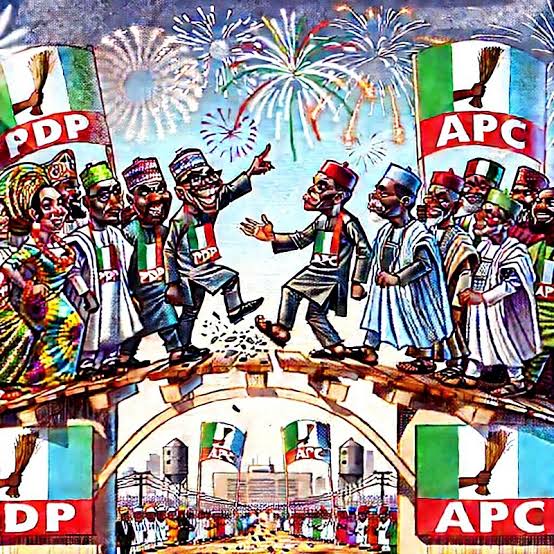
We just watched Nigeria’s political parties rehearse for power. Most, actually. In the course of it, they conveniently forgot to include the people. The primaries are now done. The announcements are out. But calling what happened “primaries” insults the word; it insults the process, and it insults everyone who spent valuable time watching and monitoring. It was choreographed chaos, a performance of democracy without its substance.
Everyone acquainted with the theatre understands that farce is harmless when it stays on stage. This one doesn’t. It decides who gets access to power either at the center or at the provincial level; it decides who manages public funds and our future. That turns a bad play into something worse: a tragedy written at the country’s expense. Not surprisingly, most Nigerians are not particularly shocked by all of this, because it falls into a pattern long established in a maniacal quest to capture, hold and use power. It mitigates the effects of the tragedy. Nigerians have learned to manage their expectations when it has to do with such matters as politics and political processes.

As we can now see, primaries in Nigeria are scarcely contests of ideas, like every contest in our political landscape. They are auctions. Delegates have a price list, aspirants have a budget, and the highest bidder wins. Some others win simply because they are darlings of national or provincial tin-gods. Policy doesn’t enter the room and competence is often thrown out of the window.
So, when you talk about “party primaries,” you are really talking about a peculiar bazaar: one of cash-and-carry and of filial vending. You are talking about thuggery not being just a bug; it is recruitment, intimidation and termination rolled into one. The whole exercise filters anyone who isn’t willing to normalize violence or hire it out. And the message is clear: if you flinch, you are out.
You are talking about why there are no electoral consequences for performance in this system. You can underperform, steal, insult voters to their faces and still show up in the next cycle under the same platform or a new one. After all, political parties are mere special-purpose vehicles and the law is always an ass. It doesn’t matter. Ultimately, the machine rewards persistence, not competence.
It is essentially for that reason that men and women with good learning, inflexible character, proven competence and sense of community keep their distance. The arena isn’t built for them. It is built to chew them up and spit them out, or force them to become what they despise in order to survive. So, the good ones stay out, those the wise old man would call “philosopher kings,” the crème of the land. And the cycle of mediocrity and prebendalism continues. The principle is unambiguous: Power is everything – the beginning and the end of everything.
In the early 1990s during Gen Ibrahim Babangida’s duplicitous regime, Chief Arthur Nzeribe unwittingly let us into a certain dark creed. He was participating in the SDP-NRC melodrama of that time. Asked why, in spite of his staggering wealth, he was desperate for a seat in the Nigerian Senate, the Oguta chief answered: “There’s a limit to what money can do, but there’s no limit to what power can do.” See? That’s the force, the pull, the motivation – as light to moths and blood to sharks.
Truth is, capable people don’t avoid politics because they’re scared of work. Far from it. They stay away because it is high-priced; its demands are costly. Politics demands that to survive, you have to unlearn who you are; that you assume another character and personality to fit the role. You spend years building a reputation for competence, for saying no, for delivering without theatrics. Then you step into a system where those traits are liabilities. Suddenly you need patrons, you need to move money through “consultants,” you need to smile through insults from people you know you’re better than. At some point the math is simple: you either keep your name or you keep your seat. You can’t keep both.
As we have come to understand, the system is designed to make integrity expensive and corruption cheap. A decent person walks in with skills, ideas and a clean record. To get anywhere, they have to pay the entry fee: fund godfathers, fund thugs, fund a structure that exists to make sure people like them never get too far. And for what? To spend four years fighting the machine you joined, losing every time because the machine was built by people better at losing than you are at winning.
Most of those who dare are either scorched and squashed, while others are sucked into the cauldron. For the latter, it is like walking enthusiastically yet blindly into a hive. One retired Inspector General of Police (IGP) has not stopped wailing over how he was “pushed” (reads “beguiled”) into contesting an election that drained away his life’s savings. He didn’t go further than the primaries. Again, you ask: All for what? Most look at the equation and walk away. Not because they don’t care, and not only because they’re not masochists, but because they can’t afford the price of our neopatrimonial politics.
To be true, politics in Nigeria is a street fight. It is for those with means, mettle and muscles – those who believe in the might of the fist in the face of the law. Koreans would say, “laws are far but fists are near.” To become a consequential politician in Nigeria – that is, one who owns and commands the troops – one will, of necessity, take on the nature of the sphinx. He has to have his front paws steeped in perfidy and hind paws planted in authority. Add to that the audaciousness of Percy Shelley’s Ozymandias, the boastful king who built a massive statue of himself with the inscription: “I am Ozymandias, King of Kings: Look on my Works, ye Mighty, and despair!” To consolidate all of those, the man has to shore himself up with men and women of oratorical artistry – good talkers who put the smiles in italics and their gestures in inverted commas; such persons who are full of hot air and are deliberately provocative and intentionally controversial.
Your archetypal Nigerian politician in authority, one who remains impervious to the calls and needs of the people they preside over, is typically cold, distant and scarcely makes an effort to charm. They walk around with dead eyes. And the thing about dead eyes is that it goes with dead conscience. “Evil starts with dead eye,” writes Victor Hugo in Les Misérables. Amedeo Modigliani, the 20th century Italian painter and sculptor said: “When I know your soul, I will paint your eyes.” Dead eyes are a symptom of dead conscience. It tells you of a man who has neither sympathy nor empathy – someone who would rather see the whole community burn than risk a single strand of his own hair come to harm. “Faced with someone whose eyes see nothing, think carefully and be afraid,” Hugo warns. When Marie Antoinette told hungry French households to “eat cake” if there was no bread, it was about the eyes. When you hear them in Nigeria say “after all, we are better than Kenya,” it’s about the eyes. When you hear them say “food is now very cheap,” it has to do with the state of their eyes and their conscience – their ruthless insensitivity.
As an evidence of their careless indifference, Nigerian politicians do not seem to believe in death. Anyone who is mindlessly grabbing and appropriating everything on sight like a heathen does not think that one day, sooner or later, he will die and leave the obscenity he accumulated. And it is doubtful that they believe there’s God who rules in the affairs of men and keeps records of every man’s deeds; that a day will come when they will account for their own deeds, personally, individually. Neither do they believe in humanity. Anyone who believes in humanity wouldn’t plunder a people’s commonwealth to a point where it not only offends basic human decency but also renders social philosophy itself unrecognizable. Here are entities who have no law above their appetite. We can fairly distinguish them as cynics, and even nihilists of a particular kind.
Someone wrote the other day that “Nigeria is being governed by a class of political operatives who have confused aggression with competence.” No one can argue with that, because it is true.
And so, one of the most important things those party primaries have revealed is this: Nigerian politics is a sham, a fraud. They justify the cynicism of the best among us who scoff and stay away from the system. Clearly, it is hard to get people who have standards and care about integrity to fit into this byzantine culture. Someone described it the other day as a culture of “anyhowness” and some say it is “motor park politics.” When you hear “politics is dirty,” that’s where people are coming from. We have also seen how that political culture has bred new vocabularies that delight in their own hideousness and vulgarity. Our literature now throbs with such terms as “money-bags,” “godfatherism,” “party elders,” “factional leader,” “party structure” and sundry others. We now also have language for political chicanery: “Automatic ticket,” “vote buying,” “imposition,” “technical glitch,” “armed thugs,” “ballot stuffing,” “ballot snatching” and the like,
The counterargument would be that, after all, these are typical of political contests in most African countries. Maybe. But we’ are talking about Nigeria, the giant of Africa. This is Nigeria, whose nationals are doing exploits in the wider world; Nigeria, whose sons and daughters are among the most educated and successful immigrant groups in the United States and the western world; Nigeria, whose men and women are manning the commanding heights of world institutions and organizations; Nigeria, which abounds with citizens of great learning, grand ideas and unshakable sense of community. Herein lies not just the irony but the tragedy of the country’s mystification.
Our thesis is that good, capable and conscientious Nigerians run away from politics because the wild has been taken over, not by the best amongst us, but by sanguivores and predators. The ugly has it! The ones who stay away understand that politics demands that you suspend the very instincts that make you capable in the first place. Directness becomes “arrogance,” integrity becomes “naivety,” and refusing to play the money game gets you labelled unserious.
So, they run a cost-benefit analysis in their heads and arrive at the same answer every time. To enter, you have to mortgage your standards to men who have none. To stay in, you have to learn the choreography of compromise until you can no longer tell where performance ends and you begin. Most decide that preserving their self-respect and effectiveness outside the system is better than burning both inside it. It is not apathy. It is self-preservation. “But Daniel made up his mind that he would not defile himself with the king’s food and wine,” the Good Book says.
. Malogo is a director at Oscar and Halliday Media Company and member of Nigerian Guild of Editors (NGE)
Facebook Comments

GIPHY App Key not set. Please check settings